Category: AI-assisted summary

This category contains posts where the content was generated primarily using A.I. but reviewed and edited by Jesper Andersen.

  • 2026 Sharepoint Intranet Benchmarking Report by SWOOP Analytics

    2026 Sharepoint Intranet Benchmarking Report by SWOOP Analytics

    About the paper

    SWOOP Analytics’ 2026 SharePoint Intranet Benchmarking Report analyses how SharePoint intranets are actually used and what drives intranet health, engagement, clutter and AI readiness.

    It is original benchmarking research based on real usage data, not survey responses, covering 410,457 intranet visitors, 253,755 intranet pages and 41 organisations worldwide over 1 October–31 December 2025.

    Length: 98 pages

    More information / download:
    https://sharepoint2026.swoopanalytics.com/

    Core Insights

    1. What is the central argument of the report?

    The report’s central argument is that SharePoint intranets have moved beyond the adoption problem. Almost all employees now access the intranet, with 95% of employees using it during the three-month benchmark period. The issue is no longer whether people visit the intranet, but whether the content they find there is useful, current, readable and well governed.

    This creates a major shift in how intranet success should be understood. The report argues that success is not primarily about publishing more content, driving more visits or creating a larger intranet. Instead, the strongest intranets are those that help employees complete tasks, find trusted guidance and navigate content efficiently. In other words, the intranet is becoming less of a broadcast channel and more of a productivity and knowledge infrastructure.

    The report is especially clear that Content pages — policies, how-to guides, reference material and other evergreen pages — are the heart of the intranet. Employees spend 10.4 minutes per workday on Content pages, compared with only 0.9 minutes on News pages. News still matters, but it is consumed lightly, skimmed quickly and performs best when short and highly relevant.

    The broader conclusion is that intranet performance now depends on disciplined governance: clear ownership, content lifecycle management, accessibility, readability, pruning of outdated pages and a stronger distinction between news, reference content and knowledge assets.

    2. What does the data show about how employees actually use intranets?

    The report shows a pattern of near-universal but increasingly selective use. Employees are not abandoning the intranet. On the contrary, access has increased from 86% in 2024 to 93% in 2025 and 95% in 2026. But they are becoming more intentional in how they use it.

    The average employee visits the intranet 3.23 times per working day, slightly down from 3.36 in 2025, while pages viewed per visit have risen modestly to 2.22. Employees also access an average of 39.6 unique pages over the three-month period. This suggests fewer casual check-ins and more purposeful visits.

    The device data is striking. Desktop remains overwhelmingly dominant, accounting for 89% of intranet access, while phone access has fallen sharply to just 1.7%. The report interprets this as evidence that intranets are mainly experienced as desktop productivity environments, not mobile-first communication channels.

    Another important signal is the increase in home-page-only visits, from 3.6% in 2025 to 6% in 2026. The report sees this as strategically significant because it may indicate scanning without engagement, overexposure to generic content or weak prompts for next action. The homepage should therefore function as a hub for tasks and journeys, not as a billboard.

    3. Which content factors most strongly affect intranet engagement?

    The report finds that engagement is driven less by publishing volume and more by content hygiene, readability, accessibility and structure. This is one of its most important findings.

    SWOOP’s Health Score combines three dimensions: Quality, Experience and Engagement. Quality includes ageing content, spelling and grammar, broken links and missing editors. Experience includes readability, heading length, heading-to-paragraph ratio and accessibility. Engagement measures whether users spend an amount of time on a page that is reasonable in relation to its length.

    For both News and Content pages, readability and accessibility are especially important. Pages with poor structure, long sentences, accessibility issues or insufficient headings perform worse. The report also notes that accessibility is not merely a compliance matter; it has a measurable relationship with engagement.

    For News pages, structure and brevity are critical. The strongest-performing news articles are typically 200–400 words, with readership declining after around 400 words and completion rates falling further for longer articles. Very long news articles, especially those over 1,000 words, have the weakest completion rates.

    For Content pages, the picture is slightly different. Broken links matter more because these pages are often used as tools or reference material. Ageing content is more ambiguous: older Content pages may be heavily used because they are mature and valuable, but the report stresses that this only works if they are reviewed periodically. Old does not automatically mean stale, but unmanaged old content becomes a risk.

    4. What does the report say about clutter and AI readiness?

    The report argues that clutter is now one of the central intranet problems, and that it directly affects both human browsing and AI performance. The Clutter Index measures low-value pages, navigation complexity, home-page-only visits, unread News pages and content relevance across departments. In 2026, the Clutter Index rose slightly to 0.33.

    Unread and irrelevant News is identified as the largest contributor to clutter. The practical message is quite direct: organisations should publish less News, apply stricter criteria for what qualifies as News, convert evergreen News into reference pages and remove stale items from prominent news streams.

    The AI Readiness findings are especially relevant. The overall AI Readiness score improved only marginally, from 51.13 in 2025 to 52.38 in 2026. This happened despite a dramatic improvement in search effectiveness, from 34.16 to 66.3. The reason is that search effectiveness only accounts for 10% of the AI Readiness index, while content readiness and engagement readiness account for 90% combined — and both declined slightly.

    The report’s sharpest AI conclusion is that AI readiness is no longer primarily a search problem. The bigger constraint is the quality, currency and governance of the content that AI depends on. If an intranet contains outdated, duplicated, unmanaged or low-value pages, AI tools may retrieve and summarise poor content more efficiently, but not necessarily more accurately or usefully.

    The report therefore warns that AI will not magically fix intranet disorder. It may amplify it.

    5. What are the main implications for communication, intranet and knowledge-management teams?

    The first implication is that intranet teams should shift from publishing management to content stewardship. More content is not the answer. Better governed content is. The report repeatedly points to pruning, lifecycle management, ownership, templates, accessibility checks and review cycles as practical levers.

    The second implication is that Content pages deserve more strategic attention than News. News is visible and often politically important, but Content pages account for the overwhelming majority of time spent. Improving policies, guidance, FAQs, how-to pages and other reference material is likely to deliver more value than increasing the volume of internal news.

    The third implication is that leaders and managers are important intranet users. The report finds that Leadership & Executive and Management roles have the highest engagement intensity. This suggests that intranet content should be designed to support leader-led communication: clear summaries, explicit actions, reusable briefing points and easily cascadeable messages.

    The fourth implication is that organisations need to think of intranets as knowledge-management systems. The report introduces a Knowledge Management Ratio comparing pages with files, distinguishing between balanced, file-dominant, content-led and news-led intranet profiles. The most AI-ready organisations are not those with the most content, but those with the clearest pathways from work artefacts to maintained, authoritative “single source of truth” guidance.

    The final implication is that governance must become supportive rather than punitive. The Boehringer Ingelheim case study shows this well: around 2,000 editors, mandatory training before publishing rights, automated health-score nudges, community support and lifecycle pruning have enabled a very large intranet to remain healthy. The report presents this as evidence that federated governance can work if editors are equipped with standards, data and support rather than simply controlled from the centre.

  • IC Index 2026 by Institute of Internal Communication

    IC Index 2026 by Institute of Internal Communication

    About the paper

    The IC Index 2026 report examines the state of internal communication in UK large organisations, focusing on trust, change, leadership, AI, manager communication and employee attention.

    It is original survey research: Ipsos Karian and Box surveyed a representative quota sample of 5,000 UK workers aged 18–75, all working in organisations with 500+ employees, between 15 and 29 January 2026.

    The geographic scope is the UK; the report also includes practitioner reflections from internal communication experts.

    Length: 37 pages

    More information / download:
    https://www.ioic.org.uk/insight-practice/ic-index.html

    Core Insights

    1. What is the central argument of the IC Index 2026 report?

    The report argues that internal communication has become more strategically important because employees are facing a tougher, more uncertain work environment, while trust, clarity and confidence are weakening. The subtitle — “The reality check” — is apt: the report presents declining communication ratings, falling trust in leaders, weak change communication, limited AI clarity and rising employee time pressure as warning signs for organisations.

    The authors frame internal communication not as a support function, but as a core mechanism for organisational resilience. They argue that internal communicators need to help leaders communicate with clarity, candour and compassion, build two-way communication systems, surface difficult conversations and connect organisational ambitions to employees’ lived reality.

    The report’s most important claim is that internal communication determines whether organisations can manage change, maintain trust and achieve their goals. The conclusion makes this explicit: organisations with dedicated IC teams have stronger strategic alignment, advocacy, information flow and representation, and the authors present this as evidence that internal communication is more critical when trust and change pressures intensify.

    2. What are the main problems the report identifies in the current employee experience?

    The report identifies six headline problems.

    First, employees are experiencing more organisational change but less clarity. More than half report restructuring in the past year, and over a third report redundancies; both are up 12 points compared with 2024. Yet only 49% agree that the reasons behind changes are clearly communicated, down seven points compared with 2023.

    Second, trust in leadership has fallen. The Trust Index is down seven points compared with 2025 and now sits at 58%. Trust in CEOs or most senior leaders and leadership teams has fallen by nine points each. Only half of employees say they trust their CEO or most senior leader, and only half trust the leadership team.

    Third, leaders appear to be overestimating how well they have communicated strategy and AI. Senior leaders are consistently much more positive than non-managers about strategy clarity, belief in strategy and AI communication. For example, 87% of senior leaders say the organisation has been clear on strategy and business priorities, compared with 57% of non-managers.

    Fourth, many employees feel poorly supported through change. Only 42% agree their organisation is good at helping employees adapt to change, while 31% actively disagree. The report links stronger change support to practical actions such as honesty about impacts, listening to employees, providing skills, and clarifying what people need to do differently.

    Fifth, frontline and digitally disconnected employees are less well served. Employees not frequently connected to a computer are more likely to hear about major changes through word of mouth and are less likely to trust leaders or feel psychologically safe.

    Sixth, employees have very little time for internal communication. Most employees spend ten minutes or less per day reading or viewing organisational news and updates, and just over one in five say they spend no or hardly any time at all.

    3. What does the report say drives employee confidence in the future?

    The report treats confidence as a multi-factor “equation”, not simply a product of optimistic messaging. Just under three in five employees — 57% — say they feel confident about the future of their organisation, while one in five actively disagree.

    The strongest driver of confidence is whether work processes allow employees to work efficiently. This is significant because it means confidence is grounded in employees’ day-to-day experience, not only in leadership narratives. Only half of employees agree that their organisation’s work processes allow them to work efficiently.

    The other major drivers are open and honest communication, clarity about strategy and business priorities, belief that AI is being used to solve the right problems, and feeling connected to people beyond one’s immediate team. The report’s implication is that internal communication can influence confidence, but cannot do so credibly if it ignores operational friction, weak processes or unclear AI adoption.

    This is one of the stronger analytical points in the report: employee confidence depends on whether the organisation feels coherent. Employees need to understand where the organisation is going, believe communication is honest, see that AI has a meaningful purpose, and experience work as efficient enough to make the future feel achievable.

    4. How does the report portray the role of leaders and managers?

    The report presents leaders and managers as central to whether communication lands — but also as part of the problem.

    Senior leaders are portrayed as increasingly disconnected from employee perceptions. They are much more likely than non-managers to believe that strategy and AI have been communicated clearly. On AI, for instance, 67% of senior leaders agree that leaders have explained clearly how AI will be used, compared with just 27% of non-managers.

    Managers are presented as the key sense-making layer. Most managers spend some time communicating with their teams each day, but more than half spend 30 minutes or less, and 14% spend less than 15 minutes. This matters because employees often depend on their direct managers to translate organisational messages into team-level meaning.

    The report also shows that manager support is uneven. More than three quarters of managers feel equipped to lead conversations about what is happening across the business, but this has declined compared with 2025 and 2024. Managers who receive training, preparation time or other structured support feel more equipped, while those receiving no support feel least equipped.

    The strongest practical insight is that managers adapting communication to their team context has a large impact. Employees whose managers do this well are far more likely to find communication relevant, rate communication as excellent and recommend their employer as a great place to work.

    5. What are the report’s most important implications for internal communication practice?

    The report’s main implication is that internal communication needs to move further upstream. It should not merely distribute decisions after they have been made; it should help leaders understand employee reality before, during and after change.

    For change communication, the report suggests that IC teams need to push for early, honest, jargon-free communication; clear rationale; regular updates; routes for questions; and visible listening. The evidence shows that employees are more positive when organisations explain the reasons for change, listen to views and clarify what people need to do differently.

    For leadership communication, the implication is that trust cannot be rebuilt through messaging alone. Leaders need visibility, openness, empathy and evidence that they understand employee challenges. The report connects falling trust especially to CEOs and senior leadership teams, making leadership communication a strategic risk area rather than a stylistic concern.

    For AI communication, the report implies that organisations are under-communicating the purpose and practical expectations of AI adoption. Only 35% believe their organisation is using AI to solve the right problems, and only 32% say their employer has clearly communicated how they are expected to use AI as part of their job.

    For channels and content, the report’s implication is that relevance is now existential. Employees have little time, and 56% say employer communications feel relevant. The report points towards personalisation, segmentation and opt-in/opt-out models, while also warning that these require good audience data and a serious channel strategy.

    Finally, the report argues that representation and good-news communication matter more than many organisations may assume. Only 42% see stories about people like them in internal communications, yet those who do are much more likely to be advocates and to trust the organisation. Similarly, good news is not merely “nice to know”: effective communication of good news has a stronger impact on advocacy and overall communication ratings than effective communication of bad news.

  • 2026 Trends in Communications Budgets by Gartner

    2026 Trends in Communications Budgets by Gartner

    About the paper

    The report analyses 2026 communications budget trends, with a focus on how CCOs are reallocating spend towards PR, AI, technology, analytics and measurement.

    It is primarily original survey research based on Gartner’s 2026 CCO Spend Survey, conducted online from late October to mid-December 2025 among 200 senior communications decision-makers in North America and Europe, all from organisations with at least $1 billion in annual revenue.

    The report also draws on secondary Gartner survey evidence from CFOs, CEOs and CMOs, so it is best understood as a mixed-evidence analyst report rather than a purely standalone survey study.

    Length: 23 pages

    More information / download:
    https://www.gartner.com/en/communications/research/cco-budget-2026-ec

    Core Insights

    1. What is the central argument of the report?

    The report’s central argument is that communications functions are being forced to transform under constrained budget conditions. Gartner argues that CCOs can no longer rely on incremental budget planning or traditional allocations. Instead, they must actively redirect resources towards AI, communications technology, analytics, measurement, PR, brand and crisis communications.

    The underlying logic is that communications is now expected to support broader business transformation, especially AI-driven transformation, while also managing heightened reputation risk, misinformation, shifting stakeholder expectations and declining trust. The report frames this as a strategic inflection point: communications functions that fail to modernise their capabilities risk further budget cuts, while those that reallocate spending towards measurable, technology-enabled and reputation-focused work will be better positioned to demonstrate business value.

    A key point is that this is not presented as a story of abundant new funding. Gartner emphasises that many CCOs face cuts or constraints: 46% say their current-year communications budget forecast was reduced due to company-wide cost-cutting, and 44% say their function lacks the budget needed to execute its strategy successfully. At the same time, 82% say their communications strategy needs to evolve rapidly to meet changing audience expectations. This creates the report’s core tension: ambition is rising, but capacity is not keeping pace.

    2. How are communications budgets changing, and where are CCOs reallocating spend?

    The report finds that overall budget growth is limited and uneven. Smaller organisations with revenue below $5 billion expect modest increases, while larger organisations face stagnant or declining budgets. Most organisations spend around 0.5% of revenue on communications, with smaller companies spending a higher percentage and very large companies spending a lower percentage, presumably because larger organisations benefit from economies of scale.

    Within constrained budgets, the mix of spending is changing. Communications budgets remain heavily weighted towards traditional areas: labour accounts for 40.3%, agencies and services for 23%, operational costs for 17.3%, and communications technology tools and internal platforms for 16.8%. However, looking ahead, technology is the area most likely to receive increased investment: 35% of communications leaders expect to increase spend on communications technology and internal platforms.

    This implies that CCOs are trying to fund transformation partly by reducing or limiting other areas. Gartner explicitly points to potential trade-offs in events, creative services, translation, operational costs and some agency spending. The report does not say these activities are unimportant, but argues that they must be streamlined, delegated, automated or tightly linked to strategic priorities if communications is to fund AI, data and analytics capabilities.

    3. Why are PR, brand and crisis communications receiving increased budget attention?

    Gartner argues that external reputation management is becoming more important because the risk environment is more volatile. PR and corporate brand command the largest shares of communications budgets, with public relations at 14.3% and corporate brand at 8.8%. Crisis communications has also grown, rising by 2.1 percentage points year on year to 4.8% of the current budget.

    The report links this shift to several forces: AI disruption, misinformation and disinformation, geopolitical uncertainty, regulatory complexity, stakeholder scrutiny and the growing speed with which reputation issues can escalate. It also argues that public large language models are changing how audiences discover and trust information, which means organisations must rethink earned media, owned content and answer engine visibility.

    This is one of the report’s more forward-looking arguments. Gartner suggests that PR is not simply about media coverage; it is becoming part of how organisations maintain discoverability, credibility and influence in AI-mediated information environments. That is why the report recommends prioritising PR and earned media investments that support “answer engine visibility”, reallocating some spending from paid media to owned and earned media, investing in authoritative owned content, and updating the corporate narrative across traditional, social and owned channels.

    4. What does the report say about AI, GenAI, technology and analytics in communications?

    The report presents AI, technology and analytics as the main transformation priorities for communications functions. GenAI investment is rising from 5.7% of total communications budget in the current fiscal year to a forecast 8.8% next year, a 54% year-on-year increase. However, Gartner also notes that current GenAI spend is below the level predicted in the previous year’s research, which suggests adoption is moving more slowly than expected.

    The barriers are not only financial. The report says 86% of communications leaders recognise the need to update team talent strategies and skill sets to capitalise on GenAI opportunities. It also says 57% believe the function must address substantial audience scepticism about GenAI integration in communications work, and 43% report that GenAI investments have not yet delivered the expected value.

    Analytics is another major theme. Thirty-four percent of leaders plan to increase spend on data and analytics, and 35% already have a dedicated communications data scientist or analyst, while another 25% plan to add one within 12 to 18 months. Yet the actual budget allocation for measurement, monitoring and analytics is still only 4.1%, up from 2.9% the year before. Gartner contrasts this with marketing’s 8% allocation and argues that communications still underinvests in the capabilities needed to link its work to organisational outcomes.

    The report’s perspective is therefore cautiously pro-investment. Gartner does not simply say “spend more on AI”. It argues that AI and technology investments must be part of a coherent strategy tied to business and communications outcomes, with proper talent development, measurement and success metrics. Otherwise, CCOs risk cutting human capability too aggressively while buying tools that fail to deliver value.

    5. What are the main implications for CCOs and communications leaders?

    The main implication is that CCOs need to become much more deliberate budget strategists. Gartner’s advice is to stop planning budgets through small adjustments to last year’s numbers and instead redraw allocations around current business priorities, reputation risks and transformation needs. The report repeatedly frames budget planning as a strategic leadership discipline, not an administrative exercise.

    A second implication is that CCOs must be able to defend investment in business terms. The report recommends linking communications outcomes to enterprise priorities such as reputation, engagement, trust and business transformation. It also urges communications leaders to benchmark spending, establish clearer budget targets for analytics and measurement, and build stronger evidence of impact.

    A third implication is that communications leaders must make harder trade-offs. Gartner explicitly recommends cutting low-value work that does not support business objectives, offloading or streamlining activities such as event management, graphics, creative services and translation where appropriate, and reassessing agency spend so it is focused on high-ROI activities or skills not available in-house.

    Finally, the report implies that internal communications should not be neglected. Although external-facing activities receive much of the budget attention, employee communications is the third-largest budget allocation, and Gartner warns that AI transformation creates employee anxiety that could threaten enterprise success. The report says 69% of communications leaders see employee anxiety from changes such as AI transformation as a significant risk over the next two years. That means CCOs must continue investing in employee communications, change communications, manager and leader communications, intranet platforms, employee experience platforms and measurement of internal communications effectiveness.

    Overall, the conclusion is clear: communications leaders are being asked to do more than protect reputation or produce content. Gartner sees the function’s future value in helping organisations navigate AI-enabled transformation, sustain trust, manage reputation risk, and prove impact through data.

  • The Changing Shape and New Economics of News Podcasting by Reuters

    The Changing Shape and New Economics of News Podcasting by Reuters

    About the paper

    The Reuters Institute report examines how news podcasting is shifting from audio-only formats towards video, personality-led “shows”, and hybrid business models.

    It is a mixed-methods report based on qualitative audience research with 50 regular news/current affairs podcast users in the US, UK, and Norway, mini-groups with a subset of those users, semi-structured interviews with 13 publishers plus industry experts and platforms, and selected Digital News Report/IAB quantitative data.

    Length: 39 pages

    More information / download:
    https://reutersinstitute.politics.ox.ac.uk/changing-shape-and-new-economics-news-podcasting-listening-watching-podcasts-shows

    Core Insights

    1. What is the central change reshaping news podcasting?

    The report argues that news podcasting is no longer simply an audio medium distributed through open RSS feeds. It is becoming a more fluid, multi-format category that blends audio, video, social clips, newsletters, live events, subscription products, and sometimes television-style shows.

    The key shift is from “podcasts” as discrete audio products to “shows” as broader audience franchises. Video is the most visible driver of this change. Platforms such as YouTube, Spotify, and Apple are increasingly prioritising or enabling video podcasting, encouraging publishers to rethink production, distribution, discovery, and monetisation.

    The report does not claim that audio is disappearing. Instead, it argues that podcasting is becoming dual-format. Audiences often use audio and video in different contexts: audio while commuting, exercising, cooking, or multitasking; video at home, on YouTube, or on connected televisions. This means publishers are not simply replacing audio with video, but trying to work out which formats, shows, and audiences justify investment in video.

    A second major change is the rise of personality-led conversational formats. These are cheaper to produce than heavily edited narrative documentaries, easier to turn into video, and better suited to social clips and host-driven audience relationships. This is pushing parts of the market away from highly produced narrative series and towards recurring, reactive, talent-led shows.

    2. How are audiences using news podcasts, and what do they value about them?

    The report finds that news podcast users are generally a highly engaged subset of the news audience. They are not usually using podcasts as their only source of news. Rather, podcasts supplement other formats by offering depth, explanation, perspective, and a more conversational relationship with journalists or hosts.

    Podcast use is described as complementary to other news habits. Social media may provide fast discovery, websites and apps provide checking and updates, radio may support routine listening, while podcasts are used for deeper understanding. This makes podcasts particularly valuable for “active knowledge-building” rather than simple headline consumption.

    The appeal of video varies by country, context, and content type. US respondents were more open to video podcasting, partly because YouTube plays a larger role in their podcast discovery and consumption. Norwegian respondents were more resistant, with stronger attachment to audio and local public-service audio platforms. UK users sat somewhere between these positions.

    Audiences gave three main reasons for choosing video:

    • personal format preference
    • consumption context
    • and content type.

    Some younger users feel more connected to hosts when they can see facial expressions, body language, and surroundings. Others only want video when the subject benefits from visuals, such as breaking news footage, complex explanations, comedy, lifestyle, or entertainment. For factual news, many still prefer audio because it is flexible, intimate, and easy to use while doing other things.

    3. How are publishers responding to the shift towards video?

    Publishers are taking video seriously, but most are cautious about a full “pivot to video”. The report identifies three main strategic reasons for investing in video: acquisition, retention, and revenue.

    For acquisition, video helps publishers reach audiences through YouTube, TikTok, Instagram, YouTube Shorts, Spotify, and connected TVs. Video clips are easier to share and can act as discovery tools for younger audiences who may not actively seek out publisher websites or podcast apps.

    For retention, podcasts deepen audience relationships. The report repeatedly emphasises the human dimension of podcasting: hosts build trust, habit, familiarity, and parasocial connection. For subscription publishers, these relationships can reduce churn and strengthen the broader value of the subscription bundle.

    For revenue, video opens access to larger advertising budgets than audio alone. However, the report is careful to note that the economics remain uncertain. Video production costs more, requires new workflows, and may not pay off in smaller markets where advertising opportunities are limited.

    Publisher strategies differ sharply. The New York Times is selective: shows such as Hard Fork, Popcast, and The Ezra Klein Show have video versions, while The Daily remains audio-first. The Guardian is also hybrid, using video for some conversational and sports formats while protecting narrative audio investigations. Die Zeit treats video mainly as a discovery layer. The Economist is exploring video inside a subscription ecosystem. Nordic publishers such as Bonnier, Schibsted/Podme, and Politiken are more cautious because they already have strong audio habits, subscription models, and smaller advertising markets.

    The report’s table on publisher strategies is especially useful because it shows that video is not one strategy but several: full video versions, short promotional clips, subscriber-only video, TV/documentary extensions, studio models, and selective experiments.

    4. What is changing in the economics of news podcasting?

    The economics are becoming more complex and hybrid. Traditional podcasting has mostly been free and advertising-supported, but publishers are now experimenting with subscriptions, bundles, premium layers, bonus episodes, live events, memberships, merchandise, IP licensing, and brand partnerships.

    The report shows that direct payment remains difficult. Audience research in the US, UK, and Norway found that many listeners value news podcasts but are reluctant to pay because there are so many free alternatives. Some would switch to another show if their favourite podcast went behind a paywall. Others might pay only for genuinely distinctive content, such as exclusive interviews, deep expertise, investigative journalism, archives, or bonus material.

    Several publishers are nevertheless testing paid audio. The Economist put most of its podcasts behind a paywall while keeping The Intelligence free. Die Zeit launched a separate podcast subscription. Politiken launched a stand-alone audio app. The New York Times offers an audio subscription mainly around archives and bonus material, while still using free recent episodes to support the broader bundle. Schibsted/Podme uses a premium podcast subscription model in the Nordics, with some free content and some exclusive paid layers.

    Advertising remains central, but video changes the opportunity. The report notes that US podcast advertising revenue reached $2.4 billion in 2024, while digital video advertising was vastly larger. That creates an incentive for podcast publishers to access video budgets. But the advertising market is still organised around separate audio and video buying teams, and measurement, ad-serving, pricing, and platform standards remain unresolved.

    The report’s broader conclusion is that podcasts are rarely just stand-alone revenue products for traditional publishers. They are often part of a wider funnel: attracting new users, increasing engagement, reducing churn, and adding value to subscriptions.

    5. What are the wider implications for journalism and media organisations?

    The report suggests that the future of news podcasting will be shaped by a tension between journalism-led publishing and creator-led show business.

    For traditional newsrooms, the challenge is organisational as much as technological. Audio, video, social, text, product, and commercial teams can no longer operate as separate silos if one recorded conversation can become a podcast episode, a video episode, social clips, a newsletter, a transcript, a written article, and a subscriber feature. This requires new skills, new production workflows, and potentially new “studio” or “show” structures inside media companies.

    The rise of talent also raises editorial questions. Podcast-first companies such as Goalhanger and Chora Media put hosts, fandoms, communities, and show brands at the centre. Their model looks less like traditional news publishing and more like a blend of creator economy, television, live events, and music-industry-style fandom. Traditional publishers may want some of that audience loyalty, but adopting the model raises questions about editorial control, host power, commercial boundaries, and whether newsrooms are set up to develop and retain talent in the same way.

    The report’s final implication is that “podcasting” itself is becoming harder to define. Some purists still tie the term to RSS distribution or audio. But in practice, audiences increasingly encounter podcasts on YouTube, Spotify, Apple, social feeds, connected TVs, apps, and paywalled publisher products. The boundaries between podcast, video show, radio programme, social franchise, and subscription product are blurring.

    The report concludes that the future is unlikely to be audio versus video. It is more likely to be a hybrid ecosystem where successful publishers combine reach and depth, free and paid layers, journalism and personality, open distribution and owned platforms. The strategic question is how much news organisations are willing to invest in creator-led, show-based formats without losing the editorial qualities that made their audio journalism valuable in the first place.

  • What is A.I. reading – May 2026 Edition by Muck Rack

    What is A.I. reading – May 2026 Edition by Muck Rack

    About the paper

    What is AI Reading? by Muck Rack’s Generative Pulse examines which sources generative AI systems cite when answering realistic consumer prompts.

    The report is a modelling/data-pack style citation analysis based on a large prompt set submitted to ChatGPT, Claude and Gemini, with more than 25 million cited links analysed across multiple industries; the geographic scope is not clearly specified in the report.

    Length: 43 pages

    More information / download:
    https://generativepulse.ai/report/

    Core Insights

    1. What is the central finding of the report about the sources AI systems cite?

    The report’s central argument is that generative AI citations are overwhelmingly shaped by non-paid, earned, third-party sources rather than paid media or advertising. About 99% of links cited by AI come from non-paid media, while paid and advertorial content accounts for only 0.3% of all citations. Press releases account for 1.1%.

    Within that non-paid universe, journalism remains a major foundation of AI visibility. The report finds that about 27% of all links cited by AI are journalistic. This is framed as a consistent pattern across Muck Rack’s previous studies, where journalism has generally accounted for 20–30% of AI citations.

    However, journalism is not the only important source category. The report’s pie charts on pages 5–7 show a broader mix: corporate blogs and content at 24%, aggregators and encyclopedic sources at 17.4%, owned media at 13.7%, government/NGO sources at 8.6%, academic/research sources at 4%, social/UGC at 2.9%, tech platforms at 0.9%, press releases at 1.1%, and paid/advertorial at 0.3%.

    The implication is clear: visibility in AI-generated answers is not mainly bought through advertising. It is earned through the kinds of sources AI systems treat as credible, relevant or useful: journalism, reference sources, third-party content, government data, academic material, user-generated platforms and some owned content.

    2. How do ChatGPT, Claude and Gemini differ in their citation behaviour?

    The report argues that each AI provider has a distinct citation ecosystem. ChatGPT, Claude and Gemini do not simply cite the same sources at different volumes; they appear to rely on meaningfully different source environments.

    ChatGPT is described as a “near-universal citer”. It includes citations in 96% of responses, but averages only about five sources per response. Claude is more selective: only 55% of its responses include citations, but when it does cite, it averages 13 sources per response. Gemini sits between the two, citing in 82% of responses and averaging eight sources per response.

    The differences become even sharper when looking at the actual domains. ChatGPT’s top cited domain is Wikipedia, followed by Axios, YouTube, Kiplinger and Forbes. Claude’s top domain is PubMed Central, followed by Wikipedia, Quora, ScienceDirect and NerdWallet. Gemini’s top cited domain is Reddit, followed by YouTube, Quora, Wikipedia and NIH.

    The report’s interpretation is that these are “three effectively separate information environments”. For PR and communications teams, this matters because AI visibility cannot be reduced to a single generic “AI search” strategy. A brand, journalist, outlet or source may matter a great deal in one model and be nearly invisible in another.

    3. What determines whether journalism, press releases or other content gets cited?

    The report finds that the type of question asked strongly shapes the type of source cited. Industry trend queries are especially likely to draw on journalism: 46% of industry trend responses cite journalistic sources, more than twice the rate for how-to and comparative queries.

    By contrast, how-to queries are less journalism-driven. The report says AI tends to rely more on reference content and brand-owned material when users ask how to do something. Comparative evaluation and best-of queries also behave differently, often pulling in review content, platforms, maps, rankings or consumer advice sources depending on the category.

    Press releases are most likely to appear in industry trend responses, but even there they remain a relatively small part of the citation mix. Around 1.16% of industry trend citations are press releases, compared with 0.33% for best-of queries, 0.27% for risk/due diligence, 0.25% for problem/discovery, 0.13% for comparative evaluation and 0.09% for how-to.

    Recency also matters, especially for journalism. Among journalism citations with known publish dates, 57% were published within the previous 12 months. The report notes a sharp peak in the first month after publication, followed by a decline through month six and then a long tail. Older articles still matter, but the bias toward recent coverage is clear.

    4. Which sources, platforms and outlets stand out most in the report?

    Several sources stand out because they behave differently from the broader pattern.

    Wikipedia is especially important for ChatGPT and Claude. It appears among the top three cited domains in 12 of 17 industries for ChatGPT and 8 of 17 industries for Claude. For Gemini, it appears in the top three in only 3 of 17 industries, because Gemini is more strongly shaped by Reddit, brand domains and Q&A platforms such as Quora.

    Reddit is particularly important for Gemini. The report says Reddit is Gemini’s single most-cited domain, accounting for about 2.4% of all Gemini citations. By contrast, ChatGPT cited Reddit only 16 times and Claude cited it zero times in the study.

    YouTube also differs by provider. It accounts for about 2.1% of Gemini citations and about 2.0% of ChatGPT citations, while Claude returned zero YouTube citations across the study. Claude does cite other video platforms such as TikTok and Vimeo, but not at the same level.

    Among journalism outlets, the standout is Axios. The report says journalism citations are spread across more than 20,000 distinct outlets, with no single publication generally dominating. Axios is the exception: it appears in ChatGPT’s top three cited domains across 13 of 17 industries. The Associated Press appears in the top three for one industry, while The New York Times and Reuters do not appear in the top three most cited sources for any industry in the report.

    5. What are the main implications for PR and communications teams?

    The report’s main implication is that AI visibility is increasingly connected to earned authority across multiple information environments. Traditional media relations still matters, but not in a simple “get mentioned in top-tier media” way.

    First, journalism remains important because it accounts for about 27% of all AI citations and is especially influential for industry trend queries. For brands that want to shape how AI explains what is happening in a sector, credible media coverage appears to be particularly valuable.

    Second, the report suggests that citation strategy must be model-specific. A communications team optimising for ChatGPT would pay close attention to Wikipedia, Axios, YouTube and sector-specific sources. A team concerned with Gemini would need to understand Reddit, YouTube, Quora and other user-generated or community-driven environments. For Claude, academic, research, personal finance and reference-style sources appear more prominent.

    Third, owned media still matters, but it is not enough on its own. Owned media accounts for 13.7% of citations, while corporate blogs and content account for 24%. The distinction in the report is important: third-party corporate/blog content is categorised as earned when it is not owned by the company or product targeted in the query, while first-party corporate/blog content is owned media. This suggests that corporate content can influence AI, but third-party validation remains highly significant.

    Fourth, communications teams need to think beyond classic media lists. Depending on the sector and query type, AI may cite Google Maps, TripAdvisor, Reddit, Quora, YouTube, PubMed Central, NIH, government websites, academic databases, review sites, ranking platforms or trade publications. The relevant source ecosystem changes by industry.

    Finally, the report implies that AI visibility is dynamic. The methodology section explicitly notes that generative AI systems are rapidly evolving and opaque, and that observed behaviours may shift as models are updated or retrained. So the findings should be treated as a snapshot of AI citation behaviour in May 2026, not as a permanent rulebook.

  • 2026 Work Trend Index by Microsoft

    2026 Work Trend Index by Microsoft

    About the paper

    Microsoft’s 2026 Work Trend Index Annual Report examines how A.I. agents are changing work, arguing that as agents take on more execution, human agency shifts towards intent-setting, judgement, orchestration and accountability.

    It is a mixed-methods report based on Microsoft 365 telemetry, a 20,000-person online survey of A.I.-using knowledge workers across 10 markets, a separate 1,800-person global survey on managers and agentic A.I., and expert perspectives; the main survey covers Australia, Brazil, France, Germany, India, Italy, Japan, the Netherlands, the UK and the US.

    Length: 29 pages

    More information / download:
    https://www.microsoft.com/en-us/worklab/work-trend-index/agents-human-agency-and-the-opportunity-for-every-organization

    Core Insights

    1. What is the central argument of the report?

    The report’s central argument is that AI and agents are not merely productivity tools; they are forcing a redesign of the operating model of work. Microsoft frames this as a shift in which agents take on more execution, while humans gain more “agency”: more capacity to define intent, direct work, exercise judgement and own outcomes.

    The report is explicit that the key question is no longer simply whether organisations are adopting AI. The larger question is whether they are structurally capable of capturing its value. Its thesis is that many workers are already using AI in advanced and resourceful ways, but their organisations have not yet redesigned the surrounding systems — leadership alignment, incentives, governance, performance evaluation, culture and management practices — to match what AI now makes possible.

    A useful way to express the report’s logic is this: AI raises individual capability, but organisational design determines whether that capability becomes institutional advantage. The report repeatedly contrasts “AI adoption” with “AI absorption”. Adoption means people or teams use tools. Absorption means the organisation changes how work is designed, evaluated, governed, learned from and scaled.

    This is why the report’s three-part structure matters. At the employee level, AI expands what individuals can do. At the leader level, the task becomes rearchitecting work rather than simply deploying tools. At the organisational level, the most advanced firms become “Learning Systems” that capture lessons from AI-enabled work and turn them into repeatable practices.

    2. How does AI change the role and value of individual employees?

    The report argues that AI lifts the ceiling on individual potential by helping people do more complex, higher-value work. In Microsoft’s privacy-preserving analysis of more than 100,000 Microsoft 365 Copilot chats, 49% of classified conversations supported cognitive work such as analysing information, solving problems, evaluating and thinking creatively. The rest were split between working with people, finding information and producing work.

    Survey findings reinforce this. According to the report, 66% of AI users say AI has allowed them to spend more time on high-value work, and 58% say they are producing work they could not have produced a year earlier. Among “Frontier Professionals” — the most advanced AI users in the research — that latter figure rises to 80%.

    However, the report does not present this as simple automation. Its stronger claim is that human value moves. As AI takes on more execution, the employee’s differentiating contribution becomes judgement, quality control, critical thinking, intent-setting and the design of the human-AI workflow. The report says AI users themselves recognise this: 50% name quality control of AI output as an increasingly important human skill, while 46% name critical thinking. A striking 86% say they treat AI output as a starting point, not a final answer, and that they remain responsible for the thinking.

    The report’s page 9 framework is particularly useful. It describes four modes of working with AI: asking, delegation, collaboration and exploration. The key point is not that one mode is superior. The most advanced users know which mode a task requires. Quick factual queries may be “asking”; recurring reports or structured summaries may be “delegation”; proposals and judgement-heavy communication may require “collaboration”; and unfamiliar workflows may call for “exploration”. This is an important conceptual distinction because it moves the discussion beyond “prompting” towards work design.

    3. What is the “Transformation Paradox” identified by the report?

    The “Transformation Paradox” is the report’s term for the gap between workers’ AI readiness and organisations’ ability to support it. Microsoft maps respondents across two dimensions: individual AI capability and organisational readiness. The result is a five-zone model.

    Only 19% of AI users fall into the “Frontier” zone, where both individual capability and organisational readiness are high. Another 10% are in “blocked agency”: they have strong individual AI capability, but their organisations are not ready to support or absorb it. A further 5% represent “unclaimed capacity”, where the organisation is more ready than the individual. Sixteen per cent are “stalled”, with both low individual capability and low organisational readiness. The largest group, 50%, sits in the “emergent” zone, where both individual practice and organisational conditions are still forming.

    The paradox is that the pressure to use AI is rising, but the organisational systems still reward old ways of working. The report says 65% of AI users fear falling behind if they do not adapt quickly with AI, yet 45% say it feels safer to focus on current goals than to redesign work with AI. Only 13% say they are rewarded for reinventing work with AI even when results are not immediately achieved.

    This is one of the report’s most important findings because it reframes AI transformation as a management and systems problem. The obstacle is not simply lack of tools or lack of individual skill. It is the mismatch between what employees are capable of doing and what their organisations measure, encourage, permit and reward.

    4. What role does leadership play in turning AI use into organisational value?

    The report places substantial responsibility on leaders and managers. It argues that the job of every leader is now to “rearchitect work” — not just introduce AI tools, but redesign workflows, roles, incentives, metrics, governance and expectations around what humans and agents should each do.

    Leadership alignment appears to be weak. Only 26% of AI users say their leadership is clearly and consistently aligned on AI. The report also finds a perception gap between leaders and employees: leaders are more likely than employees to say AI-driven reinvention feels safe and rewarded. That suggests that senior leaders may believe the organisation is more supportive of AI transformation than employees experience in practice.

    Managers are presented as especially important because they translate strategy into everyday behaviour. A separate Microsoft-led study of 1,800 employees globally found that when managers actively model AI use, employees report a 17-point lift in AI value, a 22-point lift in critical thinking about AI use and a 30-point lift in trust in agentic AI. When managers create psychological safety around experimentation, employees report higher AI readiness and value, and are more likely to be high-frequency users of agentic AI.

    The report also shows that Frontier Professionals tend to work in stronger managerial environments. Compared with non-Frontier Professionals, they are more likely to say their manager openly uses AI, sets quality standards for AI-assisted work, creates space for experimentation and encourages more ambitious work redesign. This supports the report’s broader argument: individual AI skill matters, but it compounds only when leaders create the right organisational conditions.

    5. What does the report mean by saying every firm must become a “Learning System”?

    The report uses “Learning System” to describe an organisation that captures what AI-enabled work is teaching it and turns those insights into shared, repeatable and improving practices. This is the report’s organisational endgame: the firms that win are not simply those with the most AI tools, but those that learn fastest from their own work.

    The evidence behind this claim comes from Microsoft’s AI Impact Analysis. The report finds that organisational factors — culture, manager support and talent practices — account for more than twice the reported AI impact of individual mindset and behaviour: 67% versus 32%. The top single factor is organisational AI culture, followed by talent practices and manager support. The methodology is careful to state that these are statistical associations, not causal effects, because the variables are self-reported at the same moment.

    The report argues that as agents become more active, they generate valuable signals: what worked, what failed, where quality drifted, which hand-offs broke down and where workflows need redesign. In weaker organisations, these signals stay local. In stronger ones, they are captured, shared and encoded into routines. This is what Microsoft calls “Owned Intelligence”: institutional know-how that compounds over time, is specific to the firm and is difficult for competitors to copy.

    The report identifies three questions every advanced organisation must answer:

    1. who reviews agent performance
    2. who has authority to update agent workflows
    3. and how local wins are captured and scaled.

    It also argues that this requires coordination across four roles: employees who redesign their work around intent and review; leaders who redesign processes around outcomes and agent autonomy; IT teams that manage agents as entities with identities, permissions and lifecycle controls; and security teams that build monitoring, auditability and policy enforcement into the system.

    The implication is clear: AI transformation is not finished when employees start using AI. It becomes strategically meaningful only when the organisation builds the infrastructure to learn from AI-enabled work, codify that learning and continuously improve how humans and agents work together.

  • The Wharton Blueprint for A.I. Agent Adoption by Wharton

    The Wharton Blueprint for A.I. Agent Adoption by Wharton

    About the paper

    The report is a mixed-methods synthesis rather than a single original study: it combines recent academic research on human-AI interaction, practitioner perspectives from executives at firms deploying AI agents, and recommendations from Wharton faculty.

    It does not present one unified sample or fieldwork design; instead, it draws on multiple experiments, surveys, working papers, and case-informed expert contributions, with sample sizes and geographies varying by cited study and not clearly specified at the report level.

    Length: 47 pages

    More information / download:
    https://knowledge.wharton.upenn.edu/special-report/wharton-blueprint-ai-agent-adoption/

    Core Insights

    1. What is the central argument of the report?

    The report’s core argument is that AI agent adoption is no longer mainly constrained by technology, but by psychology. The authors argue that many people are still unwilling to let AI agents perform meaningful tasks on their behalf, not because the systems cannot do anything useful, but because users hesitate to believe that the agent is competent, to trust it, and to hand over control. The report therefore frames adoption as a behavioural and design challenge rather than a purely technical one.

    It organises this adoption problem into three “psychological frictions”:

    • perceived competence
    • trust
    • and delegation of control.

    These are presented as the three core barriers that developers and organisations must overcome if they want broader acceptance of AI agents. In other words, the report is not asking only whether agents work; it is asking what makes people willing to let them work on their behalf in real settings.

    The report is also quite explicit that this is a practical blueprint. It is designed for people building or deploying AI agents and aims to translate behavioural science into design recommendations. That makes its purpose strongly applied: it is less about theorising AI adoption in the abstract and more about showing how organisations can reduce resistance and increase real-world uptake.

    2. How does the report explain the first friction, perceived competence, and what makes users believe an AI agent can do the job?

    The first friction is perceived competence, which the report defines as the user’s subjective belief in the agent’s ability to perform desired actions. The key point here is that perceived competence is not the same as technical capability. An agent may be highly capable in a technical sense, but if users do not experience it as capable, they will still hesitate to adopt it.

    The report argues that users prefer agents that appear competent rather than warm. Across cited experiments, people were less willing to use AI that sounded cheerful or friendly than AI that signalled expertise, consistency, and reasoning. Competence cues included explaining criteria, showing reasoning, and making recommendations in a way that felt rigorous rather than overly personable. In practice, the report suggests that in serious domains such as health, finance, law, and professional work, a warm personality can actually undermine adoption if it makes the system seem less capable.

    Another major idea is that people judge whether the agent adds value. In the report’s discussion of AI-enabled travel agents, four factors shaped that perception:

    • convenience
    • personalisation
    • ubiquity
    • and superior functionality.

    At the same time, benefits alone are not enough. Privacy concerns, technology anxiety, and the desire for human interaction can still depress adoption even when users recognise obvious advantages. That means perceived competence depends both on positive cues about usefulness and on reducing perceived reasons not to engage.

    The report also places strong weight on explanations. In high-stakes contexts, users felt AI was more reliable and safer when it explained its process in detail, including the steps taken, data considered, or method used. Explanations therefore function not only as transparency, but as a signal of seriousness and quality. Finally, the report argues that agents can borrow competence from humans: when AI is presented as supporting a credible human expert rather than acting as an equal or rival, resistance falls and competence rises. This is one of the clearest examples of the report’s broader logic that adoption depends heavily on perception and framing.

    3. What does the report say about trust, and which factors most strongly increase or weaken trust in AI agents?

    The second friction is trust, defined as the user’s willingness to rely on the AI agent despite uncertainty. The report presents trust as central because AI agents are not just offering information; they are potentially taking action. That raises the stakes, since users must feel confident not only in what the system says but in what it might do.

    One of the strongest findings is that trust improves when users understand the agent’s limitations. The report cites experiments showing that people trusted AI more, and worked more effectively with it, when they were explicitly told where it was likely to fail. Rather than undermining confidence, acknowledging weaknesses helped users feel that they understood the system’s boundaries and therefore knew when to rely on it and when to be cautious. This is an important insight because it runs against the instinct to present AI as broadly capable and seamless.

    The report also argues that proof of successful outcomes often matters more than technical explanations. Users were more persuaded by evidence that the agent had successfully performed similar tasks before than by detailed accounts of how the system worked internally. The implication is that many users do not primarily want interpretability in a technical sense; they want reassurance that the system delivers results. Similarly, trust rises when agents reduce uncertainty before, during, and after use by making goals explicit, showing steps as they happen, and demonstrating how feedback improves future actions.

    Other trust-building mechanisms in the report include making the agent seem as though it understands the user’s goals, labelling it as “learning” or “improving,” using precise rather than rounded numbers, and tailoring outputs to specific user criteria rather than generic averages. The report repeatedly warns against the opposite pattern: trust falls when AI feels generic, when it seems to optimise for “most users,” or when it makes the process so effortless that users feel detached from the outcome. That last point is especially interesting, because the report suggests that convenience alone does not guarantee trust; too much automation can reduce psychological ownership and make people less willing to accept the result.

    4. How does the report understand delegation of control, and what level of autonomy does it recommend?

    The third friction is delegation of control, which the report defines as the user’s willingness to grant the AI the autonomy required to act on their behalf. This is where adoption becomes most sensitive, because an AI agent can move from being a helpful assistant to something that feels intrusive or disempowering.

    The report’s clearest conclusion is that people prefer a moderate level of autonomy. Too little autonomy makes the agent feel burdensome and not worth using, because the human has to micromanage it. Too much autonomy makes people feel that their freedom and control are being taken away. The recommended design pattern is therefore “human in the loop”: the agent should do meaningful preparatory or analytical work, but final decisions or key approvals should remain visible and accessible to the user.

    Control is not just about actual permissions; it is also about felt control. The report highlights research showing that concerns about control account for a substantial share of people’s decision whether to adopt AI. It therefore recommends making edit, pause, stop, reverse, and review options highly visible. Users need to know not only that controls exist, but where they sit and how easily they can be used. This is consistent with the report’s wider emphasis on transparency, checkpoints, and reversibility.

    The report adds two further nuances. First, adoption increases when users feel the agent is “theirs,” for example through naming, setup choices, or preferences, because ownership increases willingness to invest attention and effort. Second, the report notes that people rely more on AI under pressure, because repeated evaluation is cognitively costly. Yet it does not recommend manufacturing urgency; instead, it suggests using real workflow pressures to make AI the easier default. The overall message is that delegation works best when autonomy is earned gradually, bounded clearly, and embedded in a structure where the human still feels like the principal actor.

    5. What are the report’s wider implications for organisations, and what limitations does it acknowledge?

    For organisations, the report implies that successful AI agent deployment depends as much on behavioural design, workflow design, and communication as on model performance. The most important practical lesson is that adoption is unlikely to follow automatically from capability. Even if agents can perform useful tasks, users may resist them unless systems are positioned as competent, transparent, bounded, and supportive rather than all-powerful or frictionless. In organisational terms, this means deployment strategies must address psychology deliberately.

    The report’s recommendations point towards a fairly specific organisational philosophy. Agents should be framed as assistants, not authorities; they should explain their reasoning in business terms; they should show users what they are doing before, during, and after action; and they should operate within structures resembling job descriptions, permissions, escalation paths, and measurable outcomes. This effectively treats AI agents less like magical automation and more like junior or specialist collaborators who require oversight, governance, and staged trust-building.

    At the same time, the report is careful to acknowledge limitations. It explicitly states that this is based on the current best scientific evidence in a rapidly evolving field, and that many insights are extrapolated from adjacent AI and organisational behaviour research because AI agents themselves are still relatively novel. The report also notes limitations study by study: many cited findings come from experiments, hypothetical scenarios, specific sectors such as travel, healthcare, e-commerce, or financial advice, or controlled lab environments rather than long-term real-world deployments. That means the blueprint is evidence-informed, but not final or universally settled.

    So the deeper implication is twofold. First, organisations should not wait for perfect certainty before designing for adoption, because the report offers a strong behavioural framework already. Second, they should treat these recommendations as a living playbook, to be tested, adapted, and updated as both the science and the technology mature. That combination of confidence and caution is one of the report’s defining features.

  • 2025 PR Performance Report by Prezly

    2025 PR Performance Report by Prezly

    About the paper

    The report argues that effective PR performance depends on combining inbound discovery with outbound outreach, using platform data from Prezly newsrooms and campaign sends in 2025 plus a cited secondary analysis on AI citations.

    It is best described as a mixed-methods data report based mainly on large-scale proprietary behavioural data, but the exact number of campaigns, organisations, users, or countries covered is not clearly specified in the report.

    Its evidence appears to be drawn from Prezly platform activity, with some broader industry context added from external analysis; the geographic scope is not clearly specified in the report.

    Length: 10 pages

    More information / download:
    https://www.prezly.com/insights

    Core Insights

    1. What is the report’s central argument about how PR performance should be understood?

    The core argument is that PR performance cannot be judged mainly through campaign metrics such as opens and clicks. Prezly argues that PR teams need to see inbound and outbound activity as connected parts of one system: a newsroom that attracts discovery through search and AI, and targeted outreach that drives engagement with the right recipients. The report repeatedly frames this as a shift away from narrow campaign reporting towards a broader understanding of how audiences actually find and use PR content.

    This matters because the report claims that much of PR’s real impact happens outside traditional email performance dashboards. Search visits, AI citations, and delayed direct visits may all reflect communications value, yet they are often omitted from standard reporting. Prezly’s perspective section makes this explicit by saying that teams measuring only opens and clicks are “measuring the smallest part” of the work.

    2. What does the report show about inbound PR and how people discover newsroom content?

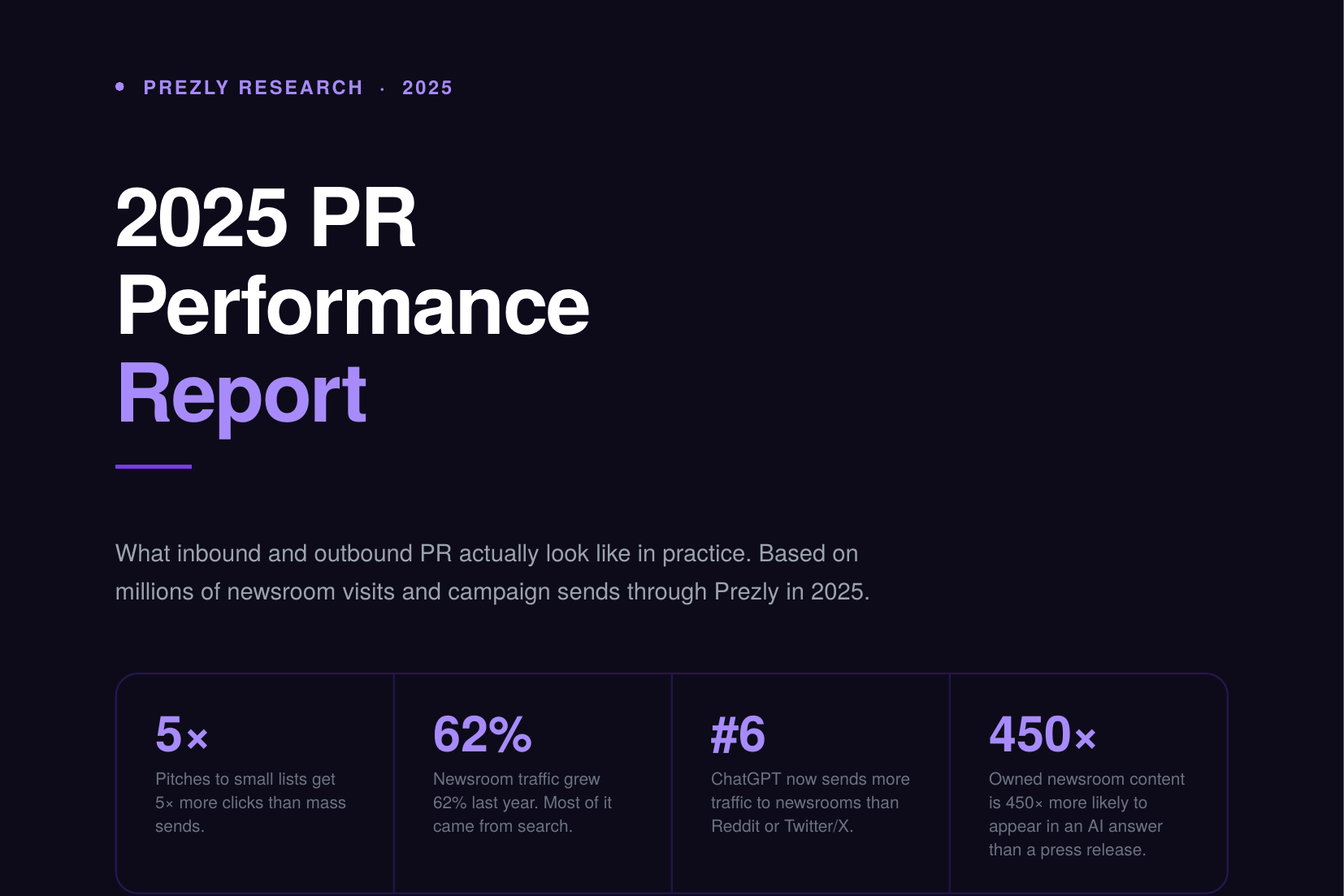
    The clearest finding is that search is the dominant driver of newsroom traffic. The report says newsroom traffic grew 62% year on year, with 65% of traffic coming from search, 29% from direct traffic, 5% from social media referrals, and 1% from AI referrals such as ChatGPT, Claude, and Perplexity. It also notes that direct traffic includes pitch-email clicks because many email clients do not pass referrer data.

    The implication is that newsroom content increasingly serves discovery audiences beyond journalists receiving a pitch. On page 2, the report states that for every tracked click from ChatGPT, roughly 50 more people may have seen the content within an AI response, suggesting that visible referral traffic understates AI exposure. The chart on page 2 reinforces this broader discovery logic by showing Google far ahead of other referral sources.

    The report also argues that owned newsroom content is much more likely than syndicated PR material to appear in AI-generated answers. Citing a BuzzStream analysis via Search Engine Journal, it says 98.6% of relevant AI-cited PR content came from owned newsroom content, compared with 1.2% from wire services and 0.2% from syndicated PR. That is the basis for the report’s “450× more likely” claim. This is important because it supports Prezly’s case that publishing location now affects not only search visibility but also AI discoverability.

    A further practical point is device use. The report says 54.7% of newsroom visits are on mobile, versus 44.8% on desktop and 1.5% on tablet. So even if teams produce good content, the user experience may still fail if newsrooms are designed mainly for desktop behaviour.

    3. What does the report find about outbound outreach and what makes pitches perform better?

    The strongest pattern is that smaller media lists perform much better than large sends. On page 4, the report says pitches sent to lists of 1 contact achieve a 19.3% click-through rate, lists of 2–10 achieve 16.8%, lists of 51–200 achieve 5.8%, and lists of 200+ achieve 3.6%. The chart on that page shows a steady decline in CTR as list size increases. This underpins the report’s repeated argument that relevance beats volume.

    Personalisation helps, but only within a sound targeting strategy. The report states that personalisation lifts CTR by 15%, with the strongest gains in lists of 2–25 recipients. Its interpretation is that personalisation amplifies a good list rather than rescuing a poor one. The chart on page 5 visually supports that point by showing the personalised version outperforming the non-personalised version most clearly in smaller list ranges.

    Pitch length also matters. Prezly argues against the common assumption that shorter is always better, saying the 201–300 word range nearly doubles CTR compared with shorter pitches. The chart on page 6 shows the 201–300 word band as the strongest performer at 6.25% CTR, clearly above other length ranges.

    By contrast, subject line length seems less decisive. The report says open rate “barely moves” with subject line length, while CTR peaks at 20–40 characters and very short subject lines underperform. So the report suggests that teams may spend too much time optimising superficial elements and not enough on list quality, relevance, and body copy.

    4. What assumptions and perspective shape the report?

    The report is clearly written from a platform-company perspective, and that matters to how its argument is framed. Prezly’s viewpoint is that PR teams undervalue the newsroom as a performance asset and over-focus on campaign-level metrics. The document consistently argues for seeing newsrooms, search visibility, AI discovery, and targeted pitching as an integrated workflow. That framing aligns closely with Prezly’s product positioning.

    Its underlying assumptions are that discoverability now matters as much as distribution, that owned content is strategically more important than wire-based distribution, and that behavioural data offers a better view of performance than legacy PR metrics alone. Those assumptions are plausible within the report’s evidence base, but they are still shaped by the lens of a vendor analysing its own ecosystem.

    Methodologically, the report is also selective. It relies heavily on aggregated platform data, but it does not clearly specify sample size, client mix, timeframe boundaries beyond “last year” or “2025”, sector spread, or geography. That does not invalidate the findings, but it does mean the report is more directional than fully transparent academic-style research.

    5. What are the main implications for PR teams and communications leaders?

    The biggest implication is measurement. If teams continue to report mainly on opens and clicks, they may systematically understate communications impact. The report suggests that leaders should expand dashboards to include newsroom traffic, search visibility, AI discoverability, and post-campaign engagement beyond the original send.

    The second implication is strategic. PR teams may need to treat their newsroom as a discoverability engine rather than simply a repository for press releases. Because search is the top traffic source and owned content dominates AI citation patterns, publishing discipline, structure, and content freshness become more important. The report effectively reframes the newsroom as infrastructure for earned, search, and AI exposure.

    Third, the report points towards a more selective outreach model. Smaller, more targeted lists, better personalisation, and stronger pitch construction outperform scale-based blasting. For PR leaders, that implies a capability shift away from volume and towards segmentation, judgement, and relevance.

    Finally, there is a practical user-experience implication: mobile cannot be treated as secondary. With more than half of newsroom visits coming from phones, weak mobile experiences risk undermining otherwise strong content.

    Taken together, the report’s conclusion is that the best PR teams will be those that connect content publishing, discoverability, outreach, and measurement into one coherent operating model rather than treating them as separate tasks.

  • The 2026 AI Index Report by Stanford University

    The 2026 AI Index Report by Stanford University

    About the paper

    The Stanford AI Index Report 2026 is a broad, global data-pack and secondary-analysis report on the state of artificial intelligence across research, technical performance, responsible AI, economy, science, medicine, education, policy and public opinion.

    It is based on multiple datasets and contributors, including sources such as Epoch AI, GitHub, Lightcast, LinkedIn, Quid, Zeki and McKinsey; it is not a single original survey, and sample sizes vary by section.

    The report’s geographic scope is global, though some chapters rely heavily on U.S., China, Europe and selected country-level data; some methodology details are chapter-specific rather than contained in one unified method statement.

    Length: 425 pages

    More information / download:
    https://hai.stanford.edu/ai-index/2026-ai-index-report

    Core Insights

    1. What is the central argument of the AI Index Report 2026?

    The central argument is that AI is scaling faster than the surrounding systems can adapt. The report frames 2025–26 as the period “after arrival”: AI is no longer an emerging technology sitting on the margins, but a mainstream force moving through work, education, science, medicine, infrastructure and policy. Generative AI reached roughly 53% population-level adoption within three years, organisational adoption reached 88%, and AI companies are scaling revenue and investment faster than previous technology waves.

    But the report repeatedly stresses that capability growth is outpacing governance, measurement and institutional readiness. Benchmarks are saturating, leading models are becoming harder to distinguish, frontier labs are disclosing less, and independent testing does not always confirm developer-reported performance. The result is not a simple story of progress or danger, but a more complex pattern: AI capabilities, adoption and investment are accelerating, while evaluation, regulation, education, labour-market adaptation and responsible AI practice are struggling to keep up.

    2. What does the report say about AI capability and model competition?

    The report argues strongly against the idea that AI capability is plateauing. Frontier systems continued to improve in 2025 across reasoning, coding, mathematics, multimodal understanding and agentic task execution. On SWE-bench Verified, performance rose from around 60% to near the human baseline in a single year. Some models now meet or exceed human baselines on PhD-level science questions, multimodal reasoning and competition mathematics.

    At the same time, the report highlights a “jagged frontier”. AI systems can produce astonishing results in some domains while remaining surprisingly weak in others. One striking example is that Gemini Deep Think achieved gold-medal performance at the International Mathematical Olympiad, while the top model could read analogue clocks correctly only about half the time. Similarly, AI agents improved dramatically on OSWorld, from around 12% to roughly 66% task success, but still fail about one in three attempts on structured computer-use tasks. Robots also remain far from general competence in the physical world, succeeding in only 12% of household tasks despite strong performance in controlled simulation environments.

    The competitive landscape is also changing. The U.S.–China model performance gap has effectively closed, with U.S. and Chinese models trading the lead multiple times since early 2025. As of March 2026, the top U.S. model led the top Chinese model by only 2.7%. At the same time, top frontier models from Anthropic, xAI, Google, OpenAI, Alibaba and DeepSeek are tightly clustered, making raw benchmark performance less useful as a differentiator. The report suggests that competition may increasingly shift towards cost, reliability, latency, usability and domain-specific performance.

    3. How are AI development, infrastructure and talent distributed globally?

    The report shows a field that is both concentrated and dispersing. Frontier model development remains heavily concentrated in industry and in a small number of countries. Industry produced more than 90% of notable AI models in 2025, while academia produced only two notable models. The United States still leads in notable model production, with 59 notable models in 2025 compared with China’s 35 and South Korea’s 8.

    However, China leads in several research and innovation indicators: publication volume, citations, patent output and industrial robot installations. The U.S. still retains advantages in top-tier model production, higher-impact patents and private investment, but China’s scale in research and patenting is now central to the global AI landscape. South Korea stands out for innovation density, leading the world in AI patents per capita.

    Infrastructure is even more concentrated. The United States hosts 5,427 data centres, more than ten times any other country, and global AI compute capacity has grown roughly 3.3 times per year since 2022. Yet the hardware supply chain has a critical dependency: TSMC in Taiwan fabricates almost every leading AI chip. This makes AI sovereignty difficult for most countries because the underlying compute, chips, data centres and talent are unevenly distributed.

    Talent patterns are also shifting. The U.S. remains home to more AI talent than any other country, but the number of AI researchers and developers moving to the U.S. has dropped 89% since 2017, including an 80% decline in the last year alone. Switzerland and Singapore lead in AI researchers and developers per capita, while the report notes that gender gaps in AI talent remain deeply entrenched, with no country approaching parity.

    4. What economic, labour-market and environmental consequences does the report identify?

    Economically, the report depicts AI as both a major investment boom and an uneven productivity story. U.S. private AI investment reached $285.9 billion in 2025, more than 23 times the $12.4 billion invested privately in China, though the report notes that private investment alone may understate China’s total AI spending because of government guidance funds. The U.S. also led in entrepreneurial activity, with 1,953 newly funded AI companies in 2025.

    The productivity evidence is promising but not universal. The report cites productivity gains of 14% to 26% in customer support and software development, while finding weaker or even negative effects in tasks requiring more judgement. This is important because some of the clearest productivity gains appear in fields where entry-level employment is beginning to decline. In U.S. software development, developers aged 22 to 25 saw employment fall nearly 20% from 2024, while headcount for older developers continued to grow.

    The environmental footprint is becoming much harder to ignore. Grok 4’s estimated training emissions reached 72,816 tons of CO₂ equivalent. AI data centre power capacity rose to 29.6 GW, roughly comparable to New York state at peak demand. The report also estimates that annual GPT-4o inference water use may exceed the drinking water needs of 1.2 million people. The implication is that AI’s economic value and social utility must increasingly be weighed against energy, water, infrastructure and supply-chain constraints.

    5. What does the report imply for governance, education, science, medicine and public trust?

    The report’s broader implication is that AI is moving into high-stakes domains before institutional systems are fully ready. Responsible AI is not keeping pace with capability: leading frontier developers commonly report capability benchmarks, but responsible AI benchmark reporting remains inconsistent. Documented AI incidents rose from 233 in 2024 to 362, and the report notes that improving one responsible AI dimension, such as safety, can sometimes degrade another, such as accuracy.

    In education, formal systems are lagging behind actual use. More than 80% of U.S. high school and college students now use AI for school-related tasks, but only half of middle and high schools have AI policies, and just 6% of teachers say those policies are clear. This suggests a growing gap between everyday AI use and the institutional guidance needed to use it well.

    In science and medicine, the report is cautiously optimistic but evidence-conscious. AI models for science can outperform human scientists on some benchmarks, such as ChemBench, but they remain weak in areas such as astrophysics replication and Earth observation. The report also notes that smaller, specialised models can outperform much larger ones in scientific domains, challenging the assumption that bigger is always better. In medicine, AI scribes and clinical note-generation tools saw substantial adoption, with some physicians reporting up to 83% less time spent writing notes and reduced burnout. But the broader evidence base remains thin: a review of more than 500 clinical AI studies found that nearly half relied on exam-style questions rather than real patient data, and only 5% used real clinical data.

    Policy is becoming more active but also more fragmented. AI sovereignty is emerging as a defining policy principle, especially as countries seek greater control over infrastructure, data, models, applications and talent. National AI strategies are expanding, particularly among developing economies, but actual capabilities remain uneven. The EU, U.S. and Asian countries are also moving in different policy directions, with the EU AI Act’s first prohibitions taking effect while the U.S. shifted towards deregulation.

    Finally, public opinion is divided. Experts and the public view AI’s future very differently: 73% of experts expect AI to have a positive impact on how people do their jobs, compared with only 23% of the public. Trust in institutions to regulate AI is fragmented, with the United States reporting the lowest level of trust in its own government to regulate AI among surveyed countries, at 31%. The report therefore closes on a central tension: AI is becoming more capable, more widely adopted and more economically valuable, but trust, governance and social readiness remain far less mature.

  • Want RoI from A.I.? Go for growth by PwC

    Want RoI from A.I.? Go for growth by PwC

    About the paper

    PwC’s AI performance study examines why some large companies generate measurable ROI from AI while others remain stuck in pilot activity.

    It is original proprietary survey research based on 1,217 senior executives, all director-level or above, across 25 sectors and across Africa, Asia, Europe, the Middle East, North America and South America; fieldwork took place in October and November 2025.

    The sample is heavily weighted towards large publicly listed companies: 91% were publicly listed and 76% had revenue of US$1 billion or more.

    Length: 30 pages

    More information / download:
    https://www.pwc.com/gx/en/issues/technology/ai-performance/want-ai-roi-go-for-growth.html#the-takeaways

    Core Insights

    1. What is the central argument of the report?

    The report argues that AI ROI is not mainly a function of how many AI pilots a company launches. It comes from what PwC calls “AI fitness”: the ability to aim AI at important business outcomes, build the foundations that make AI scalable and reliable, and embed AI deeply across the enterprise.

    PwC’s headline finding is that the most AI-fit companies achieve AI-driven financial performance that is 7.2 times higher than other companies. The study defines this performance as revenue and efficiency gains attributable to AI, adjusted against sector medians. According to the report, 20% of the surveyed companies capture 74% of AI-driven returns, showing that value is highly concentrated among a relatively small group of leaders.

    The core message is therefore: companies should stop counting pilots and start building the organisational machinery that turns AI activity into measurable business impact. The strongest performers treat AI not as a tool for scattered productivity gains, but as a reinvention engine that can reshape products, business models, operating models and competitive positioning.

    2. What does PwC mean by “AI fitness”?

    PwC defines AI fitness as a combination of six foundational capabilities and three measures of AI use.

    The six foundations are:

    1. Innovation — dedicated infrastructure, business-unit ownership and disciplined portfolio reviews.
    2. Governance and risk — Responsible AI frameworks, access controls, compliance processes and oversight bodies.
    3. Data and technology — modern platforms, trusted data, reusable components and redesigned workflows.
    4. Strategy — a clear connection between AI deployment and corporate strategy.
    5. Investment — sufficient funding and the ability to reallocate resources as priorities shift.
    6. Workforce — skills, incentives, collaboration models and trust in AI-generated insights.

    The three measures of AI use are:

    1. Breadth and depth — how widely AI is used across the value chain and how deeply it is embedded into workflows.
    2. Sophistication — whether AI is used merely to assist and summarise, or whether it executes tasks, operates within guard rails or becomes autonomous.
    3. Capturing value from industry convergence — whether AI helps the company identify and exploit new value pools across traditional sector boundaries.

    The important point is that PwC does not define AI leadership as “using more AI” in a generic sense. Leadership comes from combining AI use with the organisational conditions that make AI repeatable, trusted and commercially meaningful.

    3. Why does the report say companies should aim AI at growth and reinvention, not just efficiency?

    The report acknowledges that many companies use AI to improve efficiency: faster claims processing, code generation, customer support automation, productivity improvements and cost reduction. But PwC argues that the biggest returns come when AI changes what the company sells, how it creates value and where it competes.

    AI leaders are 2.6 times as likely as other companies to say AI has improved their ability to reinvent their business model. They are also more likely to use AI to identify emerging value pools, respond to changing customer needs, collaborate across sectors and compete outside their traditional industry boundaries.

    The strongest individual AI fitness factor in the study is the ability to capture growth from industry convergence. PwC’s logic is that AI allows companies to detect and act on new combinations of customer needs, data, services and partnerships that cut across old sector lines.

    The John Deere example illustrates this argument. The company used AI-powered precision spraying not simply to make an existing machine smarter, but to support a more service-like model linked to verified outcomes. According to the report, See & Spray was used on more than 1 million acres in the 2024 growing season and saved an estimated 8 million gallons of herbicide mix, while also positioning John Deere for recurring services revenue rather than one-off hardware differentiation.

    4. What foundations do AI leaders build differently from other companies?

    PwC’s argument is that foundations matter because they improve the “conversion rate” from AI use to measurable results. Companies with stronger foundations reportedly see nearly double the improvement in AI-driven performance when they increase AI use, compared with companies with weaker foundations.

    The report highlights five especially important foundation-building practices.

    First, AI leaders fund and flex the portfolio like investors. They invest materially more in AI — PwC says leaders invest 2.5 times as much of revenue as other companies — and they are better at reallocating financial and human resources towards higher-value AI opportunities.

    Second, they create infrastructure for innovation. They are more likely to provide sandbox environments and dedicated technical infrastructure for experimentation, and more likely to place accountable innovation owners inside business units.

    Third, they build workforce trust. Employees in AI-leading organisations are 2.1 times as likely to trust AI-generated insights and act on them in daily decisions. The report links this trust to cross-functional co-creation, role-based learning, incentives to experiment and clear guard rails.

    Fourth, they use governance to accelerate rather than obstruct. Leaders are more likely to have a documented Responsible AI framework and a cross-functional governance board, but the report frames governance as a way to move routine use cases faster while escalating only higher-risk cases.

    Fifth, they remove data and technology friction. AI leaders are much more likely to have reusable centrally catalogued AI components, high-quality accessible data, modern cloud-based platforms, and redesigned workflows that incorporate AI rather than merely adding AI tools on top of existing processes.

    The overall message is pragmatic: companies should not try to modernise everything at once. They should build only the foundations needed to scale the AI initiatives most closely tied to strategic outcomes.

    5. What are the report’s main implications for executives?

    The main implication is that executives need to move from an “AI activity” mindset to an “AI performance” mindset.

    PwC repeatedly warns against treating AI pilots as proof of progress. The report suggests that many companies have visible AI activity but little evidence of revenue growth, cost reduction, better decisions or improved customer outcomes. The practical challenge is therefore to connect AI to specific business objectives, measure impact, and stop or scale initiatives based on evidence.

    The report’s recommended executive agenda has four parts.

    First, aim AI at strategic value, especially growth, reinvention and industry convergence, rather than only internal productivity.

    Second, assign ownership and metrics. Every important AI initiative should have a business owner, success measures and accountability for outcomes.

    Third, industrialise what works. Companies should take proven use cases and replicate them across functions, regions, workflows and decision points, rather than leaving value trapped in isolated pockets.

    Fourth, move carefully towards greater autonomy. PwC argues that automation of routine, high-frequency decisions is strongly linked to AI-driven performance, but it should happen within explicit guard rails, with decision quality measured and trust thresholds met before expansion.

    The conclusion is that AI advantage may compound. The leading companies are learning faster, redeploying solutions faster and safely automating more decisions. For laggards, the risk is not just missing short-term efficiency gains, but falling behind as AI-fit competitors turn their foundations into a widening performance premium.

  • 2026 Global RepTrak 100 by RepTrak

    2026 Global RepTrak 100 by RepTrak

    About the paper

    The report argues that corporate reputation has entered a “multiplayer” era in which it is shaped less by top-down corporate messaging and more by communities, employees, creators and, now, AI systems.

    It is a mixed-methods report built primarily on RepTrak’s proprietary survey-based reputation dataset, using responses from the informed general public across 14 major economies collected at the end of 2025, with additional case-based interpretation; the precise number of survey respondents is not clearly specified in the report, although the overall panel reach is described as 70 million consumers and business professionals globally.

    Length: 11 pages

    More information / download:
    https://www.reptrak.com/globalreptrak/

    Core Insights

    1. What is the report’s central argument about how corporate reputation is changing?

    The core argument is that reputation no longer belongs mainly to companies or to the communication channels they control. Instead, it is increasingly co-created by stakeholder networks: communities, employees, creators, cultural participants, and AI systems that synthesise what those groups are already saying. The report calls this shift “multiplayer” reputation. In practical terms, that means the old model of corporate-heavy storytelling through press releases, media relations and investor relations is losing relative power, while reputation increasingly depends on whether external stakeholders choose to carry and reinforce a company’s narrative.

    The report is careful not to say that corporate communication has become irrelevant. Rather, it says companies still set inputs and core storylines, but they are no longer the “final shapers” of perception. The decisive difference is whether others pick up that story and validate it through their own voices and experiences. The conclusion on page 11 is especially clear: reputation now “belongs to the communities that choose to carry it”.

    That framing also reveals the author’s perspective. RepTrak is not merely describing a media trend; it is arguing for a strategic reorientation in corporate communications. The implied advice is that companies should spend less energy trying to dominate the narrative and more energy creating the conditions for genuine third-party advocacy.

    2. How does the report support its “multiplayer” thesis with methodology and evidence?

    The report’s main evidence comes from RepTrak’s global reputation model. It says the 2026 ranking is based on survey responses collected across 14 major economies at the end of 2025 from what it calls the informed general public, meaning people who know a company and have formed an opinion about it. Companies had to meet revenue, familiarity and reputation-score thresholds to qualify for inclusion. RepTrak then applies its proprietary “Feel, Think, Do” model, linking emotional response, rational drivers and behavioural outcomes.

    The report uses this framework to show that headline reputation remains strong while the underlying mechanics are changing. Average global Reputation Scores rose for a third straight year to 74.6, suggesting that the system is not collapsing. But beneath that stable surface, channel effectiveness is shifting and the companies rising fastest tend to be those whose reputations are sustained by broader stakeholder networks rather than by owned channels or tightly controlled brand ecosystems.

    The evidence is therefore both quantitative and interpretive. Quantitatively, the report cites changes in scores, rank movements, and channel impact. Interpretively, it adds company case examples such as LEGO, adidas, Nike and NVIDIA to show how those shifts may work in practice. That makes this less a pure data pack and more a research-led argument built from proprietary survey analysis plus illustrative case reading. The methodology is fairly clear on the survey structure and qualification rules, but the exact respondent count for this specific edition is not clearly specified in the report.

    3. Which companies best illustrate the report’s view of winners and losers in the new reputation environment?

    The clearest winner is LEGO. It retained the number one position with a Reputation Score of 78.2, and the report treats it as the model multiplayer brand. Its importance lies not only in rank but in the source of its resilience: even when its Products & Services driver slipped slightly, overall reputation held because a wider network of fans, educators, builders and communities continued to advocate for it. The LEGO case on page 6 deepens this argument by showing how product strength fuels community expansion through the Botanical Collection, Fortnite participation, and collaborations with Crocs and adidas. The message is that strong products recruit new communities, and those communities then do reputational work that product quality alone cannot achieve.

    Adidas is the other flagship winner. It rose from #16 in 2024 to #2 in 2026, with the report highlighting gains in Conduct, Workplace and “Fair in business”. The argument is that adidas rebuilt and broadened its reputation not through classic controlled brand campaigns, but through creator ecosystems, cultural collaborations and participation in spaces such as Roblox. In the report’s logic, those communities did not merely consume the brand story; they helped author it.

    NVIDIA is the most interesting new entrant. It debuts at #14 and is described as a company whose reputation was built “almost entirely without traditional corporate communications infrastructure”. The report attributes that to its developer community, the broader cultural moment around AI, and consistent execution over time. That makes NVIDIA an important proof point for the claim that a company can accumulate reputational strength through network effects well beyond formal communications.

    On the losing side, Nike is the key contrast case. It fell to #50, and the report presents this as the result of narrowing its ecosystem through a direct-to-consumer strategy centred on owned channels. In the report’s reading, Nike pursued control in the name of community, but ended up weakening the independent stakeholder network that could have supported it when performance and conduct issues emerged. Spotify and Harley-Davidson are also presented as declines that support the broader thesis, while Disney is cited as an example of a once-strong reputation falling out of the rankings entirely.

    4. What does the report say about channels, and why is AI such an important development?

    One of the report’s most important findings is that channel impact is compressing. It says impact, defined as the gap in Reputation Score between those exposed to a channel and those not exposed, is now at its lowest recorded level across every channel. But the report insists this should not be misread as simple decline. The exposed score has mostly stayed flat or risen; the big change is that the non-exposed score has risen by 2 to 4 points across nearly every touchpoint since 2017. In other words, strong perceptions formed in one place now travel across the wider ecosystem, lifting the baseline everywhere else.

    This is where the report introduces its “co-authorship effect”. People reached through a channel do not remain passive recipients. They carry their interpretations into other spaces, interactions and communities. That helps explain why individual channels appear less decisive on their own: they now operate inside a networked environment where meaning spills across boundaries.

    AI matters because it is presented as a fundamentally different kind of channel. Unlike other channels that people encounter passively or habitually, generative AI is used in response to explicit questions. That makes it an answer engine rather than just a distribution channel. The report says AI reaches only 10% of stakeholders, ranking 11th out of 14 channels by reach, but already ranks 7th in impact with a score of 6.6. Its exposed score is 80.4 versus a non-exposed score of 74, giving it one of the largest impact gaps in the dataset.

    The implication is striking: AI does not simply repeat corporate messaging. It synthesises what everyone else has said about a company. For firms with genuine stakeholder alignment, AI amplifies that positive signal. For firms with a gap between claimed identity and lived reality, AI becomes, in the report’s phrase, an “unsparing auditor”. That is one of the report’s strongest strategic warnings for communications leaders.

    5. What broader implications does the report draw for corporate communications and reputation strategy?

    The report’s biggest implication is that communications strategy must move from message control to stakeholder alignment. It suggests that the companies that will perform best are not the loudest broadcasters but those that provide a clear, consistent and credible core story that others are willing to adapt and carry in their own voice. That requires communicators to think less like message managers and more like stewards of an ecosystem.

    A second implication is that fundamentals still matter. The report does not celebrate decentralised storytelling for its own sake. It repeatedly argues that community amplification only works when there is something worth amplifying: strong products, credible leadership, visible values, and employee cultures that can withstand scrutiny. This is why LEGO’s product strength is so central, and why firms under pressure on performance, conduct or leadership lose ground even in a networked environment.

    A third implication comes from the “Feel, Think, Do” data. Reputation appears to be splitting between short-term transaction behaviour and longer-term commitment. Buy and Recommend both fell by one percentage point, while Invest rose by one point. The report interprets this as stakeholders becoming more selective in immediate transactions but more willing to back companies they believe in over time. That suggests reputation may increasingly function as a buffer and a trust reserve, not just a demand driver.

    Taken together, the report’s conclusion is quite pointed: the architecture of trust has not changed, but the environment in which trust is formed has. More channels, more peer influence and AI synthesis mean that companies cannot rely on communications volume or channel control alone. They have to earn consistency across products, behaviour, culture and stakeholder experience, because that is what communities and AI will now reflect back to the market.

    This post’s ‘featured image’ was constructed with A.I. to fit the entire paper’s title into a 3:2 image.

  • Thought Leadership Alpha Report by Cardinal 40

    Thought Leadership Alpha Report by Cardinal 40

    About the paper

    The report examines whether CEO “thought leadership” — voluntary, owned executive communications such as op-eds, speeches, interviews, public statements and shareholder letters — is associated with stock-market value.

    It is an associative, observational event-study using 1,034 CEO communications from 357 S&P 500 companies over 26 years, with a narrower 287-event non-shareholder sample for its strongest “canon similarity” finding.

    The methodology combines Fama-French three-factor cumulative abnormal return analysis over a one-week window with computational text analysis, including 63 formulaic text features, whole-document embeddings, and semantic comparison against a curated canon of landmark CEO communications.

    The geographic scope is U.S. publicly traded companies; the report explicitly says findings may not generalise to private companies or non-U.S. markets.

    Length: 24 pages

    More information / download:
    https://cardinal40.com/2026-alpha-report/

    Core Insights

    1. What is the report’s central claim about CEO thought leadership and shareholder value?

    The report’s central claim is that the quality of CEO thought leadership is associated with measurable differences in short-term stock-market performance. It argues that CEO communications are not merely neutral containers for information already created elsewhere in the business; the way the CEO frames, writes and communicates ideas may itself be associated with value.

    The headline number is deliberately attention-grabbing: the report says that the difference between top- and bottom-decile communication quality corresponds to roughly 0.9 percentage points in one-week cumulative abnormal returns. For the median S&P 500 company, it translates this into approximately $367 million in shareholder value; for the average Magnificent Seven company, it says the equivalent would be about $25 billion.

    However, the report is careful — at least in several places — to stress that this is not a causal finding. It does not prove that writing a better CEO op-ed, speech or letter will mechanically increase the share price. Rather, it identifies an association between certain kinds of CEO communication and abnormal returns over a short market window. This distinction matters because the report’s own framing sometimes leans rhetorically towards “words create value”, while the research design can only support “words are associated with value”.

    2. How does the report define and measure “thought leadership”?

    The report defines thought leadership as voluntary public communication authored by, or directly attributed to, a sitting CEO. It includes four categories:

    1. bylined op-eds
    2. public speeches and testimony
    3. interviews and public statements
    4. and annual shareholder letters.

    The communications had to have a known publication or delivery date, and the authors excluded communications that could not be reliably dated or that coincided with obvious market-moving information such as quarterly earnings.

    The main financial outcome is the one-week Fama-French three-factor cumulative abnormal return, or FF3 CAR, measured from the trading day of publication through five trading days afterwards. This controls for broad market return, company size and value factors. In plain English, the report is asking: after adjusting for what the stock might normally have been expected to do, did it outperform or underperform in the week after the CEO communication?

    The study then uses two samples. The full universe contains 1,034 communications and is used to show the overall spread of market reactions, to test simple text features, and to test broad embedding-based prediction. The narrower sample contains 287 non-shareholder communications and excludes shareholder letters because these are often published alongside annual reports or other financially material disclosures, making it harder to isolate the communication effect.

    Methodologically, this is best described as an original, mixed-methods-style empirical report: it combines original data collection, financial event-study analysis, natural language processing, and a professionally curated qualitative benchmark of “great” CEO communications. It is not an expert survey, not a simple secondary analysis, and not a modelling/data pack alone.

    3. What does the report find about ordinary writing advice and formulaic text features?

    One of the report’s more interesting findings is negative: simple writing rules do not explain the variation in market outcomes. The authors tested 63 text features, including things such as word count, reading level, sentiment, use of data, and pronoun choices. Only three were statistically significant at the 95% level, and none remained significant after multiple-testing corrections.

    This matters because it pushes against much conventional communications advice. The report is effectively saying that the market signal, if there is one, is not captured by easy prescriptions such as “make it shorter”, “use more data”, “sound more positive”, or “avoid jargon”. Those features may still matter for readability, reputation, clarity or persuasion, but in this study they did not reliably predict one-week abnormal returns.

    The implication is that “good” executive communication cannot be reduced to a checklist. The authors’ interpretation is that quality lives in the whole document: the underlying argument, tone, originality, judgement, structure, substance and credibility of the communication as a complete act of leadership. That is a useful point, although it also makes the report less prescriptive than its commercial framing might suggest.

    4. What role do embeddings and the “canon” play in the report’s argument?

    After simple text features failed, the report turns to whole-document embeddings. These convert each communication into a position in a 384-dimensional semantic space, intended to capture the overall meaning and character of the document rather than isolated attributes. Using five-fold cross-validation, the embedding model produced a statistically significant but modest relationship between predicted and realised one-week abnormal returns. The reported correlation is around r = +0.079 in the main discussion, meaning the model explains less than 1% of the variance.

    That result supports the report’s claim that some textual signal exists, but it does not tell communicators what “good” looks like. To make the finding more interpretable, the authors construct a canon of 33 landmark CEO communications, including examples such as Warren Buffett’s annual letters, Steve Jobs’s Stanford commencement speech, Andrew Carnegie’s “The Gospel of Wealth”, and Marc Andreessen’s “Why Software Is Eating the World”. They then measure how semantically similar each CEO communication is to this canon.

    The strongest interpretable finding is that communications closer to the canon are associated with stronger abnormal returns in the 287-event non-shareholder sample. The pooled correlation is modest, r = +0.101, with p = 0.087, which does not meet the conventional 5% significance threshold. But top-quartile canon-similar communications averaged +0.469 percentage points in abnormal return, compared with +0.084 percentage points for the full non-shareholder sample.

    This is the report’s most distinctive idea: “quality” is not defined as mimicry of one famous CEO, but as semantic proximity to a broad region occupied by communications that experienced practitioners judge to be exemplary. The report’s page 20 chart visualises a permutation test suggesting that the observed canon relationship is unlikely to be just an artefact of one hand-picked canon, though the canon itself still rests on professional judgement.

    5. What are the most important limitations and implications of the report?

    The most important limitation is that the study is observational. The authors cannot randomly assign different CEO communications to different companies, so the findings are correlational rather than causal. The report explicitly acknowledges that unobserved firm characteristics, strategic timing, concurrent events or CEO quality more broadly could explain some or all of the observed relationship.

    A second limitation is statistical modesty. The embedding result is statistically significant but explains less than 1% of variance. The canon similarity result is directionally consistent and economically interesting, but it does not clear the conventional 0.05 significance threshold. The report itself warns that neither result should be treated as a strong predictive tool.

    A third limitation is generalisability. The study is based on publicly traded U.S. companies with sufficient trading data, and on communications that could be systematically collected. It may not apply to private firms, non-U.S. markets, internal communication, political communication, social media, podcasts or other executive-visibility formats not covered by the taxonomy.

    The practical implication is not “write like Warren Buffett and your stock will rise”. A more defensible takeaway is that CEO communication quality may be financially material, but that quality is holistic, contextual and difficult to reduce to simple writing hacks. For communications leaders, the report strengthens the case for investing in executive thought leadership as a serious strategic discipline — while also warning against overclaiming what the current evidence proves.

  • State of the Global Workplace 2026 by Gallup

    State of the Global Workplace 2026 by Gallup

    About the paper

    The paper examines employee engagement, wellbeing, daily emotions, job-market sentiment and the human side of AI adoption, arguing that management quality is a decisive factor in whether AI translates into organisational value.

    It is an original survey-based research report built primarily on Gallup World Poll data, supplemented by additional random U.S. workforce web samples; the report draws on 263,810 respondents in 2025, including 141,444 employed adults, and on a full 2009–2025 trend base of 5,754,327 respondents, covering more than 160 countries and areas worldwide.

    Length: 251 pages

    More information / download:
    https://www.gallup.com/workplace/349484/state-of-the-global-workplace.aspx

    Core Insights

    1. What is the report’s central argument about the global workplace in 2026?

    The report’s central argument is that the workplace challenge is not simply technological change, but whether organisations are managed well enough to convert change into performance. Gallup explicitly frames the report around “the human side of the AI revolution” and says the manager is the strongest predictor of employee AI adoption apart from technical integration. In other words, the report treats management effectiveness, employee engagement and organisational readiness as the real bottlenecks in turning AI into measurable gains.

    That argument rests on a broader point: workplaces are entering the AI era while employee engagement is weakening rather than strengthening. Global engagement fell again in 2025, to 20%, its lowest level since 2020, and Gallup argues this matters because engagement is a practical indicator of readiness for disruption and change. Low engagement, in this framing, is not just a morale issue but an economic and strategic one.

    2. What are the report’s most important global findings on engagement, wellbeing, emotions and the job market?

    The most striking headline is that global employee engagement declined for a second consecutive year, falling to 20% in 2025 from a 2022 peak of 23%. At the same time, 64% of employees are classified as not engaged and 16% as actively disengaged. Gallup estimates that low engagement cost the global economy about $10 trillion in lost productivity, or 9% of global GDP.

    By contrast, wellbeing improved slightly. Global thriving rose from 33% to 34% in 2025, the first improvement in three years. But that modest recovery sits alongside persistently high negative emotions: 40% reported stress, 22% anger, 23% sadness and 22% loneliness. The report makes clear that these emotional burdens remain above pre-pandemic levels, suggesting that the workplace has not returned to its earlier psychological baseline.

    Job-market sentiment also improved, but only slightly. Globally, 52% of employees said it was a good time to find a job, up one point from the previous year, though still below the 2019 peak. So the overall picture is mixed: modest improvement in wellbeing and job confidence, but continued weakness in engagement and continued elevation in emotional strain.

    3. Why does Gallup place so much emphasis on managers?

    Gallup’s answer is that the recent global deterioration in engagement is largely a management story. The report says lower engagement among managers accounts for most of the recent downturn, and manager engagement has dropped by nine points since 2022. On the chart on page 7, managers fall from 31% engaged in 2022 to 22% in 2025, while non-managers move only marginally, from 20% to 19%. That is a significant loss of what Gallup calls the former “engagement premium” of being a manager.

    The report also argues that managers are pivotal to meaningful AI adoption. In Gallup’s Q1 2026 U.S. workforce survey, the top two drivers of frequent AI use are integration with existing systems and manager-led adoption. Employees in AI-investing organisations who strongly agree that their manager actively supports AI are 98.7 times as likely to strongly agree that AI has transformed how work gets done, and 97.4 times as likely to strongly agree that AI gives them more opportunities to do what they do best every day.

    Gallup’s perspective is therefore not that AI will bypass human leadership, but almost the reverse: the better the management layer, the more likely AI is to become valuable. The report even suggests AI could improve global engagement if it helps managers apply stronger people-management practices more consistently.

    4. What patterns does the report reveal across regions, and what do they imply?

    The regional data show a world that is far from uniform. On engagement, the United States and Canada rank first at 31%, followed closely by Latin America and the Caribbean at 30%, while Europe ranks last at just 12%. That makes Europe the lowest-engagement region globally despite relatively strong life evaluation and job-climate scores. This suggests that a region can look comparatively strong on broader life outlook without generating much attachment to work itself.

    On wellbeing, Latin America and the Caribbean lead at 56% thriving, closely followed by Australia and New Zealand at 55%, whereas South Asia is lowest at 16%. On job climate, Southeast Asia leads at 64%, while the Middle East and North Africa is lowest at 36%. The United States and Canada stand out for a sharp deterioration in job confidence, dropping 10 points year on year to 47%, making the region second-to-last on that measure.

    Emotionally, the picture is equally uneven. South Asia has the highest anger and sadness, Sub-Saharan Africa and South Asia the highest loneliness, while Post-Soviet Eurasia records the lowest stress. The report’s implication is that there is no single global workplace condition. Instead, different regions combine engagement, wellbeing, stress and job optimism in distinct ways, which matters for both management practice and interpretation.

    5. What does the report suggest about AI, jobs and the future of work?

    Gallup presents AI as a force that is already boosting individual productivity for many workers but has not yet reliably produced organisation-level gains. The report notes that in U.S. organisations that have implemented AI, 65% of workers say AI has had a somewhat or extremely positive effect on their productivity, yet only 12% strongly agree that AI has transformed how work gets done in their organisation. This gap between personal efficiency and institutional transformation is one of the report’s core tensions.

    The report also shows rising concern about AI-related job loss. In Q1 2026, 18% of U.S. employees said it was somewhat or very likely their job would be eliminated within five years because of technological innovation, rising to 23% in organisations where AI had been implemented. In finance, insurance and technology, the figures are higher still. At the same time, Gallup says the employment effects are not uniformly negative: larger AI-implementing employers are more likely to be reducing headcount, while smaller ones are more likely to be expanding.

    The broader conclusion is that AI is reconfiguring work, but outcomes depend heavily on context, especially leadership, workforce choice and upskilling. Gallup repeatedly links optimism and wellbeing to employees feeling they have choices in the work they do. So the report’s future-of-work message is not deterministic. AI may intensify pressure, flatten structures and increase job anxiety, but it may also improve management and expand capability, depending on how organisations lead the transition.

  • Crossing the Rubicon by the Scriptorium Initiative

    Crossing the Rubicon by the Scriptorium Initiative

    About the paper

    This is a conceptual whitepaper about how brand and communications functions should evolve into AI-native operating models, arguing that AI changes not just the tools of communication but the logic of the function itself.

    It reads as a practitioner whitepaper grounded in secondary analysis, cited literature, and practice-based reflection rather than original empirical research; no respondent base, interview sample, fieldwork period, or defined geographic dataset is clearly specified in the report.

    Length: 28 pages

    More information / download:
    https://scriptorium-initiative.ai/follow-us

    Core Insights

    1. What is the report’s central argument about AI and the future of the communications function?

    The report’s central argument is that AI represents a structural break for communications, not a simple productivity tool. It says previous technologies expanded reach and speed, but AI changes the function more fundamentally because it can read, write, interpret and increasingly act. In that sense, AI is described not just as another channel, but as “the medium, the message, and the messenger”.

    That leads to the paper’s key claim: communications leaders must decide whether to use AI merely to do old work faster, or to redesign the function around intelligence itself. The report repeatedly frames this as “crossing the Rubicon” — an irreversible leadership choice to rebuild workflows, governance, measurement and roles around human–machine collaboration.

    Importantly, the paper does not argue for replacing communicators. It argues that the purpose of communications remains the same — building trust and shaping behaviour — but that the operating model must change. In the author’s framing, the communicator moves from being chiefly a producer of messages to becoming a steward of intelligence, coherence and meaning.

    2. According to the report, what stays constant even as AI transforms communications?

    The report is very clear that the fundamentals do not change even when the tools do. Across different chapters, it returns to two enduring anchors: trust and behaviour. Communications, in the author’s view, has always been about credibility and action — earning belief and shaping what people do. In the AI era, these anchors become more rather than less important because synthetic content, deepfakes and machine-generated noise make trust scarcer and therefore more valuable.

    The paper also identifies five timeless principles that should still guide the profession: truth and transparency, audience understanding, narrative coherence, reciprocity and feedback, and governance and accountability. These are presented almost as first principles for navigating AI disruption. The implication is that while AI may transform production, distribution and optimisation, it does not remove the need for human honesty, empathy, judgment and responsibility.

    That continuity matters because it gives the report its normative centre. The author is not celebrating automation for its own sake. The paper argues that AI-native communications should be assessed by whether intelligence is aligned with integrity, whether meaning remains coherent, and whether human accountability is preserved.

    3. How does the report say the work of communicators will change in practice?

    The report says communicators will increasingly work inside hybrid systems made up of humans and intelligent agents. In these systems, AI will handle more of the executional load: drafting, monitoring, summarising, simulating reactions, spotting reputational risks and supporting decisions in real time. Humans, meanwhile, will focus more on interpretation, ethical judgment, tone, legitimacy and connection.

    One of the strongest ideas in the whitepaper is the shift from “messages” to “meaning systems”. In the old model, communications teams created messages and distributed them through chosen channels. In the new model, messages are filtered, rewritten, summarised and ranked by algorithms before they reach audiences. That means communicators can no longer assume control over the final expression of what they say. Their job becomes designing the system around intent, boundaries, tone and ethics so that AI-generated outputs still cohere over time.

    The paper also says roles will become less rigid. Traditional job boundaries such as press officer, content manager or speechwriter weaken as AI absorbs more production work. What becomes valuable are higher-order capabilities: sensemaking, narrative judgment, ethical discernment and orchestration. Measurement changes too: instead of counting outputs, speed or reach, the report says the function should focus on trust, credibility and behavioural effect.

    A further practical change concerns career development. The report worries that entry-level apprenticeship work may erode if AI takes over research, drafting and scheduling. That creates a paradox: short-term productivity may rise while long-term human capability weakens. So the future communicator is imagined not as someone learning by doing repetitive tasks, but as someone learning to supervise, question and guide intelligent systems.

    4. What leadership model does the report propose for communications chiefs and senior teams?

    The report argues that leadership must shift from control to coherence. Because AI systems are probabilistic rather than fully predictable, leaders cannot simply rely on traditional command-and-control models. Instead, they need to create clear intent, shared values, ethical boundaries and governance structures that keep human judgment at the centre.

    A core principle here is the “human communicator-in-the-loop”. The report insists that AI can assist, accelerate and act, but cannot be accountable. Responsibility for truth, tone and trust must remain human. This is not framed as a minor safeguard but as a foundational leadership doctrine for the AI-native communications function. Humans do not need to approve everything, but they must intervene wherever legitimacy, emotion, trust or significant consequences are involved.

    For chief communications officers in particular, the report outlines a changing role across three phases. In Phase I, the CCO is a learner who builds fluency, shared language and psychological safety around AI. In Phase II, the CCO becomes an architect who integrates AI into workflows, governance and cross-functional collaboration. In Phase III, the CCO becomes a steward of intelligence, acting as the moral and narrative compass for a function whose “Comms Cortex” sits at the centre of the operating model.

    This leadership model is as cultural as it is technical. The paper stresses that people do not simply need tools; they need readiness, trust and inclusion. Leaders must explain why AI is being adopted, what will change, and what must not change. In that sense, the paper presents AI transformation not as a software implementation exercise, but as an exercise in organisational meaning-making and ethical design.

    5. What roadmap does the report offer, and what are its main implications for organisations?

    Rather than promising a fixed end state, the report offers what it calls the “Scriptorium Journey”, a three-phase path towards an AI-native communications function. Phase I, “Wake Up and Skill Up”, is about literacy, orientation and ethical grounding. Phase II, the “Agentic Foundry”, is where experimentation becomes structured integration and hybrid workflows begin to take shape. Phase III, “AI Native and Hybrid Teams”, is the point at which intelligence becomes the organising logic of the function and the Comms Cortex becomes its central cognitive infrastructure.

    One of the report’s most interesting assumptions is that organisations should stop thinking in terms of static target operating models. Because AI is evolving too quickly, the author argues that success should not be defined as reaching a final destination. Instead, organisations need a quarterly rhythm of foresight, experimentation, leadership alignment, team immersion and ongoing evolution. Readiness and relevance over time matter more than finishing a transformation programme.

    The wider implication is that hesitation also carries risk. The report warns that organisations that delay may find their voice increasingly shaped by systems they do not govern. By contrast, those that redesign communications deliberately around intelligence, while retaining human accountability, can preserve trust, relevance and strategic influence. In the paper’s closing logic, the future function may be smaller in structure but deeper in purpose: less focused on output volume, more focused on aligning purpose, perception and behaviour at scale.

    Overall, the report is less a research study than a strategic manifesto for senior communications leaders. Its value lies in the conceptual framework it offers: AI as a structural shift, trust and behaviour as constants, human accountability as non-negotiable, and transformation as a continuing leadership rhythm rather than a one-off change project.

  • 2026 Global Communication Report by USC Annenberg

    2026 Global Communication Report by USC Annenberg

    About the paper

    This report examines how political and social polarization is reshaping corporate communication and the PR profession, arguing that the industry is undergoing “a quiet shift” from expansive purpose-led speech to a more cautious, situational approach.

    It is a mixed-methods report based on an online survey of 704 PR professionals, a parallel online survey of 1,011 U.S. adults, and qualitative research involving six individual CCO interviews plus a focus group with eight senior communications professionals; the PR sample was global in reach but heavily U.S.-weighted, while the public survey was U.S.-only.

    The methodology is clearly stated, though the PR professional survey used non-probability sampling, which limits how broadly those findings can be generalised.

    Length: 50 pages

    More information / download:
    https://annenberg.usc.edu/research/center-public-relations/global-communication-report

    Core Insights

    1) What is the central argument of the report about polarization and the communications profession?

    The report’s core argument is that polarization has become a persistent condition rather than a temporary phase, and that this is fundamentally reshaping the communications function. Instead of treating polarization as a passing disruption, the report frames it as a structural reality that is changing how companies decide when to speak, what to say, and what risks they are willing to take.

    That is what the title phrase, “a quiet shift,” is meant to capture. The shift is not presented as a dramatic collapse of corporate communication, but as a strategic recalibration. Companies are not necessarily speaking less overall; rather, they are becoming more selective, more conditional, and more defensive in their communications choices. The report suggests that the profession is moving away from broad purpose-driven dialogue and toward a more situational model of corporate speech shaped by risk, scrutiny and backlash.

    Importantly, the report does not portray this as a decline in PR’s relevance. In fact, it makes the opposite case: polarization may be socially harmful, but it has increased the strategic importance of communications inside organisations. PR professionals increasingly see themselves as advisers navigating reputational landmines, internal tensions and stakeholder expectations in a climate where one misstep can trigger immediate consequences. That is why the report repeatedly returns to the tension between PR as “trumpet” and PR as “shield” — between amplifying positive narratives and defending organisations in hostile conditions.

    So the central argument is twofold: polarization is pushing companies towards caution, but that same volatility is making PR more indispensable. The profession is becoming less about confident public positioning and more about judgement, risk management, counsel and selective engagement.

    2) How do PR professionals and the U.S. public differ in how they perceive polarization and its consequences?

    One of the report’s most important findings is that PR professionals perceive polarization as more intense, more damaging and more enduring than the general public does. Among PR professionals, 81% say the current level of political and social polarization in the United States is extremely high or high, compared with 69% of the general public. That gap matters because it helps explain why communicators may act with more caution than many audiences expect.

    The two groups also differ over which issues are seen as most polarizing. Both groups rank immigration highly, and crime is another area where views are relatively aligned. But beyond that, the divergence becomes more pronounced. PR professionals are much more likely than the public to describe issues such as LGBTQ+ rights, abortion and climate change as highly polarizing, while the public places greater emphasis on inflation and affordable housing. In other words, PR professionals appear more attuned to culture-war fault lines, while the general public is somewhat more focused on economic pressures.

    The same pattern shows up in perceptions of impact. PR professionals overwhelmingly believe polarization is harming quality of life, affecting mental health and is unlikely to decrease any time soon. The public agrees on the direction of impact, but less intensely. The report explicitly raises the possibility that communicators may be “oversensitized” to polarization. That does not necessarily mean they are wrong; it means they experience the issue through a professional lens in which reputational risk is more visible, more immediate and more consequential.

    There is also a generational dimension within the PR sample. Gen X and Baby Boomer practitioners are more likely than Gen Z and Millennials to see current polarization levels as severe. Younger professionals, having entered the workforce in a more polarized era, seem more likely to treat these conditions as normal rather than exceptional. That generational difference is significant because it suggests that the profession’s internal culture may continue to evolve as younger cohorts move into leadership roles.

    Overall, the report shows that PR professionals do not merely mirror public sentiment. They interpret polarization through a heightened risk lens, which shapes how they counsel leaders, prioritise issues and recommend communication strategies.

    3) How is polarization changing expectations around corporate speech, corporate purpose, and the role of business in social issues?

    The report shows a marked retreat from the expansive expectations placed on corporate speech in recent years. Since 2020, the USC team has asked whether companies should engage in social issues even when those issues are not directly related to the business. In 2023 and 2024, nearly nine in ten PR professionals said yes. By 2025 that fell to 52%, and in 2026 it stands at 55%. Among the general public, only 42% agree. That is one of the clearest indicators in the report that corporate purpose, at least in its more outward and activist form, has lost momentum.

    The report does not suggest that social responsibility has disappeared. More than half of PR professionals still believe business has some responsibility to advocate or support social issues, and younger practitioners are especially likely to hold that view. But the dominant mood has shifted from confidence to caution. The report links this to increased political scrutiny, a more punitive public environment, and a broader sense that speaking out now carries higher downside risk.

    That change is reinforced by another finding: both PR professionals and the public assign only a limited role to large public companies in reducing national polarization. Just 30% of PR professionals and 29% of the public say large public companies have a great deal of responsibility here. By contrast, most of the responsibility is placed on political parties, elected officials, social media companies and news media. This is a notable re-scaling of corporate expectations. Business is no longer widely seen as a primary agent for solving societal division.

    The report also uses examples and third-party analyses to show how this shift plays out in practice. It contrasts the broad corporate response after George Floyd’s murder in 2020 with the much more muted response to later killings in Minneapolis in 2026. It also presents secondary analyses from Cometrics.io and Meltwater suggesting that corporate and executive communication has shifted away from environmental and purpose-led themes and towards more corporate topics, especially AI. Even when the overall volume of communication remains steady, the content mix has changed substantially.

    In effect, the report argues that business is moving from public moral positioning towards narrower, lower-risk communication. Companies may still engage on issues, but they are increasingly likely to do so only when there is a clear fit with business priorities, stakeholder expectations or operational relevance. The era of broad-based corporate commentary appears to be giving way to a more selective and defensible model.

    4) How is the day-to-day practice of PR changing in response to this environment?

    The report suggests that the everyday practice of PR is becoming more controlled, more tactical and more risk-conscious. This is visible both in the recommended strategies and in how practitioners define their role. The strongest consensus is around restraint and preparation rather than boldness. Large majorities say relationships with influencers and external organisations should be vetted more carefully, scenario planning should happen more often, internal communications should be prioritised, and messages should be more thoroughly pre-tested. Higher approval thresholds for public statements also receive strong support.

    This does not mean the profession has become uniformly silent or passive. On the question of posture, practitioners are split. Nearly half favour the idea that “a good offense is the best defense,” while a substantial minority prefer a more defensive approach. Agency professionals lean more towards proactive communication, whereas in-house professionals are more likely to favour defence. That split makes sense: agencies may be structurally more inclined to push outward-facing strategies, while in-house teams bear more direct responsibility for internal risk, leadership exposure and organisational fallout.

    The report also shows that protecting corporate reputation has become a central responsibility of PR in this environment. Communicating company values, addressing issues important to stakeholders and providing counsel to the C-suite all rank highly. By contrast, acting as the conscience of the organisation and building the business rank lower. That is revealing. It suggests a profession that still sees itself as strategically important, but less in terms of moral leadership and more in terms of judgement, alignment and protection.

    Silence, notably, has become a legitimate tactic. Forty-one percent of PR professionals agree that silence should be employed as a defensive communication strategy in some cases, and the figure rises above half among in-house respondents. That does not mean silence is always preferred, but it does show how much the communicative norm has changed. In a more volatile environment, saying nothing is no longer automatically seen as failure; it can be framed as disciplined judgement.

    The report also points to changes in media strategy. Trust is highest in major newspapers, financial media and trade publications, while influencers, social media, paid media and AI platforms attract much less trust overall. This reinforces the report’s broader argument that communicators are becoming more selective not just about messages, but also about channels and partners. The profession is tightening control: fewer risks, fewer loose affiliations, more testing, more filtering, and more reliance on trusted or controllable environments.

    5) What does the report suggest about the future direction of the profession over the next five years?

    The future described in the report is not one of decline, but of reallocation and adaptation. PR professionals expect resources to move away from DEI, sustainability and purpose-driven initiatives, and towards areas more directly connected to resilience and organisational survival. The highest expected increases are in AI innovation and ethics, crisis communications, government relations/public affairs, influencer engagement, and measurement and evaluation. This is a clear signal that the profession expects its future value to be judged more on operational usefulness than on symbolic positioning.

    AI sits at the top of that list, which is striking. The report treats AI not as a peripheral tool but as a major strategic priority. At the same time, it suggests that communications leaders will need to claim that terrain quickly if they want to shape the transformation rather than have it defined by other functions. That is part of a broader message running through the report: PR’s future influence will depend less on visibility and more on demonstrable business contribution.

    That is why one of the strongest future-facing findings concerns measurement. Asked what would have the strongest impact on addressing the profession’s challenges if polarization continues, respondents put aligning communication measurement with business objectives at the top. Creating stronger partnerships with other C-suite executives also ranks highly. Together, those findings suggest a profession trying to secure its future not mainly by asserting its importance rhetorically, but by proving it in business terms.

    The report also anticipates structural change. More than two-thirds of in-house communicators say their organisations are likely to restructure the communication function in the near future. That implies that PR’s role inside organisations is still unsettled. The profession may gain status, but it will also face pressure to redefine its remit, integrate more closely with other functions and show clearer returns.

    At the same time, the tone is not pessimistic. Personal satisfaction among PR professionals remains high, and 72% say the outlook for future growth of the profession is positive. The concluding argument is that PR will remain essential, but it will become more pragmatic: more focused on trust, risk, business alignment, public policy, finance and AI, and somewhat less driven by idealism, creativity and broad-purpose storytelling. In that sense, the future of the profession is not simply more cautious. It is more hard-edged, more accountable and more explicitly tied to organisational resilience.