
About the paper
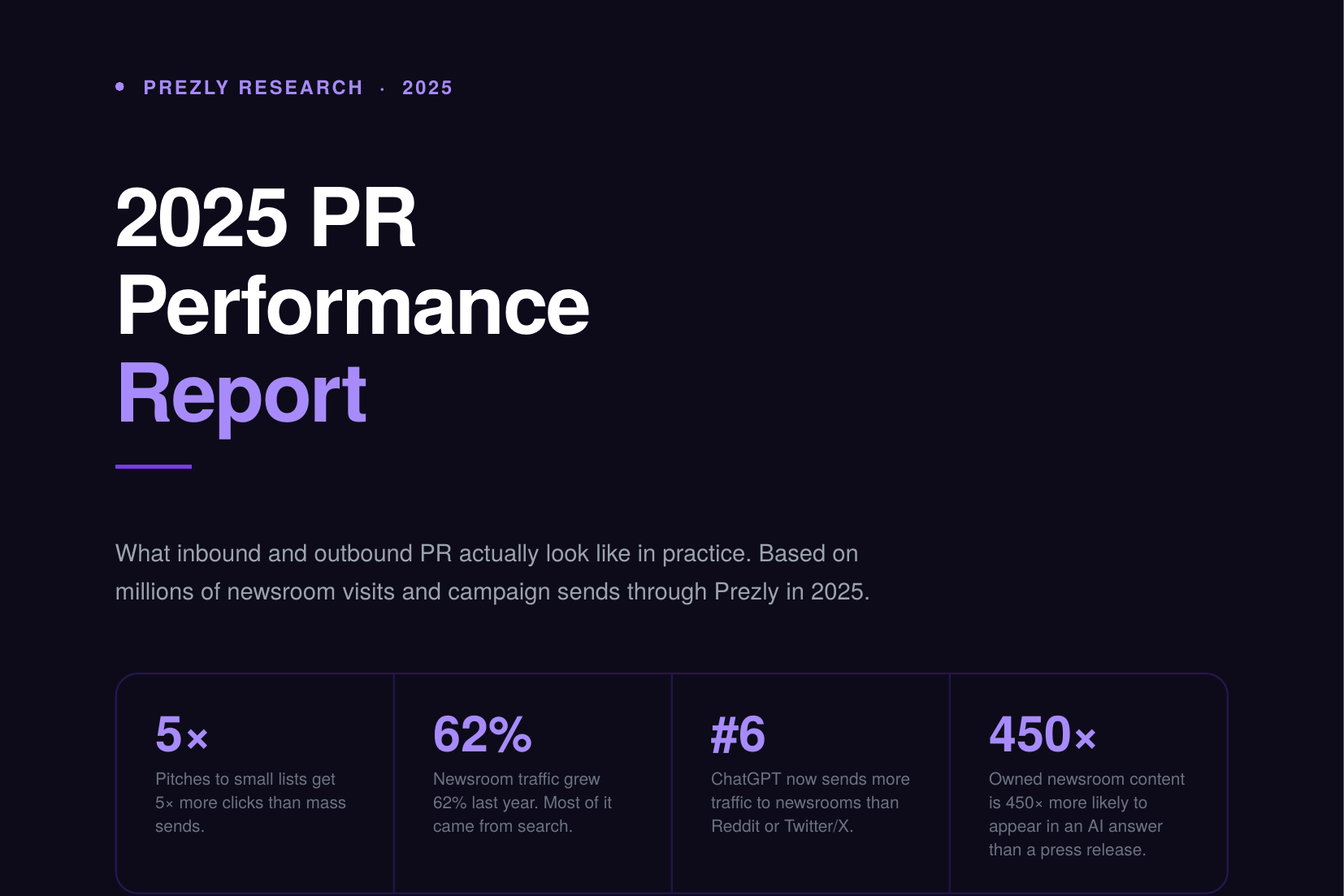
The report argues that effective PR performance depends on combining inbound discovery with outbound outreach, using platform data from Prezly newsrooms and campaign sends in 2025 plus a cited secondary analysis on AI citations.
It is best described as a mixed-methods data report based mainly on large-scale proprietary behavioural data, but the exact number of campaigns, organisations, users, or countries covered is not clearly specified in the report.
Its evidence appears to be drawn from Prezly platform activity, with some broader industry context added from external analysis; the geographic scope is not clearly specified in the report.
Length: 10 pages
More information / download:
https://www.prezly.com/insights
Core Insights
1. What is the report’s central argument about how PR performance should be understood?
The core argument is that PR performance cannot be judged mainly through campaign metrics such as opens and clicks. Prezly argues that PR teams need to see inbound and outbound activity as connected parts of one system: a newsroom that attracts discovery through search and AI, and targeted outreach that drives engagement with the right recipients. The report repeatedly frames this as a shift away from narrow campaign reporting towards a broader understanding of how audiences actually find and use PR content.
This matters because the report claims that much of PR’s real impact happens outside traditional email performance dashboards. Search visits, AI citations, and delayed direct visits may all reflect communications value, yet they are often omitted from standard reporting. Prezly’s perspective section makes this explicit by saying that teams measuring only opens and clicks are “measuring the smallest part” of the work.
2. What does the report show about inbound PR and how people discover newsroom content?
The clearest finding is that search is the dominant driver of newsroom traffic. The report says newsroom traffic grew 62% year on year, with 65% of traffic coming from search, 29% from direct traffic, 5% from social media referrals, and 1% from AI referrals such as ChatGPT, Claude, and Perplexity. It also notes that direct traffic includes pitch-email clicks because many email clients do not pass referrer data.
The implication is that newsroom content increasingly serves discovery audiences beyond journalists receiving a pitch. On page 2, the report states that for every tracked click from ChatGPT, roughly 50 more people may have seen the content within an AI response, suggesting that visible referral traffic understates AI exposure. The chart on page 2 reinforces this broader discovery logic by showing Google far ahead of other referral sources.
The report also argues that owned newsroom content is much more likely than syndicated PR material to appear in AI-generated answers. Citing a BuzzStream analysis via Search Engine Journal, it says 98.6% of relevant AI-cited PR content came from owned newsroom content, compared with 1.2% from wire services and 0.2% from syndicated PR. That is the basis for the report’s “450× more likely” claim. This is important because it supports Prezly’s case that publishing location now affects not only search visibility but also AI discoverability.
A further practical point is device use. The report says 54.7% of newsroom visits are on mobile, versus 44.8% on desktop and 1.5% on tablet. So even if teams produce good content, the user experience may still fail if newsrooms are designed mainly for desktop behaviour.
3. What does the report find about outbound outreach and what makes pitches perform better?
The strongest pattern is that smaller media lists perform much better than large sends. On page 4, the report says pitches sent to lists of 1 contact achieve a 19.3% click-through rate, lists of 2–10 achieve 16.8%, lists of 51–200 achieve 5.8%, and lists of 200+ achieve 3.6%. The chart on that page shows a steady decline in CTR as list size increases. This underpins the report’s repeated argument that relevance beats volume.
Personalisation helps, but only within a sound targeting strategy. The report states that personalisation lifts CTR by 15%, with the strongest gains in lists of 2–25 recipients. Its interpretation is that personalisation amplifies a good list rather than rescuing a poor one. The chart on page 5 visually supports that point by showing the personalised version outperforming the non-personalised version most clearly in smaller list ranges.
Pitch length also matters. Prezly argues against the common assumption that shorter is always better, saying the 201–300 word range nearly doubles CTR compared with shorter pitches. The chart on page 6 shows the 201–300 word band as the strongest performer at 6.25% CTR, clearly above other length ranges.
By contrast, subject line length seems less decisive. The report says open rate “barely moves” with subject line length, while CTR peaks at 20–40 characters and very short subject lines underperform. So the report suggests that teams may spend too much time optimising superficial elements and not enough on list quality, relevance, and body copy.
4. What assumptions and perspective shape the report?
The report is clearly written from a platform-company perspective, and that matters to how its argument is framed. Prezly’s viewpoint is that PR teams undervalue the newsroom as a performance asset and over-focus on campaign-level metrics. The document consistently argues for seeing newsrooms, search visibility, AI discovery, and targeted pitching as an integrated workflow. That framing aligns closely with Prezly’s product positioning.
Its underlying assumptions are that discoverability now matters as much as distribution, that owned content is strategically more important than wire-based distribution, and that behavioural data offers a better view of performance than legacy PR metrics alone. Those assumptions are plausible within the report’s evidence base, but they are still shaped by the lens of a vendor analysing its own ecosystem.
Methodologically, the report is also selective. It relies heavily on aggregated platform data, but it does not clearly specify sample size, client mix, timeframe boundaries beyond “last year” or “2025”, sector spread, or geography. That does not invalidate the findings, but it does mean the report is more directional than fully transparent academic-style research.
5. What are the main implications for PR teams and communications leaders?
The biggest implication is measurement. If teams continue to report mainly on opens and clicks, they may systematically understate communications impact. The report suggests that leaders should expand dashboards to include newsroom traffic, search visibility, AI discoverability, and post-campaign engagement beyond the original send.
The second implication is strategic. PR teams may need to treat their newsroom as a discoverability engine rather than simply a repository for press releases. Because search is the top traffic source and owned content dominates AI citation patterns, publishing discipline, structure, and content freshness become more important. The report effectively reframes the newsroom as infrastructure for earned, search, and AI exposure.
Third, the report points towards a more selective outreach model. Smaller, more targeted lists, better personalisation, and stronger pitch construction outperform scale-based blasting. For PR leaders, that implies a capability shift away from volume and towards segmentation, judgement, and relevance.
Finally, there is a practical user-experience implication: mobile cannot be treated as secondary. With more than half of newsroom visits coming from phones, weak mobile experiences risk undermining otherwise strong content.
Taken together, the report’s conclusion is that the best PR teams will be those that connect content publishing, discoverability, outreach, and measurement into one coherent operating model rather than treating them as separate tasks.