Tag: Public Relations

  • What is A.I. reading – May 2026 Edition by Muck Rack

    What is A.I. reading – May 2026 Edition by Muck Rack

    About the paper

    What is AI Reading? by Muck Rack’s Generative Pulse examines which sources generative AI systems cite when answering realistic consumer prompts.

    The report is a modelling/data-pack style citation analysis based on a large prompt set submitted to ChatGPT, Claude and Gemini, with more than 25 million cited links analysed across multiple industries; the geographic scope is not clearly specified in the report.

    Length: 43 pages

    More information / download:
    https://generativepulse.ai/report/

    Core Insights

    1. What is the central finding of the report about the sources AI systems cite?

    The report’s central argument is that generative AI citations are overwhelmingly shaped by non-paid, earned, third-party sources rather than paid media or advertising. About 99% of links cited by AI come from non-paid media, while paid and advertorial content accounts for only 0.3% of all citations. Press releases account for 1.1%.

    Within that non-paid universe, journalism remains a major foundation of AI visibility. The report finds that about 27% of all links cited by AI are journalistic. This is framed as a consistent pattern across Muck Rack’s previous studies, where journalism has generally accounted for 20–30% of AI citations.

    However, journalism is not the only important source category. The report’s pie charts on pages 5–7 show a broader mix: corporate blogs and content at 24%, aggregators and encyclopedic sources at 17.4%, owned media at 13.7%, government/NGO sources at 8.6%, academic/research sources at 4%, social/UGC at 2.9%, tech platforms at 0.9%, press releases at 1.1%, and paid/advertorial at 0.3%.

    The implication is clear: visibility in AI-generated answers is not mainly bought through advertising. It is earned through the kinds of sources AI systems treat as credible, relevant or useful: journalism, reference sources, third-party content, government data, academic material, user-generated platforms and some owned content.

    2. How do ChatGPT, Claude and Gemini differ in their citation behaviour?

    The report argues that each AI provider has a distinct citation ecosystem. ChatGPT, Claude and Gemini do not simply cite the same sources at different volumes; they appear to rely on meaningfully different source environments.

    ChatGPT is described as a “near-universal citer”. It includes citations in 96% of responses, but averages only about five sources per response. Claude is more selective: only 55% of its responses include citations, but when it does cite, it averages 13 sources per response. Gemini sits between the two, citing in 82% of responses and averaging eight sources per response.

    The differences become even sharper when looking at the actual domains. ChatGPT’s top cited domain is Wikipedia, followed by Axios, YouTube, Kiplinger and Forbes. Claude’s top domain is PubMed Central, followed by Wikipedia, Quora, ScienceDirect and NerdWallet. Gemini’s top cited domain is Reddit, followed by YouTube, Quora, Wikipedia and NIH.

    The report’s interpretation is that these are “three effectively separate information environments”. For PR and communications teams, this matters because AI visibility cannot be reduced to a single generic “AI search” strategy. A brand, journalist, outlet or source may matter a great deal in one model and be nearly invisible in another.

    3. What determines whether journalism, press releases or other content gets cited?

    The report finds that the type of question asked strongly shapes the type of source cited. Industry trend queries are especially likely to draw on journalism: 46% of industry trend responses cite journalistic sources, more than twice the rate for how-to and comparative queries.

    By contrast, how-to queries are less journalism-driven. The report says AI tends to rely more on reference content and brand-owned material when users ask how to do something. Comparative evaluation and best-of queries also behave differently, often pulling in review content, platforms, maps, rankings or consumer advice sources depending on the category.

    Press releases are most likely to appear in industry trend responses, but even there they remain a relatively small part of the citation mix. Around 1.16% of industry trend citations are press releases, compared with 0.33% for best-of queries, 0.27% for risk/due diligence, 0.25% for problem/discovery, 0.13% for comparative evaluation and 0.09% for how-to.

    Recency also matters, especially for journalism. Among journalism citations with known publish dates, 57% were published within the previous 12 months. The report notes a sharp peak in the first month after publication, followed by a decline through month six and then a long tail. Older articles still matter, but the bias toward recent coverage is clear.

    4. Which sources, platforms and outlets stand out most in the report?

    Several sources stand out because they behave differently from the broader pattern.

    Wikipedia is especially important for ChatGPT and Claude. It appears among the top three cited domains in 12 of 17 industries for ChatGPT and 8 of 17 industries for Claude. For Gemini, it appears in the top three in only 3 of 17 industries, because Gemini is more strongly shaped by Reddit, brand domains and Q&A platforms such as Quora.

    Reddit is particularly important for Gemini. The report says Reddit is Gemini’s single most-cited domain, accounting for about 2.4% of all Gemini citations. By contrast, ChatGPT cited Reddit only 16 times and Claude cited it zero times in the study.

    YouTube also differs by provider. It accounts for about 2.1% of Gemini citations and about 2.0% of ChatGPT citations, while Claude returned zero YouTube citations across the study. Claude does cite other video platforms such as TikTok and Vimeo, but not at the same level.

    Among journalism outlets, the standout is Axios. The report says journalism citations are spread across more than 20,000 distinct outlets, with no single publication generally dominating. Axios is the exception: it appears in ChatGPT’s top three cited domains across 13 of 17 industries. The Associated Press appears in the top three for one industry, while The New York Times and Reuters do not appear in the top three most cited sources for any industry in the report.

    5. What are the main implications for PR and communications teams?

    The report’s main implication is that AI visibility is increasingly connected to earned authority across multiple information environments. Traditional media relations still matters, but not in a simple “get mentioned in top-tier media” way.

    First, journalism remains important because it accounts for about 27% of all AI citations and is especially influential for industry trend queries. For brands that want to shape how AI explains what is happening in a sector, credible media coverage appears to be particularly valuable.

    Second, the report suggests that citation strategy must be model-specific. A communications team optimising for ChatGPT would pay close attention to Wikipedia, Axios, YouTube and sector-specific sources. A team concerned with Gemini would need to understand Reddit, YouTube, Quora and other user-generated or community-driven environments. For Claude, academic, research, personal finance and reference-style sources appear more prominent.

    Third, owned media still matters, but it is not enough on its own. Owned media accounts for 13.7% of citations, while corporate blogs and content account for 24%. The distinction in the report is important: third-party corporate/blog content is categorised as earned when it is not owned by the company or product targeted in the query, while first-party corporate/blog content is owned media. This suggests that corporate content can influence AI, but third-party validation remains highly significant.

    Fourth, communications teams need to think beyond classic media lists. Depending on the sector and query type, AI may cite Google Maps, TripAdvisor, Reddit, Quora, YouTube, PubMed Central, NIH, government websites, academic databases, review sites, ranking platforms or trade publications. The relevant source ecosystem changes by industry.

    Finally, the report implies that AI visibility is dynamic. The methodology section explicitly notes that generative AI systems are rapidly evolving and opaque, and that observed behaviours may shift as models are updated or retrained. So the findings should be treated as a snapshot of AI citation behaviour in May 2026, not as a permanent rulebook.

  • 2025 PR Performance Report by Prezly

    2025 PR Performance Report by Prezly

    About the paper

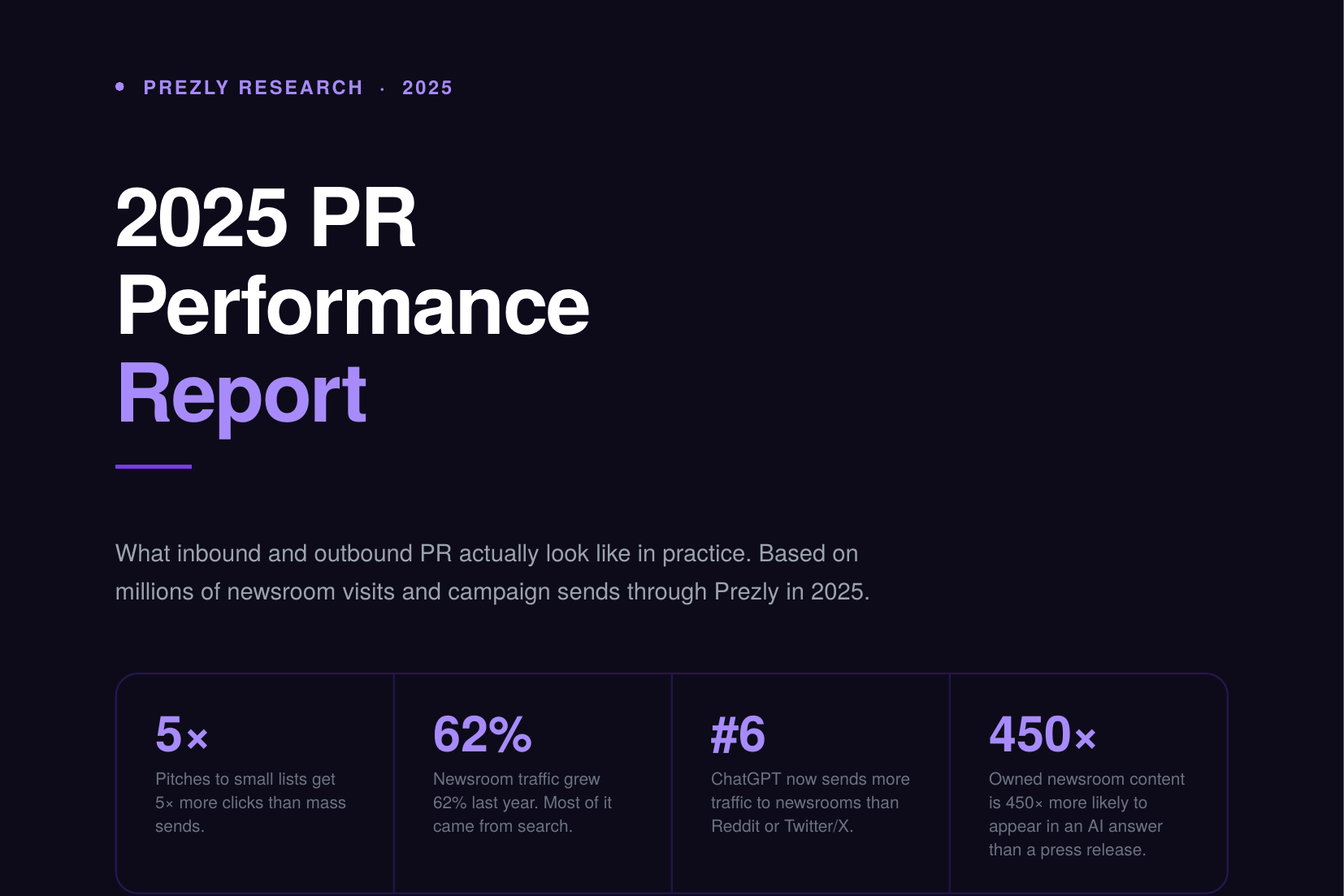
    The report argues that effective PR performance depends on combining inbound discovery with outbound outreach, using platform data from Prezly newsrooms and campaign sends in 2025 plus a cited secondary analysis on AI citations.

    It is best described as a mixed-methods data report based mainly on large-scale proprietary behavioural data, but the exact number of campaigns, organisations, users, or countries covered is not clearly specified in the report.

    Its evidence appears to be drawn from Prezly platform activity, with some broader industry context added from external analysis; the geographic scope is not clearly specified in the report.

    Length: 10 pages

    More information / download:
    https://www.prezly.com/insights

    Core Insights

    1. What is the report’s central argument about how PR performance should be understood?

    The core argument is that PR performance cannot be judged mainly through campaign metrics such as opens and clicks. Prezly argues that PR teams need to see inbound and outbound activity as connected parts of one system: a newsroom that attracts discovery through search and AI, and targeted outreach that drives engagement with the right recipients. The report repeatedly frames this as a shift away from narrow campaign reporting towards a broader understanding of how audiences actually find and use PR content.

    This matters because the report claims that much of PR’s real impact happens outside traditional email performance dashboards. Search visits, AI citations, and delayed direct visits may all reflect communications value, yet they are often omitted from standard reporting. Prezly’s perspective section makes this explicit by saying that teams measuring only opens and clicks are “measuring the smallest part” of the work.

    2. What does the report show about inbound PR and how people discover newsroom content?

    The clearest finding is that search is the dominant driver of newsroom traffic. The report says newsroom traffic grew 62% year on year, with 65% of traffic coming from search, 29% from direct traffic, 5% from social media referrals, and 1% from AI referrals such as ChatGPT, Claude, and Perplexity. It also notes that direct traffic includes pitch-email clicks because many email clients do not pass referrer data.

    The implication is that newsroom content increasingly serves discovery audiences beyond journalists receiving a pitch. On page 2, the report states that for every tracked click from ChatGPT, roughly 50 more people may have seen the content within an AI response, suggesting that visible referral traffic understates AI exposure. The chart on page 2 reinforces this broader discovery logic by showing Google far ahead of other referral sources.

    The report also argues that owned newsroom content is much more likely than syndicated PR material to appear in AI-generated answers. Citing a BuzzStream analysis via Search Engine Journal, it says 98.6% of relevant AI-cited PR content came from owned newsroom content, compared with 1.2% from wire services and 0.2% from syndicated PR. That is the basis for the report’s “450× more likely” claim. This is important because it supports Prezly’s case that publishing location now affects not only search visibility but also AI discoverability.

    A further practical point is device use. The report says 54.7% of newsroom visits are on mobile, versus 44.8% on desktop and 1.5% on tablet. So even if teams produce good content, the user experience may still fail if newsrooms are designed mainly for desktop behaviour.

    3. What does the report find about outbound outreach and what makes pitches perform better?

    The strongest pattern is that smaller media lists perform much better than large sends. On page 4, the report says pitches sent to lists of 1 contact achieve a 19.3% click-through rate, lists of 2–10 achieve 16.8%, lists of 51–200 achieve 5.8%, and lists of 200+ achieve 3.6%. The chart on that page shows a steady decline in CTR as list size increases. This underpins the report’s repeated argument that relevance beats volume.

    Personalisation helps, but only within a sound targeting strategy. The report states that personalisation lifts CTR by 15%, with the strongest gains in lists of 2–25 recipients. Its interpretation is that personalisation amplifies a good list rather than rescuing a poor one. The chart on page 5 visually supports that point by showing the personalised version outperforming the non-personalised version most clearly in smaller list ranges.

    Pitch length also matters. Prezly argues against the common assumption that shorter is always better, saying the 201–300 word range nearly doubles CTR compared with shorter pitches. The chart on page 6 shows the 201–300 word band as the strongest performer at 6.25% CTR, clearly above other length ranges.

    By contrast, subject line length seems less decisive. The report says open rate “barely moves” with subject line length, while CTR peaks at 20–40 characters and very short subject lines underperform. So the report suggests that teams may spend too much time optimising superficial elements and not enough on list quality, relevance, and body copy.

    4. What assumptions and perspective shape the report?

    The report is clearly written from a platform-company perspective, and that matters to how its argument is framed. Prezly’s viewpoint is that PR teams undervalue the newsroom as a performance asset and over-focus on campaign-level metrics. The document consistently argues for seeing newsrooms, search visibility, AI discovery, and targeted pitching as an integrated workflow. That framing aligns closely with Prezly’s product positioning.

    Its underlying assumptions are that discoverability now matters as much as distribution, that owned content is strategically more important than wire-based distribution, and that behavioural data offers a better view of performance than legacy PR metrics alone. Those assumptions are plausible within the report’s evidence base, but they are still shaped by the lens of a vendor analysing its own ecosystem.

    Methodologically, the report is also selective. It relies heavily on aggregated platform data, but it does not clearly specify sample size, client mix, timeframe boundaries beyond “last year” or “2025”, sector spread, or geography. That does not invalidate the findings, but it does mean the report is more directional than fully transparent academic-style research.

    5. What are the main implications for PR teams and communications leaders?

    The biggest implication is measurement. If teams continue to report mainly on opens and clicks, they may systematically understate communications impact. The report suggests that leaders should expand dashboards to include newsroom traffic, search visibility, AI discoverability, and post-campaign engagement beyond the original send.

    The second implication is strategic. PR teams may need to treat their newsroom as a discoverability engine rather than simply a repository for press releases. Because search is the top traffic source and owned content dominates AI citation patterns, publishing discipline, structure, and content freshness become more important. The report effectively reframes the newsroom as infrastructure for earned, search, and AI exposure.

    Third, the report points towards a more selective outreach model. Smaller, more targeted lists, better personalisation, and stronger pitch construction outperform scale-based blasting. For PR leaders, that implies a capability shift away from volume and towards segmentation, judgement, and relevance.

    Finally, there is a practical user-experience implication: mobile cannot be treated as secondary. With more than half of newsroom visits coming from phones, weak mobile experiences risk undermining otherwise strong content.

    Taken together, the report’s conclusion is that the best PR teams will be those that connect content publishing, discoverability, outreach, and measurement into one coherent operating model rather than treating them as separate tasks.

  • Leading at the Intersections 2026 by Weber Shandwick

    Leading at the Intersections 2026 by Weber Shandwick

    About the paper

    Weber Shandwick’s Leading at the Intersections 2026 is a short corporate affairs trends report about the strategic shifts reshaping modern corporate affairs, especially in the U.S. and for U.S. multinationals.

    It is primarily an expert commentary / advisory perspective, with one referenced survey of Fortune 1000 communications and corporate affairs executives conducted by Weber Advisory and Gravity Research; the sample size, fieldwork method and timeframe are not clearly specified in the report.

    The geographic focus is mainly the United States, with some attention to global stakeholder expectations around U.S. companies abroad.

    Length: 13 pages

    More information / download:
    https://webershandwick.com/news/the-five-shifts-redefining-the-c-suite-agenda-in-2026

    Core Insights

    1. What is the central argument of the report?

    The report argues that corporate affairs leaders are now operating “at the intersections” of several forms of disruption:

    • geoeconomic instability
    • polarised U.S. politics
    • reputational volatility
    • AI-driven transformation
    • workforce anxiety
    • cultural fragmentation
    • and changing expectations around responsible business.

    Its core message is that corporate affairs can no longer be treated as a reactive communications function. The authors frame it as a strategic leadership capability that must help organisations make sense of complexity, protect licence to operate, create stakeholder value and support business resilience.

    The report’s strongest underlying assumption is that the operating environment has become too volatile for narrow, bottom-line-only communication. Companies need to understand how business value, stakeholder expectations, culture, politics, technology and social impact now interact. In that sense, the report positions modern corporate affairs as a form of integrated strategic intelligence.

    2. How does the report suggest companies should think about value in a time of disruption?

    The report warns that in uncertain times, leaders may be tempted to focus narrowly on economic value and the bottom line. Weber Shandwick argues the opposite: disruption is precisely when companies need to broaden their understanding of value.

    It identifies several value dimensions beyond financial performance:

    • functional value
    • emotional value
    • and societal value.

    The point is not that profit becomes irrelevant, but that companies’ licence to operate depends on more than profit. Trust, relevance, purpose, stakeholder relationships and perceived contribution to society all become part of the value equation.

    The report links this especially to the 2026 U.S. midterm environment. Affordability, cost of living, inequality, trade, healthcare, housing, immigration and AI regulation are all described as issues shaping public expectations. In this environment, companies face reputational risk if they are seen as detached from ordinary stakeholder concerns.

    One particularly useful insight is that “corporate speak” is no longer neutral. The report frames over-polished, generic language as a credibility risk. Companies are advised to communicate with more emotion, empathy and candour — not as a stylistic preference, but as a trust-building necessity.

    3. What new expectations does the report identify for corporate diplomacy?

    The report argues that U.S. multinationals will be pushed into more explicit forms of corporate diplomacy in 2026. The key issue is that foreign stakeholders may increasingly expect U.S. companies to show that they are not simply proxies for U.S. foreign policy.

    This is an important distinction. The report suggests that U.S. brands have, so far, retained some independence from declining perceptions of U.S. political leadership. But that separation may become harder to maintain if U.S. government actions become more confrontational or less aligned with international norms.

    Three expectations stand out. First, companies must demonstrate local accountability: where decisions are made, how local interests are protected and which commitments endure despite political shifts in Washington. Second, they need deeper local relationships across government, business and civil society, because these relationships become a form of reputational defence. Third, executives may need to speak more visibly and carefully abroad, because silence can increasingly be interpreted as alignment.

    The report also connects this to B2G strategy in an “America First” context. For tech companies in particular, it recommends local storytelling around outcomes governments already care about: workforce upskilling, manufacturing, energy resilience, defence readiness and public-sector efficiency.

    4. Why does the report treat cultural intelligence as a leadership capability?

    The report presents cultural intelligence as a core leadership currency because companies are increasingly pressured to respond to cultural flashpoints in real time. Digital discourse, ideological polarisation, influencer dynamics, bots and platform algorithms all make it harder for organisations to remain silent or generic without others filling in the blanks.

    The report’s argument is not that companies should comment on everything. Rather, leaders need to know their organisation’s “true north” and make sharper decisions about when to engage, how to engage and when not to engage. Cultural intelligence is therefore both an external sensing capability and an internal decision-making discipline.

    The report highlights three ways to build cultural adaptation fluency. Companies should internalise organisational values so they function as an operating system rather than decorative statements. They should dig deeper into the “why” behind cultural signals, not just track what is trending. And they should make scenario planning a routine practice, using AI and other tools to anticipate how cultural communities and influencers may react.

    A useful nuance here is the distinction between audiences and algorithms. The report notes that meaning still comes from human belief, but reach is shaped by platforms. Leaders therefore need to design communication for both human interpretation and algorithmic circulation.

    5. What implications does the report draw for responsible business and AI transformation?

    The report argues that responsible business is not disappearing, even if the language around ESG, sustainability or social impact changes for political and practical reasons. The fundamentals remain important because companies still need to balance material business pressures, stakeholder tensions and reputational risk.

    Three responsible business challenges are highlighted.

    1. First, companies must define the future of human work as AI integration accelerates. Stakeholders will expect human-first integration plans, workforce readiness and credible opportunities for future talent.
    2. Second, the report argues that climate action is becoming more fragmented because coordinated multilateral action is weakening, while “China First” green tech and “America First” energy politics reshape the context.
    3. Third, companies must separate values from “vibes”: in a fragmented information environment, responsibility strategies must be anchored in the business model rather than broad, consensus-seeking purpose claims.

    On AI, the report’s position is pragmatic rather than utopian. AI transformation is treated as unavoidable, but the authors warn against simplistic winner/loser narratives. Companies need a transformation narrative that proves the business case while addressing the human side of change.

    The report identifies three AI-related communication challenges:

    • real-time stakeholder insight
    • machine readability intelligence
    • and human-centred generative creativity.

    The most distinctive point is “machine readability”: companies now need to understand how they appear in AI search and AI-generated summaries, which sources shape those outputs, and how to correct misinformation or poor representations.

    The final message is: be AI-enabled, not AI-enthralled. For B2B marketing in particular, AI should not replace the entire martech stack or become a reason to defund other vital technologies. The stronger argument is for deliberate integration: clear use cases, regulatory awareness, privacy safeguards and attention to workforce impact.

  • 2026 Edelman Trust Barometer by Edelman

    2026 Edelman Trust Barometer by Edelman

    About the paper

    The 2026 Edelman Trust Barometer is based on Edelman’s 26th annual online survey, fielded from 25 October to 16 November 2025 across 28 countries, with 33,938 respondents and roughly 1,200–1,501 respondents per country; the report states the data are representative of the general population by age, gender and region within each market.

    The report also uses partial-sample questions for some topics, including future outlook, media exposure, trust brokering and foreign-company trust, so some findings rest on smaller subsamples with larger margins of error.

    Methodology is generally clear, though several analyses rely on derived scales or partial samples explained in the technical appendix.

    Length: 77 pages

    More information / download:
    https://www.edelman.com/trust/2026/trust-barometer

    Core Insights

    1. What is the report’s central argument about the state of trust in 2026?

    The core argument is that trust has not simply weakened in a uniform way; it has become more inward-looking. Edelman frames this as a progression from polarization to grievance and then to insularity, which it defines as a reluctance to trust anyone who is different from you. The report’s main claim is that economic displacement, cost-of-living pressures, misinformation, discrimination, geopolitical tension and the pandemic have pushed many people towards safety, familiarity and sameness rather than openness.

    That argument is supported by one of the report’s most important headline findings: globally, 7 in 10 respondents are classified as having an “insular trust mindset”, meaning they are either hesitant or unwilling to trust someone who differs from them in values, facts, problem-solving approaches, or culture/background. The segmentation is not casual wording; it is built from a specific measurement model in the appendix, where respondents are grouped as unwilling, hesitant or open based on their average willingness to trust people unlike themselves.

    The report therefore presents 2026 not as a simple trust crisis, but as a trust reorientation. Trust is moving away from broad, shared institutions and towards one’s own immediate circle, local ties and familiar actors. That is why the title, Trust Amid Insularity, matters: trust still exists, but it is increasingly conditional, local and bounded.

    2. What evidence does the report provide that people are turning inward rather than outward?

    The strongest evidence is the combination of pessimism, fear and narrowing openness. Globally, only 32% say the next generation in their country will be better off than today, down 4 points year on year. That is a strikingly low level of forward optimism for a study centred on public trust, because it suggests that many respondents do not see broad-based future progress as plausible.

    The report also shows elevated economic anxiety. Among employees, worry about losing one’s job because of a looming recession and concern about international trade and tariff conflicts hurting one’s employer have both reached all-time highs in the global trend data presented. Alongside that, fear that foreign countries are deliberately contaminating domestic media with falsehoods has risen sharply and reached an all-time high in many countries.

    A further sign of retreat is informational narrowing. Only 39% say they get information at least weekly from sources with a different political leaning than their own, a 6-point drop from 2025, with statistically significant declines in 20 of 28 countries. This matters because the report links insularity not just to emotion, but to reduced exposure to difference itself.

    Finally, the report shows that recent societal events have increased trust in people close at hand while reducing trust in shared institutions. Among those who say major events affected their trust, respondents report net gains in trust for neighbours, family and friends, coworkers and CEOs, but net losses for national government leaders, major news organisations and foreign business leaders. In other words, “we” gives way to “me” and “my circle”.

    3. How uneven is trust across countries, classes and institutions?

    The report makes clear that trust is highly uneven geographically. The global Trust Index rises slightly from 56 to 57, but this masks a sharp divide between developing and developed countries: developing countries average 66, while developed countries average 49. China, the UAE, India, Indonesia and Saudi Arabia sit near the top of the ranking, while Japan, France, the UK and Germany are much lower. So the story is not one of universal decline, but of divergence.

    There is also a pronounced income divide. On the long trend shown in the report, the gap in the Trust Index between high-income and low-income groups has widened from 6 points in 2012 to 15 points in 2026 in the 21-market tracking average. In the current 28-market snapshot, high-income respondents score 65 on trust versus 50 for low-income respondents. The report explicitly describes these as “different trust realities”.

    At the institutional level, employers and business remain the most trusted institutions globally. The report shows trust at 78% for “my employer” among employees and 64% for business overall, compared with 58% for NGOs, 54% for media and 53% for government. That hierarchy matters because it underpins Edelman’s later argument that employers and business are best placed to act as trust brokers.

    The report also argues that insularity and grievance are closely linked. Among people with an insular mindset, a moderate or high sense of grievance is substantially more common than among those with an open mindset. That gives the report a broader sociological claim: distrust is not just about institutions failing in abstraction, but about groups feeling excluded, harmed or left behind.

    4. What does the report say are the consequences of insularity for society, work and business?

    One of the report’s most important claims is that insularity is not just an attitudinal problem; it has concrete economic and organisational costs. On page 18, sizeable minorities say they would rather switch departments than report to a manager with different values, would put less effort into helping a project leader with different political beliefs succeed, or would support reducing foreign companies in their country even if it led to higher prices. This is Edelman’s case that insularity can damage productivity, increase workplace conflict and reinforce economic nationalism.

    The report also shows that people with insular mindsets trust their own circle but distrust institutions led by people unlike them. Among this group, neighbours and CEOs inside their own frame score relatively well, while journalists and government leaders score much lower. Separate analysis shows large trust gaps between open-minded and insular respondents when institutions are imagined as being led by people who differ from them in values, facts, approaches or background.

    For multinational business, the consequence is geopolitical insularity. Respondents in several countries trust companies headquartered in their own country markedly more than foreign-headquartered firms. The report’s implication is that global scale alone no longer guarantees legitimacy; local embeddedness matters more. That is why it argues multinationals may need a more “polynational” model rooted in long-term local relationships.

    The broader consequence is that difference itself becomes a barrier to cooperation. The report warns that if perfect alignment becomes a prerequisite for trust, progress stalls: innovation becomes harder, leadership weakens and social divides deepen. In that sense, the report is not only describing a mood, but warning of a drag on collective problem-solving.

    5. What solution does the report propose, and who does it believe should lead it?

    Edelman’s answer is “trust brokering”. The report defines this as a set of practices and behaviours that counter insularity by facilitating trust across difference. Crucially, it says trust brokering is not about changing people’s identities or forcing consensus. Instead, it is about surfacing common interests, listening without judgement and translating the needs and realities of one group to another.

    The report finds that this approach resonates more than simple side-taking. When asked what would most increase trust in a business responding to a highly divisive social issue, the top answer is encouraging people to cooperate on solutions without taking a side, ahead of supporting a position consistent with the company’s values or supporting the respondent’s own position. That is a revealing finding: respondents appear to prefer a convening role over performative alignment.

    It also argues that long-term local relationships matter more than one-off gestures. If a foreign company from a distrusted country wanted to operate in a local community, respondents were most likely to say it could earn trust by investing in long-term community projects and hiring local people, rather than merely helping during crises or donating to social organisations. The report’s logic is that trust is built through durable presence, not episodic signalling.

    As for who should lead, the report gives the strongest practical role to employers. It says all major institutions are seen as having an obligation to bridge divides, but employers have the smallest gap between perceived obligation and current performance. It also finds high support for employer actions such as promoting a shared identity, building teams that require people with different values to work together, and providing training for constructive dialogue. That is why the report’s concluding argument is so employer-centric: business, and especially employers, are portrayed as the institutions best positioned to scale trust brokering in practice.

  • State of AI in PR 2026 by Muck Rack

    State of AI in PR 2026 by Muck Rack

    About the paper

    The report is an original research survey about how PR professionals are using, governing and judging generative AI and emerging AI agents in their work.

    It is based on a survey of 564 PR professionals fielded from 5 December to 24 December 2025 and distributed primarily via email; responses were reviewed for low-effort patterns and outliers.

    The geographic scope is not clearly specified in the report, and the methodology is useful but relatively thin on sampling detail beyond distribution method and data cleaning.

    Length: 28 pages

    More information / download:
    https://muckrack.com/resources/research/state-of-ai-in-pr

    Core Insights

    1. What is the report’s central argument about the current state of AI in PR?

      The core argument is that generative AI has moved from novelty to normal practice in PR, but that adoption has now largely plateaued. The report says AI use has “peaked” at around three-quarters of PR professionals, with 76% already using generative AI in their workflow and only modest shares still undecided or resistant. In other words, the market now appears split between a large majority who have already incorporated AI and a smaller minority who are unlikely to change their minds soon.

      The report also argues that this is no longer just an individual experimentation story. Organisations are adapting to AI institutionally: 51% of respondents say their company has an AI use-case policy, and 43% say their workplace offers AI training. That suggests AI in PR is becoming formalised, governed and embedded in workplace practice rather than remaining a purely ad hoc tool used by curious individuals.

      At the same time, the report draws a clear line between generative AI and agentic AI. While text-generation and workflow support are mainstream, AI agents have not yet crossed into broad professional adoption. Only 12% say they use AI agents in their work, and most respondents remain uncomfortable with autonomous action without human review. So the report’s bigger message is not “AI is coming”; it is “AI is here, but autonomy is not yet trusted.”

      2. How are PR professionals actually using AI, and where do they see the most value?

      The report shows that PR professionals are using AI mainly in mainstream knowledge and writing tasks, not in highly specialised or fully automated ways. The most common use case is editing and refinement, cited by 86%, followed by research and insights at 76%, writing and content creation at 74%, and strategy and planning at 68%. Administrative tasks are also significant at 51%, whereas media outreach, measurement and creative asset production remain much less central.

      That distribution matters because it shows where AI currently fits the profession best: it acts primarily as a cognitive and editorial assistant. It helps polish drafts, speed up background work, support ideation and assist with planning. The report says PR pros use AI in an average of four distinct work areas, which reinforces the idea that adoption is broad across tasks even if it is not yet deep in every part of the workflow.

      Perceived value is also very strong. Eighty-two per cent say AI has improved the quality of their work, while 93% say it helps them complete projects more quickly. When asked where the greatest time savings occur, respondents again point to core communication work: editing and refinement, research and insights, and writing and content creation. This suggests AI’s practical value in PR is currently less about replacing judgement and more about compressing routine labour around producing and shaping communication.

      3. What does the report suggest about trust, oversight and the limits of AI in PR practice?

      A key theme running through the report is that PR professionals are using AI extensively, but they do not trust it enough to leave it unsupervised. The clearest sign of this is editing behaviour: 98% say they always or often edit AI-generated text before using it. Although the extent of editing has decreased over time, the human review step remains almost universal. That implies AI is accepted as a draft partner, not as a final author.

      The report also reveals a selective approach to data input. Large majorities say they avoid entering financial data, personally identifiable information and proprietary or strategic material into AI systems. Yet far fewer avoid entering client or brand names and internal communications. This points to a practical but uneven data-risk mindset: many PR professionals recognise serious information-governance risks, but boundaries around what is safe to share with AI are still inconsistent.

      Trust drops even further when the report turns to AI agents. Only 7% say they would be comfortable allowing an AI agent to send messages or publish updates without human review, while about nine in ten are uncomfortable. The main conditions for greater trust are strong evidence of reliability, explicit human approval before publishing or sending, strong privacy and security safeguards, and transparent records of what the agent did. The report therefore implies that the profession is not rejecting automation outright, but it wants clear guardrails, accountability and a human in the loop.

      4. What risks, concerns and professional tensions does the report identify?

      The biggest concern in the report is not that AI will immediately destroy PR jobs, but that it could erode professional formation. Seventy-seven per cent say the main risk is that younger or newer PR professionals will fail to learn the principles of the profession and rely too heavily on tools. That is a profound concern because it goes to capability-building, judgement and the long-term health of the field.

      Other major concerns are also closely tied to quality and professional standards. Sixty-three per cent worry about unscrutinised AI output lowering the quality of communication, while 61% fear content becoming less original or creative and 61% think audiences may be overwhelmed by rising volumes of content. There is also concern that clients or firms may conclude they no longer need content creators. Together, these findings show that respondents fear AI may devalue craft, raise noise levels and weaken the human distinctiveness of communication work.

      Among non-users, the resistance is often principled rather than merely practical. The report notes that the 7% who do not plan to explore generative AI often cite environmental impact, plagiarism and broader ethical concerns. Many of them do not appear persuadable: 80% say they do not see themselves using AI in the future no matter what. That is important because it means non-adoption is not simply a training gap for everyone; for some, it reflects a deeper values-based objection.

      5. What are the report’s main implications for the future of PR work, capability-building and organisational practice?

      The report points towards a future in which the competitive edge in PR will come not from whether someone uses AI, but from how well they use it under proper governance. Since adoption has already stabilised at a high level, the next differentiator is likely to be capability. Respondents say the most important new skills are prompt writing or engineering, ethical decision-making, AI tool evaluation and selection, and data literacy. That suggests the profession is shifting from simple tool familiarity to a broader blend of technical fluency, judgement and governance awareness.

      There is also a strong implication for employers. Training and policy appear to matter. Among those open to AI but not yet using it, 60% say training or proven examples would help them start. At the same time, the growth in workplace policies and training since 2024 suggests companies are beginning to respond to that need. So the report implies that organisational maturity around AI is no longer optional; it is becoming part of professional infrastructure.

      Finally, the report suggests that PR is heading towards a hybrid future rather than a fully automated one. Paid AI use is rising rapidly, and everyday AI-supported work is now common, but agentic AI remains marginal because trust, accountability and reputational risk still demand human control. The underlying conclusion is that PR professionals are prepared to augment their work with AI, but not to surrender authorship, responsibility or final judgement to it. That is probably the report’s most important strategic implication.

    1. The Global Reputation Economy by Burson

      The Global Reputation Economy by Burson

      About the paper

      This Burson report argues that reputation should be treated as a measurable corporate asset class, which it calls “Reputation Capital”.

      It is a mixed-methods, proprietary modelling report combining stakeholder input, brand tracking, media analysis and stock-market modelling; the methodology is more fully described than many agency papers, though some elements remain proprietary.

      The analysis covers 66 publicly traded companies, drawing on tens of thousands of stakeholders, and spans October 2024 to October 2025 across companies headquartered in the United States and other countries.

      Length: 30 pages

      More information / download:
      https://www.bursonglobal.com/p/reputation-economy

      Core Insights

      1. What is the report’s central argument about reputation, and why does Burson believe it matters now?

      The core argument is that reputation is no longer a soft, retrospective PR concept but a quantifiable form of capital that can be measured, managed and used as a strategic business asset. Burson argues that in a hyper-connected environment, where companies are exposed to constant scrutiny from legacy media, social platforms, activists and independent publishers, traditional reputation tools are too slow and too shallow. In that context, companies need something closer to near real-time intelligence rather than annual surveys or periodic brand tracking.

      The report therefore reframes reputation as “Reputation Capital”: an asset that can create competitive advantage, build resilience, support bolder decision-making and fuel sustainable growth. It also claims this asset matters not just to communications teams, but to investors, boards and corporate leaders because it can be linked directly to upside and downside in business performance.

      The deeper point is that reputation affects strategic freedom. Companies with strong reputations can absorb setbacks more easily, take bigger risks and retain stakeholder trust. Companies with weak reputations are more exposed: a single misstep is interpreted not as an exception, but as proof of a broader pattern. In that sense, the report presents reputation as a buffer, an enabler and a financial driver all at once.

      2. How does the report measure reputation, and what kind of evidence does it use?

      Burson presents this as a mixed model connecting three domains: stakeholder belief, media signals and financial outcomes. It says the model draws on tens of thousands of stakeholders, including consumers, business decision-makers and opinion leaders, using a comprehensive question set alongside daily brand tracking. It then combines that with large-scale monitoring of traditional and social media, described as terabytes of daily mentions, to build a media profile for each company. Finally, it links those inputs to stock performance by isolating the “unexpected return” in share price movement that cannot be explained by normal market trends or financial fundamentals alone.

      That is important because the report is not presenting original survey data alone, nor a pure media audit, nor a simple financial analysis. It is explicitly a mixed-methods modelling exercise designed to connect perception to business value. Burson says this is what allows reputation to move from an attitudinal concept to a leading indicator of performance. The model was also externally validated, according to the report, by Dr Felipe Thomaz of Oxford/Saïd Business School.

      At the heart of the model is an eight-lever framework: Products, Innovation, Financial Performance and Creativity on one side, and Leadership, Governance, Workplace and Citizenship on the other. Burson treats these as the building blocks of reputation and claims the framework can show not just how a company is perceived overall, but which levers are driving strength, weakness and business impact.

      3. What does the report claim about the financial value of reputation?

      The headline claim is that reputation produced an average of 4.78% in added, unexpected annual shareholder returns across the companies studied. Burson defines these returns as “unexpected” because they sit beyond what standard financial indicators such as revenue or margins would predict, and “additional” because the model attributes them directly to reputation.

      From that base, the report extrapolates to the wider market and estimates the global “Reputation Economy” at just over $7 trillion. It also says that, within its sample, the value of reputation varied widely by company, ranging from $2 million to as much as $202 billion. These numbers are used to support the broader thesis that reputation is not merely symbolic or narrative-based, but economically consequential.

      The report also argues that the biggest opportunity is not simply to maintain a good reputation, but to move from “Reputation Stagnation” into “Reputation Cultivation”. It groups companies into three categories: cultivation, stagnation and erosion. Roughly 60% of firms fall into stagnation, according to the report, suggesting that many companies are leaving value on the table because they lack a deliberate, data-driven reputation strategy.

      That framing reveals Burson’s perspective clearly: reputation management should be treated as value creation, not just risk mitigation. The report is effectively making the case for boards and leaders to think about reputation in capital-allocation terms.

      4. According to the report, what separates reputation leaders from laggards?

      Burson’s argument is that there is no single silver bullet. The biggest difference between leaders and laggards is not one lever but broad, disciplined strength across all eight. The report says the top quartile scores 11 to 15 points higher on every lever and that the gap between top and bottom performers is 13.8 points on a 100-point scale.

      Even so, three gaps stand out most strongly in the report’s description of a modern reputation leader: visionary innovation, excellence in product delivery and unimpeachable governance. Those are presented as the clearest markers of the firms that convert reputation into strategic advantage.

      What matters here is the report’s underlying assumption that reputation is systemic. Leaders do not just communicate better; they manage the organisation more coherently. Workplace culture supports innovation, governance underpins product quality, and credibility across the system gives leaders resilience. That resilience then changes the CEO’s risk calculus: strong-reputation firms can launch ambitious products, enter complex markets and recover from setbacks more easily because stakeholders grant them the benefit of the doubt. Laggards, by contrast, become defensive, incremental and strategically paralysed.

      So the report’s model of leadership is not glamour-driven. It is operational. It suggests that reputation leadership comes from sustained excellence, cross-functional consistency and the ability to avoid weak links.

      5. What are the report’s most important conclusions for sector strategy, workplace investment and AI?

      One of the most interesting parts of the report is its claim that industries have different “reputational centres of gravity”. Tech, for example, remains highly valuable in Reputation Capital terms and scores strongly on Products and Innovation, but its growth is now almost flat. Burson argues that tech’s future reputation gains will depend less on disruptive launches and more on Governance, Leadership and Citizenship, especially as AI raises broader social concerns.

      Other sectors reveal different lessons. Aerospace is presented as a comeback story built not just on better products, but on fixing foundational levers such as Governance and Workplace. Automotive is described as facing a “Citizenship Challenge”, where EV narratives are not enough if stakeholders see gaps in labour practices, safety, supply-chain ethics or broader societal impact. Finance is shown as especially vulnerable because it is declining across three protective levers at once: Leadership, Governance and Citizenship.

      The report’s strongest practical recommendation, however, is about the Workplace lever. Burson calls this the highest-ROI reputation investment because it is under-valued and under-invested, despite showing a large performance gap between best and worst performers. The argument is that employees are now the most credible carriers of company culture, so internal culture becomes a driver of external trust. In other words, the hidden engine of reputation is not the flashiest campaign, but the quality of the employee experience.

      That leads directly to the AI section. Burson says most companies discuss AI in terms of innovation and efficiency, but the more important reputational question is people. The report argues that a company’s AI strategy is effectively a statement about how it values employees. Firms that use AI for augmentation, reskilling and transparent co-creation with staff may gain a “reputation dividend”. Firms that use it mainly for opaque top-down cost cutting may pay a “reputation tax” through backlash, talent loss and weaker Workplace scores. The key question, in Burson’s words, is no longer whether a company has an AI strategy, but whether it has an “AI people strategy”.

    2. State of PR 2026 by Meltwater

      State of PR 2026 by Meltwater

      About the paper

      The paper is a global survey-based industry report on how PR and communications professionals are navigating resourcing pressure, measurement, AI, media relations, collaboration and future skills.

      The report is original survey research based on more than 1,100 international PR professionals, including almost 500 from the United States, 100 from Canada and respondents from across the world, with Europe described as particularly well represented.

      The fieldwork method, sampling approach and timeframe are not clearly specified in the report.

      Length: 56 pages

      More information / download:
      https://www.meltwater.com/en/blog/state-of-pr

      Core Insights

      1. What is the central picture the report paints of the PR industry in 2026?

      The report presents PR as an industry caught between familiar old pressures and a new wave of technological disruption. On the one hand, many of the profession’s core challenges remain highly recognisable: lack of resources, difficulty measuring impact, managing stakeholders, getting journalists to respond and doing more with less. On the other hand, AI, social media, data and changing audience behaviour are reshaping the environment in which those classic challenges now have to be solved.

      The report’s strongest overarching argument is that PR is becoming more strategically important, but still struggles to prove that importance in business terms. It explicitly links this to generative AI: as LLMs increasingly influence how brands are described and discovered, earned media and public narratives may become even more central to brand visibility. In that sense, the report positions PR not as a shrinking discipline, but as one whose relevance could grow if it can modernise its tools, metrics and internal influence.

      At the same time, the report is clear that the profession has not fully made the shift from activity-based communication to business-aligned communication. Many teams are still judged by volume and reach of media placements, while challenges around ROI, business KPIs and leadership understanding remain persistent. The conclusion frames the core issue as one of alignment: between PR and leadership on strategy and metrics, between PR and marketing on execution, and between human creativity and AI in daily workflows.

      2. What are the main operational challenges facing PR professionals?

      The most frequently cited challenge is insufficient resources, named by 24% of respondents. Measurement follows closely, with 21% identifying measuring impact and ROI as a top challenge. Managing stakeholder expectations comes next at 16%, followed by getting responses from journalists at 12% and adopting new technologies at 10%.

      This distribution matters because it shows that the profession’s biggest pressures are not only external. The difficult media environment is part of the story, but the larger picture is organisational: PR teams are under-resourced, expected to prove impact, and often dependent on leaders who may not fully understand the value or mechanics of communications work.

      The report reinforces this with budget data. A majority expect PR budgets to stay flat, while only 21.3% expect an increase and 17.3% expect a decrease. Budget decisions are also often made outside the PR function: 36.7% say the CEO decides PR spending, while 19.2% say a C-level marketing leader does. Only 32.6% say a C-level PR or communications executive makes these decisions.

      Time pressure is another recurring theme. The biggest time sinks are reactive work such as crisis response and urgent requests, cited by 27.9%, and content creation, cited by 27.5%. Measurement and reporting account for another 20.3%. The report’s implied diagnosis is that PR teams are stuck in a reactive operating model, spending too much time on urgent execution and too little on strategic, higher-value work.

      3. How mature is the industry’s approach to measurement and business impact?

      The report suggests that PR measurement remains stuck between aspiration and reality. Many teams understand that they need to connect communication to business outcomes, but their most common metrics still lean heavily towards activity and visibility.

      The most important metrics for evaluating PR success are the number of media placements and reach/impressions, both at 20.9%. Social media engagement follows at 11%, while more business-relevant or interpretive metrics such as website traffic/conversions, message pull-through, share of voice and sentiment analysis rank lower. This supports one of the report’s central criticisms: the industry is still often measuring what is easiest to measure rather than what best demonstrates business value.

      The measurement section makes this even clearer. When asked about challenges, 34.7% cite aligning metrics to business KPIs, and 27.8% cite proving PR’s value to leadership. Another 22.4% point to over-reliance on outdated metrics such as impressions and AVE. Although nearly three quarters say they have at least some of the tools needed to connect PR activity to wider business outcomes, only 32.1% say they fully have those tools; 39% say they only partially do.

      The report’s perspective is therefore not that measurement is impossible, but that PR measurement is underdeveloped and uneven. It implies that the profession needs more sophisticated reporting, closer linkage to business objectives and better executive-facing narratives about what PR contributes.

      4. How is generative AI affecting PR work, and what concerns does it raise?

      Generative AI is presented as both a practical tool and a major strategic disruptor. A majority of respondents say AI is already integrated into communication workflows: 13.3% describe it as highly integrated and 42.1% as somewhat integrated. Only 9.8% say it is not integrated at all.

      Current use is heavily concentrated around content work. The most common applications are external content creation, content optimisation and review, campaign brainstorming, internal content creation, writing press releases and crafting media pitches. Measurement and reporting are much lower at 2.1%, which suggests that many teams still use AI primarily as a production assistant rather than as a strategic analysis or intelligence tool.

      The report also highlights a gap between adoption and governance. While 36.2% say their organisation has a formal AI policy and 26.4% say one is in development, 31.4% say they do not have one. This makes AI governance one of the more practical risks in the report: usage is becoming normal before policies, training and operating models are fully mature.

      The biggest concern about AI is that it may reduce the need for human talent, cited by 28.6%. Other concerns include shrinking communications budgets and reducing PR’s seat at the table. Interestingly, concerns about accuracy and content quality appear very low in the report’s results, which may suggest either that respondents are less worried about quality than job security, or that the survey options did not fully surface deeper concerns around misinformation, ethics and brand risk.

      Looking ahead, AI dominates the future-facing findings. AI integration is the top skill PR professionals believe they will need over the next five years, and navigating new technologies such as AI is seen as the biggest future challenge. AI as a tool for content creation and data analysis is also identified as the emerging trend likely to have the greatest impact on PR.

      5. What are the most important implications for PR leaders and communication teams?

      The report’s main implication is that PR teams need to become more strategically aligned, more data-literate and more operationally efficient. The conclusion explicitly argues that success in 2026 and beyond will depend on using powerful new tools without losing the human skills that make PR valuable: storytelling, relationship-building and creativity.

      For PR leaders, the most immediate implication is the need to speak more directly in business language. Since resources and budgets are major concerns, and since budget decisions often sit with CEOs or marketing leaders, PR teams need to show clearer links between communication activity and organisational outcomes. The report repeatedly suggests that better reporting and business-aligned metrics are essential not only for measurement, but for influence.

      A second implication is that PR needs stronger collaboration across the organisation. Respondents already collaborate most often with executive leadership and marketing, but they want more involvement from leadership, customer experience, marketing and product development in communications strategy. The main barriers are misaligned priorities, departmental politics or silos, and lack of communication. This points to a broader strategic role for PR, but also to the difficulty of securing that role inside complex organisations.

      A third implication is that AI cannot simply be treated as a content shortcut. The report encourages teams to operationalise AI, formalise policies, invest in tools and training, and use AI to reduce time spent on repetitive or low-value tasks. The opportunity is not just faster content production, but freeing up capacity for more rewarding and strategic work.

      Finally, the report implies that the human fundamentals of PR remain durable. Media relevance, timeliness and reporter relationships are still the most important factors in securing coverage. Individual email remains by far the most effective pitching channel. LinkedIn is the most valuable professional social platform. These findings suggest that while the tools are changing rapidly, the profession’s underlying value still depends on judgement, relationships, relevance and trust.

    3. Inside PR 2026: Trends, challenges and what’s next by Cision

      Inside PR 2026: Trends, challenges and what’s next by Cision

      About the paper

      The report examines how PR professionals see the industry’s challenges, priorities, opportunities, skills and AI use heading into 2026.

      It is an original survey-based report drawing on responses from 561 industry professionals collected in September and October 2025 across the U.S. and UK; respondents came from different job levels and organisational settings, including agencies, in-house teams, nonprofits and the public sector.

      The methodology is clearly stated, though the report is based on a self-selected survey distributed through Cision’s customer/subscriber database, newsletters and social channels.

      Length: 40 pages

      More information/download:
      https://www.cision.com/resources/guides-and-reports/2026-inside-pr-report/

      Core Insights

      1. What does the report say are the biggest pressures reshaping PR right now and into 2026?

      The report’s core argument is that PR is being reshaped by a mix of external disruption and internal constraint. Right now, the top challenges are the changing media landscape, cited by 60% of respondents, and resource pressures, cited by 58%, with AI and automation close behind at 50%. That means the profession is being squeezed from several directions at once: media roles are blurring, budgets are tight, and teams are expected to adapt quickly to new technologies.

      Looking specifically ahead to 2026, resource pressures become the single biggest anticipated challenge, selected by 34% of respondents, followed by the changing media landscape at 21% and AI and automation at 18%. So the report suggests that, while media disruption remains highly important, many PR teams believe the more immediate pain point will be practical capacity: doing more with less, with leaner teams and tighter budgets.

      The report also shows that these pressures are experienced differently depending on role and organisational type. Executives are more focused on the media landscape, while managers are more likely to name resource pressures. Agency teams are more likely to emphasise external disruption, especially the changing media landscape and AI, whereas in-house teams are more likely to highlight internal operational strain, especially resource pressures and demands for data-driven strategy. That distinction matters because it shows there is no single PR reality; the sector is fragmented by business model and seniority.

      2. How does the report portray the gap between PR’s ambitions and its operational reality?

      A major theme in the report is that PR teams may think they are agile, but many structural factors prevent them from acting with real speed. Overall, 57% of respondents describe their teams as “very” or “extremely agile”, which sounds positive at first glance. But the report immediately complicates that picture by showing that executives rate their teams as “extremely agile” at roughly twice the rate of other colleagues. In other words, leadership appears more optimistic than those closer to day-to-day execution.

      The underlying barriers are fairly concrete. Sixty-three percent cite team size and structure as an obstacle to agility, and 53% point to slow executive decision-making. The report uses this to argue that agility is not just a cultural aspiration; it depends on organisational design, approval processes and access to timely information. That is an important analytical point, because it reframes agility from a vague buzzword into an operational issue.

      Again, agency and in-house teams diverge. Agency respondents are more likely to see team size and structure as the main barrier, while in-house teams are especially hindered by lack of real-time data. Agency respondents are also much more likely to cite skill diversity and access to the right tools and technology as obstacles. The implication is that PR’s effectiveness increasingly depends on whether organisations remove friction from the system rather than simply asking teams to work faster.

      3. What priorities and opportunities are PR teams focusing on for 2026, and what does that reveal about the direction of the profession?

      The report shows a profession trying to balance traditional communications goals with growing pressure to prove business value. Brand awareness remains the dominant priority, named by 73% of respondents as a top priority and by 36% as the single top priority. But driving sales and revenue through PR is also highly prominent, named by 55% as a top priority and 26% as the single top priority. PR measurement and ROI follows at 50%.

      That combination reveals an important shift. Brand building is still central, but the report suggests that communicators are under stronger pressure to connect PR activity to measurable commercial outcomes. Executives are more concerned than others with driving sales and revenue, while agencies also lean more heavily towards revenue and ROI than in-house teams, which remain more focused on brand awareness. The report interprets this as a possible misalignment between leadership expectations and how practitioners define PR’s core value.

      On the opportunity side, AI and automation lead clearly at 48%, followed by strengthening journalist and creator relationships at 39%, closer alignment with marketing and business strategy at 32%, and data and analytics to demonstrate ROI at 31%. This is one of the report’s most revealing sections, because it shows the future of PR being defined by two simultaneous moves: more technology and more integration with business strategy, without abandoning relationship-building. The direction of travel is not simply “more AI”; it is a more hybrid model where technology supports efficiency and insight, while human connection and strategic alignment remain essential.

      4. Which tools and skills does the report identify as most important, and what does that suggest about what successful PR work will look like?

      The toolset that respondents value most is led by media monitoring and analysis, cited by 60%, followed by content creation tools at 49% and media database or relationship management tools at 44%. Analytics and reporting dashboards and press release distribution both sit at 33%. This indicates that successful PR work is increasingly built on a mix of intelligence gathering, content production and relationship infrastructure.

      The organisational split is telling here as well. Agency teams place much higher value on media database and relationship management tools, while in-house teams place more emphasis on content creation. That makes sense within the report’s logic: agencies need broad contact networks across multiple clients and sectors, while in-house teams are more focused on brand storytelling and owned content.

      On skills, storytelling and content creation come first at 59%, followed by media relations at 44%, strategic planning at 34%, and AI integration at 33%. ROI measurement is lower down at 21%, which is striking given how much the report emphasises pressure to prove impact. That suggests the field still sees core communicative craft as more central than technical evaluation skill, even as accountability expectations rise.

      Overall, the report presents the ideal PR professional of 2026 as someone who combines creative and relational strengths with strategic and analytical capability. The future winner is not just a storyteller, and not just a data person, but someone who can connect narratives to business outcomes while using new tools intelligently.

      5. What does the report conclude about AI’s role in PR, and what broader conclusion does it draw about the future of the profession?

      AI is presented as both a pressure point and a major opportunity. The report says 40% of respondents use AI-powered media monitoring tools and 31% use AI features in analytics and reporting dashboards. When it comes to stand-alone generative AI tools such as ChatGPT, Gemini and Claude, use is already widespread: 73% use them for brainstorming ideas, 68% for writing or refining press releases, pitches or other content, 55% for research, 36% for drafting or scheduling social posts, and 31% for analysing data or generating reports. Only 8% say they do not use generative AI tools.

      That makes AI a mainstream workflow reality rather than an emerging experiment. But the report is careful not to frame this as a fully automated future. Its repeated position is that human creativity, storytelling and relationships remain indispensable. AI is valuable for efficiency, insight and scale, but it does not replace the human dimensions that make PR effective.

      The broader conclusion is that PR is moving into a more demanding, more hybrid era. The profession must adapt to unstable media dynamics, economic pressure and growing performance expectations, while also absorbing AI into everyday practice. The teams most likely to succeed, according to the report, will be those that align strategy and execution, remove structural barriers to agility, strengthen storytelling and data capabilities, and combine machine efficiency with human authenticity. In that sense, the report’s ultimate message is not that PR is being reinvented from scratch, but that its traditional strengths now have to operate inside a far more data-driven, resource-constrained and technology-enabled environment.

    4. What is AI reading? by Muck Rack

      What is AI reading? by Muck Rack

      About the paper

      The paper is a mixed-methods, proprietary analysis from Muck Rack on how web-enabled generative AI models cite sources in response to realistic prompts.

      The report says it analysed more than 1,000,000 links generated by Gemini, Perplexity, Claude and ChatGPT between July and December 2025, across a large prompt set spanning multiple industries; the number of prompts and the geographic scope of the data are not clearly specified in the report.

      Length: 35 pages

      More information / download:
      https://generativepulse.ai/report/

      Core Insights

      1. What is the report fundamentally trying to understand about AI citation behaviour?

      The report is trying to map what kinds of sources generative AI systems cite, how often they cite them, and what seems to influence those choices. It is not mainly a consumer study or a survey of users. Instead, it is an observational analysis of AI outputs and their linked citations across multiple models. Muck Rack frames this as relevant to Generative Engine Optimisation (GEO) and to PR and communications teams that want to understand how brands surface in AI-generated answers.

      At a practical level, the report studies citation behaviour across several dimensions: source type, recency, authority, industry specificity, and the balance between earned and owned media. It also emphasises that model behaviour is unstable and can change as systems are updated, so the findings should be treated as a snapshot rather than a fixed rulebook.

      The deeper argument is that AI visibility is shaped by media ecosystems, not just by a brand’s own website. For broad discovery-style prompts, the models appear to lean heavily on earned media and reputable third-party coverage; for narrower factual questions, owned channels become more important. That distinction is one of the report’s most important strategic takeaways.

      2. What does the report find about the kinds of sources AI cites most often?

      The central finding is that non-paid and earned media still dominate AI citations. The report states that about 94% of links cited by AI are non-paid media and that 82% of cited links come from earned media. Journalistic sources alone account for about a quarter of all citations. On the chart on page 5, the mix is shown as 24.7% journalistic, 24.5% third-party corporate/blog earned, 14.4% aggregators/encyclopaedic sources, 12% first-party corporate/blog owned, 7.3% academic/research, 6.7% government/NGO, 6% press release, and 4.3% social/UGC.

      That matters because it pushes against the idea that AI answers are driven mainly by brand-owned content. The report argues that traditional journalism remains highly influential, with journalistic citations holding fairly steady in the 20–30% range even though they fell slightly versus July.

      The findings also suggest that models do not all rely on the same handful of publications. The page 9 table shows different “top media outlets cited” for Claude, ChatGPT and Gemini, with only limited overlap. Reuters appears prominently for ChatGPT, while Gemini’s list includes Forbes, Investopedia and PC Magazine, and Claude’s includes U.S. News & World Report, Nature and Yahoo Finance. The report’s interpretation is that AI models pull from a diverse set of high-authority outlets, not one universally dominant list.

      3. According to the report, what makes content more likely to be cited by AI?

      The report highlights three main factors: authority, freshness, and relevance to the query domain. It explicitly says outlet authority matters, both broadly, through high-domain-authority publishers such as Reuters, and more narrowly, through specialist sources for specialist topics. It also says niche outlets remain important for industry-specific queries.

      Freshness is a major part of the story. The report says that half of all citations are to material published in the last 11 months, and that the highest citation rate occurs within the first seven days after publication. For Claude and ChatGPT, roughly 4% of all citations come from the last week, 5% from the last two weeks, and 8% from the last month. That suggests AI systems disproportionately reward timely coverage, especially soon after publication.

      The report also claims that press release structure matters. On page 15, the infographic says cited press releases have about twice as many statistics, 30% more action verbs, 2.5 times as many bullet points, mention more unique companies/products, and have a 30% higher rate of objective sentences than non-cited releases. That implies that structure and information density may affect machine readability and citation likelihood, although the report does not provide a full technical methodology for how those textual features were measured.

      4. What changes and trends does the report identify between July and December 2025?

      One of the report’s strongest messages is that AI citation behaviour is not stable. It repeatedly says that models are constantly tuning their citation mix, and page 19 gives concrete examples: ChatGPT reduced its reliance on Wikipedia, Gemini briefly spiked on YouTube in November, and Reuters gradually increased in importance across models.

      Several category-level shifts stand out. First, press release citations increased materially. The report says press releases overall rose from 1.2% to about 6% of citations from July to December, while direct citations to PR Newswire, Business Wire and GlobeNewswire rose from 0.2% in July to 1% in December, which it describes as a fivefold increase.

      Second, third-party corporate/blog citations declined. The report says this category fell by 35%, dropping from 37% to 24%, and links that decline partly to reduced reliance on management consulting content.

      Third, the report notes shifts in sector-specific citation patterns. For example, education queries are said to lean more towards .gov and .org sources than in July; healthcare is dominated by NGO and government sources, with Gemini as a partial exception because it uses YouTube; travel queries now mix in more Reddit and YouTube for some models; and technology queries appear to cite fewer unique outlets than before.

      5. What are the report’s main implications for PR, media relations and brand visibility in AI?

      The report’s practical conclusion is that earned media drives discovery in AI, while owned media matters mainly for fact-finding questions. It gives examples: broad prompts such as what coffee maker to buy are influenced by reputable earned coverage, whereas specific questions such as warranty details tend to pull from owned documentation. The report explicitly says owned content is important, but only for certain question types.

      For PR teams, this means AI visibility is not just an SEO or website issue. It is a media strategy issue. The report argues that for a given brand, much of the relevant AI citation coverage comes from a relatively small set of outlets: page 16 says 50% of a brand’s coverage can come from only 20 outlets. But it also warns there is no universal magic list; each brand has its own citation-driving mix.

      A particularly provocative implication appears on page 17: the overlap between the journalists most pitched by brands and those most cited by AI is only 2% on average. If that figure holds up, it suggests many media relations habits are poorly aligned with how AI systems actually construct answers. In other words, the report implies that PR professionals may need to rethink not just message discipline, but who they target, what formats they produce, and how quickly they publish.

      One note of caution: the report is useful, but the methodology remains somewhat thin in places. It clearly states the models used, timeframe, and the volume of links analysed, but it does not clearly specify the number of prompts, the exact sampling design, or the geographic boundaries of the dataset. So the strategic patterns are valuable, but some claims should be treated as directional rather than definitive.

    5. State of PR Measurement 2025 by Muck Rack

      State of PR Measurement 2025 by Muck Rack

      About the paper

      The report examines how PR professionals measure their work, what metrics and frameworks they use, and how AI is beginning to reshape measurement practice.

      It is based on an original self-administered online survey fielded from 1–29 September 2025; 912 PR professionals responded, with 832 retained after data cleaning, and the report notes a conservative margin of error of +/- 3.4%.

      The respondent source is described as primarily Muck Rack’s database and email contacts, but the geographic scope of the survey is not clearly specified in the report.

      Length: 33 pages

      More information / download:
      https://muckrack.com/resources/research/state-of-pr-measurement

      Core Insights

      1) What does the report say about the current status and perceived importance of PR measurement?

      The report’s first major point is that PR measurement is now broadly normalised. 81% of PR professionals say they measure their work, and nearly all regard measurement as at least somewhat important; 50% call it extremely important and 32% very important. Reporting is therefore not a niche activity or an optional extra. It has become part of the standard operating logic of PR teams.

      The report also shows why teams measure. The strongest reason is to demonstrate impact to leadership or clients, cited by 90%. That matters because it suggests measurement is still heavily shaped by accountability and justification. It is not only about learning; it is also about proving value upward. At the same time, 65% say they use reporting to inform and adjust strategy, and 60% use it to track internal performance and benchmarks. So the report presents measurement as serving both political and managerial purposes: securing legitimacy externally while helping steer work internally.

      Operationally, measurement appears widespread but not especially deep. Most respondents spend relatively little time on it, with the report stating that nine out of ten spend less than four hours per week on measurement and reporting. Monthly reporting is the most common cadence, both for general reporting and for sharing results with executive teams. That pattern suggests measurement is routine, but often light-touch rather than highly intensive or embedded in continuous decision-making.

      So the report’s overall message here is not that PR lacks interest in measurement. Quite the opposite. The field values measurement highly and practises it widely. But the form that measurement takes is often constrained, periodic and pragmatic rather than fully strategic or methodologically sophisticated.

      2) Which metrics and frameworks dominate PR measurement today, and how credible do practitioners find them?

      The report shows a striking gap between widespread measurement activity and the limited use of formal frameworks. 61% say they do not follow any industry framework, while 29% use a proprietary or internal framework. Only 7% cite the Barcelona Principles and 4% the AMEC Integrated Evaluation Framework. That means the profession is measuring a great deal, but mostly without adopting shared formal standards.

      In terms of metrics, the field remains anchored in familiar outputs. The most-used measures are number of stories placed at 86% and reach/impressions at 79%. Other commonly used metrics include sentiment, website impact, share of voice, key-message pull-through, and various social or pitch-performance indicators. Revenue impact is used by only 17%, and LLM visibility is still relatively new. The report says PR teams use about five metrics on average.

      A particularly important insight is that practitioners continue to rely on metrics they do not fully trust. Stories placed and reach/impressions are not only widely used; they are also among the most commonly seen as accurate. But the confidence is uneven. The report explicitly notes that only about half believe reach/impressions accurately reflects their work despite nearly 80% using it. Key-message pull-through, meanwhile, is used by fewer people than stories placed or impressions, yet ranks comparatively better on perceived accuracy.

      That tells us something important about the profession’s habits. PR practitioners appear to use certain metrics partly because they are easy, standardised, familiar, and expected by stakeholders, not purely because they best capture communication effects. The report therefore depicts a field still dominated by countable coverage-oriented measures even while many practitioners recognise their limitations.

      3) How closely is PR measurement tied to business outcomes, and where does the linkage still break down?

      The report presents a mixed picture. On one hand, 75% say their PR measurement efforts are at least somewhat tied to broader business KPIs such as sales, brand awareness or talent recruitment. That is a notable majority, and it suggests that the aspiration to align PR with organisational outcomes is now mainstream rather than marginal.

      On the other hand, the report makes clear that this linkage remains fragile. One of the two biggest challenges named by respondents is linking PR metrics to business goals, also cited by 54%. The other equally large challenge is managing stakeholder expectations. In addition, 45% say they lack the right measurement tools or technology, and 40% say they do not have clear goals or success metrics. Together, those findings suggest that the profession may increasingly speak the language of business impact without always having the infrastructure, clarity or internal agreement needed to prove it convincingly.

      The report reinforces this interpretation through confidence levels. 44% say they feel only somewhat confident in the metrics they report to stakeholders. Just under half say budgets are affected by whether they reach their goals, while a slight majority say budgets are not tied to performance. In other words, performance measurement matters rhetorically and operationally, but it is not yet consistently decisive in resource allocation.

      The deeper implication is that PR measurement has moved beyond vanity metrics in principle, but not fully in practice. The report suggests the field is in a transitional state: business alignment is widely desired and partly present, yet still difficult to operationalise in robust, defensible ways.

      4) How is AI changing PR measurement, especially around LLM visibility and AI-generated mentions?

      The report treats AI as the biggest near-term change agent in PR measurement. At present, adoption is still modest: 28% say they are currently using AI or AI-powered tools in measurement or reporting, while 16% plan to adopt them within the next year. So AI is not yet dominant in day-to-day practice.

      However, expectations are much bigger than current usage. 93% believe AI will have either a major or moderate impact on PR measurement within two years. Respondents see the strongest potential in AI search visibility, automation, coverage categorisation and predictive analytics. The report therefore frames AI not as a fringe add-on but as a major incoming force.

      The most distinctive AI-related theme is LLM visibility: whether brands, executives or clients appear in answers generated by tools such as ChatGPT, Perplexity and Gemini. 61% say they are either already tracking this or planning to do so. 78% say it is important to understand whether they are mentioned in AI-generated answers. And 67% believe LLM visibility will become a standard PR metric in the next two to three years. The report explicitly links this to GEO, or generative engine optimisation, positioning LLM visibility as a new frontier metric for earned visibility in AI-mediated information environments.

      At the same time, the report shows caution. The biggest concern about AI in measurement is accuracy, cited by 75%, followed by ethical risks such as bias or misinformation at 55%. Concerns about transparency, proving ROI and lacking the right tools also feature strongly. So the report’s stance is not techno-utopian. It suggests the profession expects AI to matter profoundly, but also worries that the tools may be opaque, unreliable, or difficult to justify to stakeholders.

      5) What do the findings imply about the maturity, weaknesses, and likely direction of PR measurement as a discipline?

      The report paints PR measurement as a field that is mature in adoption but uneven in sophistication. Measurement itself is now standard. Teams report regularly, use multiple metrics, and see measurement as central to their work. In that sense, the discipline has advanced beyond the older era in which measurement could be dismissed or ignored.

      Yet the report also suggests that methodological maturity lags behind cultural acceptance. The low uptake of formal frameworks, reliance on output-heavy metrics, moderate confidence in reported results, and difficulty linking PR outcomes to business goals all point to a profession that has embraced measurement without fully solving the harder questions of meaning, causality and value demonstration.

      A second implication is that PR measurement remains shaped by stakeholder pressure. Teams measure above all to demonstrate impact to leadership or clients. That helps explain why familiar metrics survive even when practitioners question their adequacy: those metrics are legible, expected, and easy to communicate. The report therefore implies that the evolution of PR measurement is not just a technical matter; it is also organisational and political. Metrics persist partly because they satisfy audiences, not only because they best represent reality.

      Finally, the likely direction is clear. The next stage of PR measurement will probably be defined by two parallel moves: a continued push to connect communications data to business KPIs, and a rapid expansion of AI-related measurement, especially around LLM visibility and AI-generated mentions. But the report also implies that this future will be credible only if the profession addresses accuracy, transparency, and framework quality more seriously than it has so far. In that sense, the report is both optimistic and cautionary: PR measurement is expanding and modernising, but its legitimacy will depend on whether it can become not just more digital, but more disciplined.

    6. People, pressure and purpose in international public relations by The PR Network

      People, pressure and purpose in international public relations by The PR Network

      About the paper

      The report examines how international public relations functions are structured, valued and managed, arguing that the role has expanded far beyond traditional media relations into a broader strategic management function.

      It is a mixed-methods-style practitioner report grounded primarily in original qualitative research: 25 in-depth interviews with senior international public relations and corporate communication leaders conducted in April and May 2025, across multiple sectors and regions, although the precise country-by-country geographic distribution of interviewees is not clearly specified in the report.

      Length: 41 pages

      More information / download:
      https://www.thepr.network/people-pressure-purpose

      Core Insights

      1. What is the report’s main argument about the true role of international public relations?

      The report’s core argument is that international public relations is already functioning as a strategic management discipline, even if organisations do not always recognise or reward it as such. It says the field has outgrown its historic association with media relations and press coverage, and now plays a much wider business role.

      According to the report, international PR teams do at least four things that place them squarely in management territory.

      • First, they support market entry by building awareness, credibility and stakeholder relationships before commercial teams are fully in place.
      • Second, they shape reputation and brand distinction in unfamiliar or competitive markets.
      • Third, they manage reputational risk and strengthen organisational resilience by spotting issues early and helping shape the response.
      • Fourth, they advise leadership on tone, timing, signalling and stakeholder expectations.

      That is why the report insists PR should not be understood as a support service concerned mainly with coverage. It presents communicators as “door openers and market makers”, leadership advisers and cultural interpreters whose work influences growth, trust and risk management. In effect, the report is trying to reframe international PR as a business-critical capability rather than a tactical communications function.

      2. How does the report say effective international PR teams should be structured and governed?

      The report rejects the idea that there is one ideal operating model. Instead, it says effective structures depend on organisational context, market maturity, growth stage, internal capacity, cultural complexity and budget.

      It identifies four main structural models.

      • A centralised model gives headquarters strong control and consistency, but offers low local autonomy.
      • A hub-and-spoke or regionalised model gives regional leads responsibility for adapting and implementing strategy under central oversight.
      • A best-in-class network model relies on independent local agencies or consultants chosen for market expertise, with high local autonomy.
      • A hybrid model combines elements of the others and adapts according to market and business needs.

      The report’s real point is not that one model is inherently superior, but that successful teams design deliberately rather than by accident. Strong structures balance strategic coherence with local responsiveness. The best teams work with clear principles, shared objectives and some central oversight, while still allowing variation by market. In other words, design matters more than doctrine.

      The report also suggests that structure is a signal of organisational seriousness. How a company structures PR reflects how much it values the function. If PR is genuinely strategic, then the reporting lines, mandates and decision rights need to reflect that.

      3. Why are local insight and cultural fluency so central to success in international PR?

      The report treats local insight as the currency of international PR. Its argument is that global strategy fails when central teams treat local markets merely as execution points rather than as sources of intelligence and judgement.

      A recurring theme in the interviews is that local teams are often closest to what is happening on the ground but furthest from decision-making. That creates risk. Campaigns or messages that ignore local nuance can damage credibility, weaken relationships and undermine the very trust they are meant to build. The report is explicit that “global” should not mean “uniform”. Alignment and adaptability have to work together.

      The table on the “five pillars of effective international public relations” makes this especially clear. It highlights trust, cultural fluency, alignment with commercial priorities, better mechanics of collaboration and stronger agency management as the main ingredients of effective cross-border work. In practice, this means local teams should have influence, not just instructions; messaging frameworks should be adaptable, not rigid; and collaboration systems should support shared planning and transparency.

      More broadly, the report elevates cultural fluency from a soft skill to a leadership capability. The best practitioners do not merely translate language. They interpret meaning, authority, timing, tone and stakeholder expectations across markets. That is presented as one of the reasons international PR practitioners add strategic value beyond their formal job descriptions.

      4. What human and organisational pressures are shaping the profession today?

      This is one of the strongest parts of the report. It argues that behind the strategic rhetoric lies a profession under significant strain. The interviews suggest that purpose remains high, but pressure is rising.

      The report identifies four interlinked pressures.

      The first is workload and burnout. International roles often span multiple time zones, lean teams and constant responsiveness, creating a “follow the sun” expectation that stretches working days and weeks. The report says the answer is not asking individuals to endure more, but redesigning workflows, protecting personal time and resourcing properly.

      The second is insecurity and emotional labour. PR is described as one of the first functions questioned when budgets tighten, especially where leadership does not fully understand its value. At the same time, communicators are expected to coach, influence and protect the organisation, often without visible recognition for that invisible labour.

      The third is the pressure to keep evolving. Practitioners are expected to become fluent in AI, data and integration while still delivering day-to-day work. The report says there is often no real space in the system for learning, which makes future-readiness harder to achieve than leaders may assume.

      The fourth is mental health and isolation. The report notes that mental strain surfaced in almost every conversation, whether explicitly or indirectly. Working across cultures, at distance and in under-resourced environments can create isolation and sustained pressure. Its broader implication is that sustainability in international PR is not just a wellbeing issue; it is an operating-model issue.

      5. How does the report think international PR should be measured and where is the field heading next?

      The report argues that measurement remains one of the profession’s most frustrating fault lines because teams are still too often judged by legacy indicators that do not capture strategic value. It says practitioners feel they are effectively maintaining two measurement systems at once: one that reflects real contribution, such as influence, access and risk mitigation, and another that satisfies dashboard expectations, such as coverage volume, impressions and sentiment.

      It is especially critical of the lingering influence of advertising-value thinking. Even if AVEs are no longer openly championed, the report suggests that the mindset behind them still shapes how senior leaders interpret success. That leaves communicators undervalued and makes it harder to connect PR to broader organisational outcomes.

      Instead, the report proposes a more rounded approach. It highlights tiered targeting, message pull-through, salience over sentiment, pipeline alignment and digital attribution as more useful methods. None is presented as perfect on its own, but together they move evaluation closer to value. It also stresses the need for integrated reporting frameworks and common definitions so teams can compare performance across markets with confidence.

      In terms of the future, the report identifies three priorities: embedding strategic value more firmly in leadership decision-making, redesigning roles and operating models for resilience, and systematically developing the skills future communicators will need, including data, AI, policy and management capability. The overall conclusion is that the future of international PR will depend on stronger recognition, better-designed systems and more sustained investment in people.

      The report’s underlying perspective is clear throughout: international PR already creates strategic value, but its structures, metrics and organisational recognition still lag behind the reality of the work.

    7. The New CCAO and CCO Mandate by United Minds

      The New CCAO and CCO Mandate by United Minds

      About the paper

      The paper examines how Chief Corporate Affairs Officers and Chief Communications Officers are adapting to political volatility, cultural complexity, economic uncertainty, and AI-enabled communications work.

      It is an original qualitative research report based on semi-structured, in-depth interviews with CCOs and CCAOs from Fortune 1000 companies, conducted over two months in early 2025; the exact number of participants is not clearly specified in the report.

      The geographic scope includes both U.S.-based and European corporate affairs leaders.

      Length: 8 pages

      More information / download:
      https://webershandwick.com/news/new-ccao-and-cco-mandate-navigating-a-new-era-of-corporate-leadership

      Core Insights

      1. What is the central argument of the report?

      The report argues that the corporate affairs and communications function has not retreated in importance as companies have pulled back from the more visible social-issue positioning of the early 2020s. Instead, CCAOs and CCOs have become less publicly visible but more strategically central inside the enterprise.

      The core claim is that corporate affairs leaders are now expected to help companies navigate a volatile intersection of business, politics, culture, stakeholder expectations, employee sentiment, and reputation risk. Their mandate is no longer simply to explain corporate decisions after the fact. They are increasingly expected to help shape those decisions before they are made.

      The report frames this as a shift from communications as a reactive function to corporate affairs as a source of enterprise foresight. The ideal corporate affairs function, according to the report, helps leaders anticipate risk, understand stakeholder dynamics, interpret political and cultural signals, and protect the company’s licence to operate.

      2. How is the CCAO/CCO role changing in relation to business strategy?

      The report’s first major theme is that corporate affairs leaders are becoming proactive business partners. Their value increasingly lies in their ability to translate political, regulatory, cultural, and stakeholder signals into business implications.

      This means they are not only advising on messages, positioning, or crisis response. They are helping business leaders understand where external pressures may require changes to products, operations, stakeholder engagement, or risk management. One example in the report describes a policy-related issue around a consumer product where corporate affairs brought data to the business, prompting an eight-week sprint that helped resolve product issues and changed the relationship between corporate affairs and the product leader.

      The report presents corporate affairs leaders as “orchestrators” across functions. Because they sit close to the CEO agenda and have an enterprise-wide view, they can connect information from legal, policy, HR, product, finance, operations, communications, and external stakeholders. Their strategic value comes from synthesising those signals into business intelligence.

      The practical recommendation is to build formal cross-functional intelligence networks and develop ways to quantify external risk in financial terms. In other words, corporate affairs must be able to speak the language of business impact, not only the language of reputation.

      3. Why does political complexity matter so much in the report?

      Political volatility is one of the report’s defining conditions. The authors locate the research in the early 2025 U.S. context, following Donald Trump’s second inauguration and first 100 days in office. The report says companies are operating in a climate shaped by executive orders, economic volatility, hyper-partisanship, and sudden political attention.

      The report argues that this has forced corporate affairs leaders to rethink public engagement. Companies are moving away from broad social activism and towards brand protection, business-aligned issue engagement, and risk management. The task is no longer simply “Should we speak out?” but “Where does engagement serve the business, where does silence reduce risk, and where is private dialogue more effective than public positioning?”

      One especially important idea is the “audience of one” problem: the risk that a single powerful political figure can draw attention to a company and create operational, reputational, or regulatory consequences. Corporate affairs leaders are therefore developing scenario plans, rapid-response frameworks, and more cautious approaches to political communication.

      This also changes the advisory role of corporate affairs. The report suggests that CCAOs and CCOs are becoming voices of restraint and judgement within executive teams, helping leaders distinguish between noise, bargaining tactics, genuine risk, and issues that require action.

      4. How does the report redefine crisis and reputation management?

      The report argues that crisis management is no longer an exceptional capability. It has become a baseline expectation. In a “permacrisis” environment, corporate affairs teams must apply crisis tools continuously, not only when a discrete crisis breaks out.

      This changes the role in two ways. First, crisis work now extends beyond media response. Corporate affairs teams are expected to help solve the underlying problem, coordinate across business functions, and prevent issues from escalating. Secondly, the report says corporate affairs leaders must make the financial case for proactive reputation management.

      One quoted example describes a corporate affairs leader asking for $2.5 million for a campaign during a contentious situation and using analysis to show that the potential return was 12 times the investment. The point is that reputation work becomes more credible in the C-suite when it is connected to profit protection, revenue risk, regulatory exposure, or operational continuity.

      The implication is that corporate affairs must move from “the team that handles crises” to “the function that helps prevent avoidable business risk”. The report recommends crisis prevention scoring, financial modelling of reputational risk, and closer collaboration with finance and analytics partners.

      5. What does the report say about employees and AI as part of the new mandate?

      The report treats employee communication as a continuing priority, but one that has become more delicate. Employees are described as one of the most important stakeholder groups, especially during uncertainty. At the same time, internal communication now has to navigate political polarisation, regulatory sensitivity, DEI-related scrutiny, and the risk that different employee groups may interpret corporate messages very differently.

      The report therefore points to a more cautious, “sanitised” form of transparency. Companies may still communicate openly, but in ways designed to avoid partisan signalling or unnecessary exposure. The authors recommend mapping internal stakeholder intersections and using tools such as message testing to understand differences within the employee base.

      AI is presented as a practical accelerator for the corporate affairs function. The report says AI is being used for tasks such as preparing Q&As, analysing large volumes of stakeholder content, vetting influencers, monitoring media and misinformation, supporting strategic planning, and improving data analysis. Rather than presenting AI mainly as a replacement threat, the report frames it as a way to free communications professionals from routine work and move them towards more strategic advisory roles.

      However, the report also makes clear that AI adoption is a change-management issue. Teams need clarity on what should remain human-led, what can be AI-assisted, and what ethical guardrails are needed around bias, accuracy, and appropriate use.

      Overall conclusion

      The report’s main message is that the CCAO/CCO mandate is expanding from communications execution to enterprise-level judgement. Corporate affairs leaders are being asked to help companies interpret volatility, anticipate risk, advise CEOs, manage political exposure, support employees, use AI responsibly, and convert stakeholder intelligence into business decisions.

      Its most important contribution is the framing of corporate affairs as a foresight function. Its main limitation is methodological: while the qualitative design is described in some detail, the report does not clearly specify the number of interviewees, which makes it harder to judge the breadth of the evidence base.

    8. The Ipsos AI Monitor 2025 by Ipsos

      The Ipsos AI Monitor 2025 by Ipsos

      About the paper

      The paper is a 30-country survey about public understanding of AI, trust, perceived risks, and expectations for AI’s impact on work, content, brands, economies and everyday life.

      It is original survey research conducted by Ipsos via its Global Advisor online platform and, in India, its IndiaBus platform, between 21 March and 4 April 2025, with 23,216 adults across 30 countries; India used a mixed face-to-face and online approach.

      The methodology is clear, but Ipsos notes that some country samples are more “connected” than nationally representative, and that the 30-country average is an unweighted average across markets rather than a population-adjusted global figure.

      Length: 57 pages

      More information / download:
      https://www.ipsos.com/en-dk/ipsos-ai-monitor-2025

      Core Insights

      1. What is the central tension in public attitudes towards AI?

      The report’s central argument is that public opinion on AI is defined by a tension Ipsos calls the “Wonder and the Worry of AI”. People recognise AI’s potential and expect it to become embedded in many areas of life, but they also feel nervous about its consequences.

      At the 30-country average level, 52% say AI products and services make them excited, while 53% say they make them nervous. That means excitement and anxiety are not opposing camps so much as overlapping reactions: many people appear to hold both views at once.

      This tension is also geographically uneven. The Anglosphere — the US, Great Britain, Canada, Ireland and Australia — is described as more nervous than excited. European markets sit in a middle zone, with moderate excitement and less intense nervousness. Several South-East Asian markets are much more positive, while Japan is presented as an outlier: neither especially excited nor especially nervous.

      The broader meaning is that AI is not being received as a simple “innovation story”. People expect progress, but they are not automatically confident that the benefits will be fairly distributed, responsibly governed, or socially benign.

      2. How much do people understand AI, and how does knowledge vary by country?

      A majority say they understand AI at a general level, but fewer say they understand where AI is actually being used.

      Across the 30 countries, 67% agree that they have a good understanding of what artificial intelligence is. However, only 52% say they know which types of products and services use AI. That gap matters: people may feel familiar with AI as a concept while still being unsure where it is embedded in everyday services.

      There are large country differences. Indonesia, Thailand and South Africa are among the highest on claimed understanding of AI, while Japan is lowest. For knowing which products and services use AI, Indonesia and Thailand again rank high, while Belgium, Japan and Canada are at the lower end.

      This suggests that “AI literacy” is not just a question of awareness. The public may know the term, recognise the general idea, and still lack practical understanding of where AI is operating in search, marketing, recruitment, news, advertising, disinformation, customer service or workplace tools.

      3. What does the report reveal about trust in AI, companies and governments?

      Trust is one of the report’s most important fault lines. People are not simply asking whether AI is useful; they are asking who controls it, who regulates it, and whether organisations using it can be trusted.

      Only 48% across the 30-country average say they trust companies using AI to protect their personal data. Trust is much higher in countries such as Indonesia, Thailand and India, while Sweden, Canada, Japan, France and the United States sit much lower. The net trust measure is only slightly positive at the global country average level, which signals a fragile trust environment for brands and platforms.

      Governments are trusted somewhat more than companies in this context: 54% say they trust their government to regulate AI responsibly. But this also varies dramatically. Singapore, Indonesia, Malaysia and Thailand are high-trust markets, while the United States, Japan, Hungary, Great Britain and Canada are much lower. Ipsos suggests that low trust in government regulation may help explain higher nervousness in some markets, especially the US.

      One striking finding is that people say they trust AI more than people not to discriminate or show bias. At the 30-country average, 54% trust AI not to discriminate or show bias, compared with 45% who trust people not to discriminate or show bias. That does not mean people think AI is neutral; rather, it suggests that public trust in human fairness is also weak.

      The strongest trust-related consensus is disclosure. Seventy-nine per cent agree that products and services using AI should have to disclose that use. This is one of the clearest implications for organisations: transparency is not a niche concern but a mainstream expectation.

      4. How do people feel about AI-generated content, advertising and brand use?

      The report shows a clear public distinction between expecting AI-generated content and preferring it. People believe AI will be widely used, but they still prefer human-created content in most cases.

      For example, 79% think AI is likely to be used for online search results, and only 28% say they are uncomfortable with that use. That suggests search may be one of the more socially acceptable AI applications. By contrast, people are much more uncomfortable with AI-generated political ads, AI-written news stories, AI screening job applicants, and AI used to create or target disinformation.

      When asked about content preferences, the public consistently favours human-driven content. Seventy per cent prefer human-driven online news articles or websites; 71% prefer human-driven photojournalism; 67% prefer human-driven movies; 62% prefer human-driven advertising; and 60% prefer human-driven customer marketing websites.

      For brands, the picture is mixed and potentially risky. People are split on whether AI use would make them trust companies more or less. At the 30-country average, AI-enhanced product images produce 34% more trust and 38% distrust; AI-written product descriptions produce 33% more trust and 42% distrust; AI-created advertising images or video produce 30% more trust and 38% distrust; and AI-written product reviews produce 29% more trust and 36% distrust.

      The implication is that AI use in marketing is not automatically reputationally damaging, but it is not automatically efficiency-positive either. Brands may gain from AI where it improves usefulness, speed or relevance, but they risk distrust when AI is perceived as deceptive, synthetic, manipulative or insufficiently disclosed.

      5. What future impact do people expect AI to have on jobs, economies and everyday life?

      People expect AI to become more important in daily life, but their expectations are uneven across domains.

      A majority already feel AI has affected them: 52% say AI products and services have profoundly changed their daily life in the past three to five years. Looking ahead, 67% say AI will profoundly change their daily life in the next three to five years. So AI is not viewed as speculative; it is already part of people’s lived experience and expected to intensify.

      On work, the findings are ambivalent. Globally, 59% think AI is likely to change how they do their current job in the next five years, but only 36% think it is likely to replace their current job. Even more importantly, people are more optimistic about their own job than about the wider labour market. Among those with a job, 38% think AI will make their own job better, while 16% think it will make it worse. But for the job market overall, only 31% think AI will make it better, while 35% think it will make it worse.

      This “my job versus the job market” distinction is one of the report’s most useful insights. People may believe they personally can adapt, benefit or remain protected, while still worrying about broader labour disruption.

      The same pattern appears in other future-facing areas. People are optimistic that AI will improve efficiency: 55% say it will make the amount of time it takes to get things done better, compared with only 10% who say worse. They are also more positive than negative about entertainment options and health. But they are much more concerned about disinformation: only 29% think AI will make the amount of disinformation on the internet better, while 40% think it will make it worse.

      Economically, the global country average is cautiously positive: 34% think AI will improve their country’s economy, while 23% think it will worsen it. Ipsos argues that countries most excited about AI tend to be countries where people are also more likely to believe AI will benefit the economy. In other words, enthusiasm appears tied not only to technology itself, but to whether people believe AI will produce visible, shared economic benefits.

    9. Reimagining Tomorrow by Global Alliance for PR and Communication Management

      Reimagining Tomorrow by Global Alliance for PR and Communication Management

      About the paper

      The report is an original global survey of how PR and communication professionals are adopting, governing, and thinking about AI in their work.

      It is based on 473 responses collected between 18 February and 17 April 2025, using a mix of multiple-choice and open-ended survey questions; the geographic scope is global, with respondents from Africa, EMENA, North America, Australia/New Zealand, Asia-Pacific, and South and Central America, although the report notes self-selection bias, regional variation, and an overrepresentation of smaller organisations.

      Length: 21 pages

      More information / download:
      https://globalalliancepr.org/reimagining-tomorrow-ai-in-pr-and-communication-management/

      Core Insights

      1) What is the central argument of the report about AI in PR and communication management?

      The core argument is that AI adoption is already widespread in the profession, but governance, ethics, training, and strategic leadership have not kept pace. The report presents PR and communication as a profession at an inflection point: practitioners are using AI enthusiastically, yet the structures needed to guide that use responsibly are still underdeveloped. On page 3, the report’s summary makes this tension very clear: 91% are allowed to use AI, but only 39.4% of organisations have responsible AI frameworks, and 38.3% have no constraints at all. It also argues that the profession’s most valuable future contribution is not merely technical implementation, but shaping ethical frameworks, governance structures, and stakeholder communication about AI.

      The interpretive section on page 4 pushes that point further. It says the real opportunity for PR and communication teams is to elevate their strategic role by helping organisations develop and implement responsible AI, rather than remaining focused on tactical use. In other words, the report is not anti-AI; it is pro-adoption but strongly argues that adoption without guardrails is risky and professionally shortsighted.

      2) What does the survey reveal about how widely AI is being used, and how organisations are managing that use?

      The survey shows that AI use is already mainstream in the field. According to the report, 91% of respondents say AI is allowed in their organisations, and among the 9% who say it is not allowed, 52.8% admit they use it anyway as “shadow AI.” That alone suggests that AI adoption is not waiting for formal permission structures. Access is also relatively broad: 65.2% say all team members in PR and communication have access, while 24.3% say access is restricted to select individuals and 10.5% say it is limited to leaders only.

      At the same time, management of AI is patchy. The report says 38.3% of organisations have no constraints or restrictions in place, 37.5% rely on approved company-wide tools, 35.8% allow staff to explore freely, and only 18.3% have formal processes for AI tool recommendation and approval. Organisational support is also middling: the average support rating for implementation is just 2.78 out of 5, which the report explicitly describes as moderate but insufficient. That is an important finding because it shows that permission to use AI is much more common than meaningful support for using it well.

      So the picture is not one of controlled institutional rollout. It is closer to democratised but uneven adoption: people have access, many are experimenting, but the quality of support, governance, and process is inconsistent.

      3) Where is the biggest gap between current AI practice and what PR professionals believe their role should be?

      The biggest gap lies between tactical activity and strategic responsibility. The report says PR and communication professionals see governance and ethics as their top priorities: 33.3% rank formal AI governance structures as the number one priority, and 27.3% rank training for ethical, safe, and transparent AI use as the top priority. Yet their actual involvement patterns do not fully reflect those priorities. The report’s alignment analysis shows that teams are often more involved in technical implementation than in the activities they themselves consider most strategically important.

      This mismatch is described in detail on page 9. The report highlights the largest misalignments in lower-value technical areas such as AI certification programmes, where the gap is 80.6%, and advising on complex prompts and use cases, where the gap is 60.4%. By contrast, the smaller gaps are in ethical AI use and formal AI governance, which suggests these are the areas closest to the profession’s intended role. The report interprets this as a resource allocation problem: teams are spending time where they are currently needed, but not necessarily where they believe they create the most value.

      This matters because it reframes the profession’s future. The report is effectively saying that PR should not define its AI contribution by being good at prompts or faster outputs. It should define it by governance, ethics, risk, literacy, stakeholder engagement, and strategic counsel.

      4) What specific weaknesses does the report identify in governance, confidence, and stakeholder communication?

      The report identifies three especially important weaknesses.

      First, governance remains thin.

      Only 39.4% of organisations have a responsible AI guideline, policy, or framework. Even where such frameworks exist, they are far from universal, and coverage is uneven. Among organisations that do have guidelines, the most common elements are ethics/law, governance/standards, security/privacy, and risk/reputation. The report also notes that because of skip logic, those framework-content percentages apply only to the subset of respondents whose organisations already have guidelines, not to the entire sample.

      Second, ethical confidence is limited.

      Only 26.2% say they feel very confident evaluating the ethical implications of AI in their roles; 60.5% are only somewhat confident, and 13.3% are not confident. The report treats this as a major training opportunity, not a marginal issue. That reading is reinforced by respondents’ own definitions of responsible AI, which emphasise ethics, beneficial use, human oversight, verification, and transparency.

      Third, stakeholder communication is surprisingly weak.

      Given that communication is the profession’s core function, the report finds it striking that fewer than half communicate about responsible AI approaches to stakeholders, 46.9% communicate about AI ethics, and only 35.6% communicate about AI governance structures. The most common topic communicated is simply how to use AI tools, at 53.6%, which the report interprets as evidence of a tactical rather than strategic focus. This is one of the report’s sharpest critiques: PR professionals are not yet communicating about AI in the way their own strategic position would suggest they should.

      5) What broader implications does the report draw for the future of the profession?

      The report suggests that AI will reshape the profession significantly over the next five years, pushing it away from routine production work and towards more strategic, advisory, and governance-oriented roles. Respondents predict shifts “from content creator to content facilitator,” more focus on strategy, more automation of routine tasks, possible workforce reduction, increasing regulatory complexity, and a risk of depersonalisation or diminished creativity.

      The concern side is equally strong. On page 13, respondents describe the main threats as job displacement, reduced creativity, authenticity problems, misinformation, and loss of human interaction. That combination shows the profession is not simply optimistic about efficiency gains; it is also worried about relevance, trust, and the erosion of distinctly human value.

      The report’s conclusion is that the profession can either be diminished by AI or elevated by it. Elevation depends on moving beyond content creation, building stronger governance and ethical frameworks, investing in training, communicating more actively with stakeholders, and positioning PR as a strategic advisor on responsible AI implementation across the organisation. Its recommendations to professionals and organisations alike all point in that direction. So the deeper implication is not just that AI will change communications work, but that it may redefine what counts as valuable communications leadership in the first place.

    10. World PR Report 2024-2025 by ICCO

      World PR Report 2024-2025 by ICCO

      About the paper

      The report is a global survey-based industry study of agency perspectives on the PR market in 2024–2025, covering growth, talent, AI, measurement, client demands, ethics, and regional differences.

      It is based on an online survey conducted between July and November 2024 among 227 PR professionals across Africa, Asia-Pacific, Eastern Europe, Western Europe, the United Kingdom, North America, Latin America, and the Middle East; some regional sub-samples were under 20, and the report does not clearly specify further methodological details beyond the survey format.

      Length: 47 pages

      More information / download:
      https://iccopr.com/world-pr-reports/

      Core Insights

      1. What is the report’s central argument about the current state of the PR industry?

      The report’s core argument is that PR is entering a decisive period shaped by two simultaneous realities: continued commercial opportunity and rising structural strain. On the one hand, agencies are still broadly optimistic. The report says 67% are optimistic about market growth and 61% expect profitability to rise. On the other hand, that optimism sits alongside budget pressure, economic uncertainty, talent strain, misinformation, and a more politically volatile operating environment.

      What makes the report more than a routine confidence survey is that it frames these pressures as a change in the nature of PR itself. The industry is moving further upstream into higher-value advisory work such as corporate reputation, strategic consulting, and increasingly public affairs. That suggests PR is no longer being defined primarily by media execution, but by its ability to help organisations navigate risk, trust, purpose, regulation, and contested public discourse.

      So the big story is not simply “the industry is growing.” It is that PR is trying to become more strategically indispensable at the same moment that technology, geopolitics, and ethical risk are making that role harder and more consequential.

      2. Where does the report see the strongest commercial growth and investment potential?

      The clearest growth pattern is a shift towards reputation-led and advisory-led work. Globally, the top growth areas over the past year were corporate reputation at 31% and strategic consulting at 28%. Looking ahead, the top expected growth areas are strategic consulting at 38%, corporate reputation at 37%, and public affairs at 23%. The rise of public affairs is especially notable because it suggests clients increasingly need help navigating political and regulatory complexity, not just public messaging.

      By sector, technology is the standout growth engine. It was the biggest growth sector over the past year at 46%, ahead of healthcare at 32% and financial and professional services at 27%. Looking forward, IT and technology remains the leading sector for expected growth at 54%, followed by healthcare at 30% and financial and professional services at 27%.

      Expected investment priorities also reveal something important about how agencies think the market is evolving. ESG leads expected investment at 40%, followed by strategic consulting at 31% and influencer communications at 29%. That mix is striking because it combines boardroom issues, advisory work, and newer influence channels. In other words, agencies appear to be investing both in strategic counsel and in the communication formats needed to activate it.

      Taken together, the report suggests that commercial growth is coming less from traditional media relations and more from helping clients manage reputation, policy exposure, stakeholder trust, and complex social expectations.

      3. How does the report portray AI’s impact on PR, and what does that imply for the profession?

      AI is presented as the single most transformative force in the report. Artificial intelligence is named by 86% of respondents as the most relevant future technology, 74% say their organisations have already integrated AI tools into everyday processes, and 79% believe AI’s impact on the industry will be significant, with a third calling it game-changing. Mastery of AI tools also ranks as the most relevant future skill set for PR executives at 47%, ahead of strategic consulting at 44%.

      But the report does not treat AI simply as a productivity story. It makes a more layered point: AI is likely to reshape both what PR does and how PR proves its value. The biggest expected AI impact area within PR is measurement and analytics at 56%, followed by multimedia content creation and research/insight/planning at 44% each. That means the report sees AI not just as a content engine, but as a tool for analysis, interpretation, and decision support. On page 20, the chart also shows that respondents expect technology to matter most for operating more efficiently, building online communities, and improving employee engagement.

      The implication is quite profound. If AI takes over more routine production and accelerates analysis, then human value in PR shifts further towards judgement, advisory capability, crisis counsel, ethics, and strategic interpretation. The report therefore points towards a profession in which technical fluency with AI becomes necessary, but not sufficient. The real differentiator becomes whether agencies can combine AI-enabled efficiency with trusted human counsel.

      4. What does the report identify as the industry’s biggest weaknesses or unresolved problems?

      The report highlights four interlocking weaknesses: commercial pressure, talent problems, thin progress on measurement maturity, and ethical vulnerability.

      Commercially, the biggest challenge for firms over the next 12 months is clients unwilling to commit sufficient funds at 37%, followed by economic conditions generally at 34% and pressure to meet profit or margin targets at 26%. So even where growth opportunities exist, agencies still face a market that is cost-conscious and demanding.

      On talent, the biggest strategic challenge is retaining key talent at 51%, followed by motivating younger executives at 35% and developing junior and mid-level staff at 33%. The report also notes a decline in perceived talent availability and in the industry’s ability to recruit from outside PR. It argues that this is especially problematic because the fastest-growing sectors, especially technology and healthcare, require specialist knowledge that traditional PR talent pipelines may not supply.

      Measurement is another weak point. Although the report presents some encouraging signs, such as measurement being used for reporting, planning, and decision-making, client demand still appears fairly basic in places. The most likely client requests are media clippings at 52%, engagement metrics at 39%, and AVE at 31%. That continued prominence of AVE suggests that parts of the market still rely on legacy proxies rather than more advanced evaluation approaches. At the same time, only 36% say they use AMEC frequently or sometimes, though Asia-Pacific performs better at 46%.

      Finally, ethics is not presented as a side issue but as a structural problem. Misinformation is the top ethical concern at 40%, lack of consequences for unethical agencies is at 38%, and balancing income with ethics is at 37%. Although 73% say they have turned down a client or job for ethical reasons, only 39% think PR is more ethical than other industries. That contrast suggests a profession that sees itself as trying to behave responsibly, while also recognising that its wider legitimacy remains fragile.

      5. What broader conclusions does the report draw about the future role of PR?

      The report’s broader conclusion is that PR’s future will depend on whether it can become more strategically important without losing ethical credibility. It repeatedly returns to three themes: reputation, responsibility, and reinvention. Clients’ most important objective is proactive corporate reputation at 61%, ahead of increased sales at 46% and crisis management at 37%. That tells us PR is increasingly tied to the stewardship of intangible value, not merely campaign delivery.

      At the same time, the profession’s future role is shown to be inseparable from ethical leadership. The report argues that PR professionals now operate in a world shaped by misinformation, polarisation, geopolitical instability, and AI-enabled content manipulation. In that context, 91% believe agencies have a duty to steer clients away from unethical behaviour. The message is that PR cannot credibly claim a strategic role unless it is also willing to act as a moral and reputational adviser.

      There is also a social dimension to this future role. Clients are most likely to prioritise sustainability and environment at 59%, followed by diversity and social inclusion at 28% and technology empowerment at 25%. That suggests PR’s remit increasingly includes helping organisations communicate around public-interest issues, not just commercial ones.

      So the report’s real conclusion is this: the future of PR will belong to agencies that can combine strategic consulting strength, AI capability, robust measurement, sector expertise, and ethical judgement. It is not a story of simple industry expansion. It is a story of professional upgrading under pressure.