Tag: Edelman

  • 2026 Edelman Trust Barometer by Edelman

    2026 Edelman Trust Barometer by Edelman

    About the paper

    The 2026 Edelman Trust Barometer is based on Edelman’s 26th annual online survey, fielded from 25 October to 16 November 2025 across 28 countries, with 33,938 respondents and roughly 1,200–1,501 respondents per country; the report states the data are representative of the general population by age, gender and region within each market.

    The report also uses partial-sample questions for some topics, including future outlook, media exposure, trust brokering and foreign-company trust, so some findings rest on smaller subsamples with larger margins of error.

    Methodology is generally clear, though several analyses rely on derived scales or partial samples explained in the technical appendix.

    Length: 77 pages

    More information / download:
    https://www.edelman.com/trust/2026/trust-barometer

    Core Insights

    1. What is the report’s central argument about the state of trust in 2026?

    The core argument is that trust has not simply weakened in a uniform way; it has become more inward-looking. Edelman frames this as a progression from polarization to grievance and then to insularity, which it defines as a reluctance to trust anyone who is different from you. The report’s main claim is that economic displacement, cost-of-living pressures, misinformation, discrimination, geopolitical tension and the pandemic have pushed many people towards safety, familiarity and sameness rather than openness.

    That argument is supported by one of the report’s most important headline findings: globally, 7 in 10 respondents are classified as having an “insular trust mindset”, meaning they are either hesitant or unwilling to trust someone who differs from them in values, facts, problem-solving approaches, or culture/background. The segmentation is not casual wording; it is built from a specific measurement model in the appendix, where respondents are grouped as unwilling, hesitant or open based on their average willingness to trust people unlike themselves.

    The report therefore presents 2026 not as a simple trust crisis, but as a trust reorientation. Trust is moving away from broad, shared institutions and towards one’s own immediate circle, local ties and familiar actors. That is why the title, Trust Amid Insularity, matters: trust still exists, but it is increasingly conditional, local and bounded.

    2. What evidence does the report provide that people are turning inward rather than outward?

    The strongest evidence is the combination of pessimism, fear and narrowing openness. Globally, only 32% say the next generation in their country will be better off than today, down 4 points year on year. That is a strikingly low level of forward optimism for a study centred on public trust, because it suggests that many respondents do not see broad-based future progress as plausible.

    The report also shows elevated economic anxiety. Among employees, worry about losing one’s job because of a looming recession and concern about international trade and tariff conflicts hurting one’s employer have both reached all-time highs in the global trend data presented. Alongside that, fear that foreign countries are deliberately contaminating domestic media with falsehoods has risen sharply and reached an all-time high in many countries.

    A further sign of retreat is informational narrowing. Only 39% say they get information at least weekly from sources with a different political leaning than their own, a 6-point drop from 2025, with statistically significant declines in 20 of 28 countries. This matters because the report links insularity not just to emotion, but to reduced exposure to difference itself.

    Finally, the report shows that recent societal events have increased trust in people close at hand while reducing trust in shared institutions. Among those who say major events affected their trust, respondents report net gains in trust for neighbours, family and friends, coworkers and CEOs, but net losses for national government leaders, major news organisations and foreign business leaders. In other words, “we” gives way to “me” and “my circle”.

    3. How uneven is trust across countries, classes and institutions?

    The report makes clear that trust is highly uneven geographically. The global Trust Index rises slightly from 56 to 57, but this masks a sharp divide between developing and developed countries: developing countries average 66, while developed countries average 49. China, the UAE, India, Indonesia and Saudi Arabia sit near the top of the ranking, while Japan, France, the UK and Germany are much lower. So the story is not one of universal decline, but of divergence.

    There is also a pronounced income divide. On the long trend shown in the report, the gap in the Trust Index between high-income and low-income groups has widened from 6 points in 2012 to 15 points in 2026 in the 21-market tracking average. In the current 28-market snapshot, high-income respondents score 65 on trust versus 50 for low-income respondents. The report explicitly describes these as “different trust realities”.

    At the institutional level, employers and business remain the most trusted institutions globally. The report shows trust at 78% for “my employer” among employees and 64% for business overall, compared with 58% for NGOs, 54% for media and 53% for government. That hierarchy matters because it underpins Edelman’s later argument that employers and business are best placed to act as trust brokers.

    The report also argues that insularity and grievance are closely linked. Among people with an insular mindset, a moderate or high sense of grievance is substantially more common than among those with an open mindset. That gives the report a broader sociological claim: distrust is not just about institutions failing in abstraction, but about groups feeling excluded, harmed or left behind.

    4. What does the report say are the consequences of insularity for society, work and business?

    One of the report’s most important claims is that insularity is not just an attitudinal problem; it has concrete economic and organisational costs. On page 18, sizeable minorities say they would rather switch departments than report to a manager with different values, would put less effort into helping a project leader with different political beliefs succeed, or would support reducing foreign companies in their country even if it led to higher prices. This is Edelman’s case that insularity can damage productivity, increase workplace conflict and reinforce economic nationalism.

    The report also shows that people with insular mindsets trust their own circle but distrust institutions led by people unlike them. Among this group, neighbours and CEOs inside their own frame score relatively well, while journalists and government leaders score much lower. Separate analysis shows large trust gaps between open-minded and insular respondents when institutions are imagined as being led by people who differ from them in values, facts, approaches or background.

    For multinational business, the consequence is geopolitical insularity. Respondents in several countries trust companies headquartered in their own country markedly more than foreign-headquartered firms. The report’s implication is that global scale alone no longer guarantees legitimacy; local embeddedness matters more. That is why it argues multinationals may need a more “polynational” model rooted in long-term local relationships.

    The broader consequence is that difference itself becomes a barrier to cooperation. The report warns that if perfect alignment becomes a prerequisite for trust, progress stalls: innovation becomes harder, leadership weakens and social divides deepen. In that sense, the report is not only describing a mood, but warning of a drag on collective problem-solving.

    5. What solution does the report propose, and who does it believe should lead it?

    Edelman’s answer is “trust brokering”. The report defines this as a set of practices and behaviours that counter insularity by facilitating trust across difference. Crucially, it says trust brokering is not about changing people’s identities or forcing consensus. Instead, it is about surfacing common interests, listening without judgement and translating the needs and realities of one group to another.

    The report finds that this approach resonates more than simple side-taking. When asked what would most increase trust in a business responding to a highly divisive social issue, the top answer is encouraging people to cooperate on solutions without taking a side, ahead of supporting a position consistent with the company’s values or supporting the respondent’s own position. That is a revealing finding: respondents appear to prefer a convening role over performative alignment.

    It also argues that long-term local relationships matter more than one-off gestures. If a foreign company from a distrusted country wanted to operate in a local community, respondents were most likely to say it could earn trust by investing in long-term community projects and hiring local people, rather than merely helping during crises or donating to social organisations. The report’s logic is that trust is built through durable presence, not episodic signalling.

    As for who should lead, the report gives the strongest practical role to employers. It says all major institutions are seen as having an obligation to bridge divides, but employers have the smallest gap between perceived obligation and current performance. It also finds high support for employer actions such as promoting a shared identity, building teams that require people with different values to work together, and providing training for constructive dialogue. That is why the report’s concluding argument is so employer-centric: business, and especially employers, are portrayed as the institutions best positioned to scale trust brokering in practice.
  • 2025 Edelman Trust Barometer by Edelman

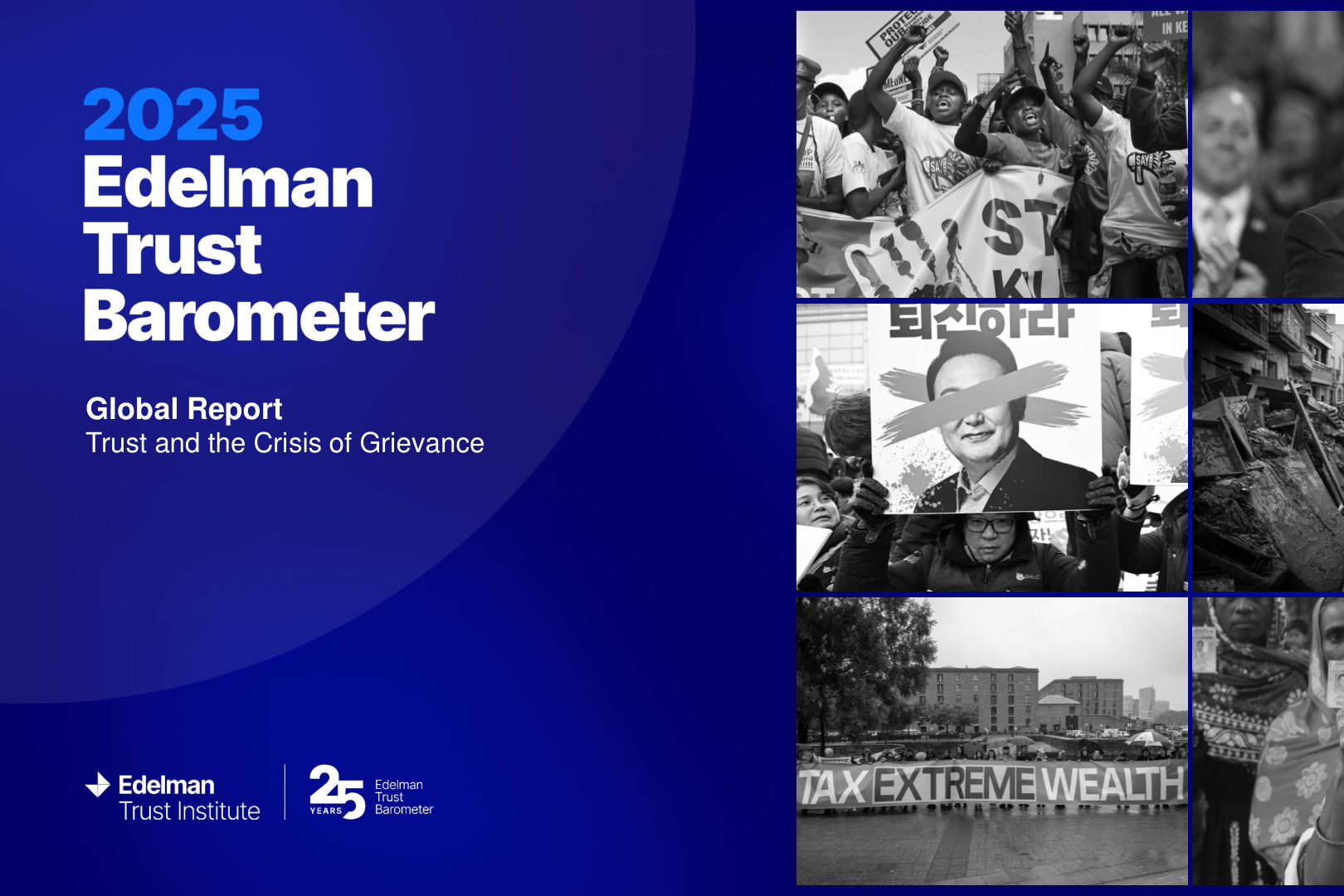
    2025 Edelman Trust Barometer by Edelman

    About the paper

    The report is an original research study based on Edelman’s 25th annual online survey of the general population, examining global trust and what it calls a growing “crisis of grievance”.

    Fieldwork ran from 25 October to 16 November 2024 across 28 countries, with more than 33,000 respondents in total and country samples ranging from 1,150 to 2,124; the geographic scope is global, spanning markets in North America, Latin America, Europe, Asia, the Middle East and Africa.

    The methodology is clearly stated, though some analyses exclude certain countries or rely on adjustments because of question sensitivity or translation issues, and the report notes that in lower-internet-penetration countries the online sample may skew younger, more urban and more affluent.

    Length: 78 pages

    More information / download:
    https://www.edelman.com/trust/2025/trust-barometer

    Core Insights

    1. What is the central argument of the 2025 Edelman Trust Barometer?

    The report’s core argument is that a long run of institutional failures has produced not just scepticism, but a deeper and more combustible public mood: grievance. Edelman’s framing is that trust is no longer the only issue. The bigger problem is that many people now feel that business, government and the wealthy operate for the benefit of a select few, while ordinary people bear the costs. That sense of unfairness is presented as the defining context for public trust in 2025.

    The report argues that this grievance mindset has material consequences. It erodes trust across institutions, darkens expectations for the future, increases acceptance of zero-sum thinking, and creates a harsher environment for leadership, public discourse and social cohesion. Its conclusion is that the challenge is not merely reputational. It is social, economic and political: when people believe the system is rigged, trust falls, optimism fades and conflict becomes easier to justify.

    2. What evidence does the report present that trust is fragile and that grievance is widespread?

    Several findings build that case. Globally, the overall Trust Index is flat at 56, and the report’s headline on page 6 is that elections failed to improve trust. Among the 13 countries with national elections or leadership changes in the relevant period, only Argentina and South Africa saw significant trust gains. That supports Edelman’s view that political turnover by itself is not fixing the underlying problem.

    The report also shows a broad climate of anxiety and disillusionment. Job insecurity fears rose across every threat measured, including recession, trade conflict, automation and lack of training. Employer trust, which had long been a relative bright spot, fell by 3 points globally to 75, which the report describes as an unprecedented global decline. Only 36% say the next generation will be better off, and in most developed countries fewer than one in five believe that. Fear of experiencing prejudice, discrimination or racism rose to an all-time high of 63 globally, up 10 points from 2024 in the countries tracked for that measure.

    Most importantly, grievance itself is widespread. The report says 61% have a moderate or high sense of grievance against business, government and the rich, and majorities reach that level in 23 of the 26 countries included in the grievance analysis. High grievance is also linked to a far stronger zero-sum outlook: 53% of those with high grievance believe that what helps people with different politics comes at a cost to them, versus 23% among those with low grievance.

    3. How does grievance reshape trust in institutions, leaders and technology?

    This is where the report becomes especially sharp. Among people with low grievance, business, government, NGOs and media all sit in either trust or near-trust territory. Among those with high grievance, all four are distrusted: business falls to 42, government to 25, NGOs to 45 and media to 34. In other words, grievance does not just lower trust a little; it imposes a full-spectrum trust penalty.

    The same pattern appears with business leaders and artificial intelligence. Trust in CEOs in general drops from 64 among those with low grievance to 30 among those with high grievance. Trust in one’s own CEO also falls sharply, from 72 to 51. Comfort with business use of AI declines from 50 to 29, while trust in AI falls from 56 to 34. The report’s message is that grievance makes people more suspicious not only of institutions, but also of the leaders and technologies associated with them.

    It also deepens perceptions of institutional motive. On page 34, those with high grievance are much more likely to say news organisations would rather attract a large audience than tell people what they need to know, and more likely to believe media would support an ideology rather than inform the public. On page 35, the report finds that understanding ordinary people matters more for legitimacy than formal authority, especially among the highly aggrieved. That suggests a growing premium on empathy, fairness and lived relevance over status or office.

    4. What does the report say about business, and why does it treat business differently from the other institutions?

    Business occupies a complicated position in the report. On the one hand, it remains the most trusted institution globally at 62, ahead of NGOs at 58 and well ahead of government and media, both at 52. The report also argues that business is the only institution seen as both competent and ethical in its 2025 mapping, and it notes a 19-point increase in perceived business ethics since 2020 in the subset of countries used for that analysis.

    On the other hand, that relative advantage does not amount to a free pass. The report shows that people with high grievance are more likely, not less, to say business is not going far enough on affordability, climate change, retraining, misinformation and discrimination. At the same time, there is very strong cross-group agreement that business is obliged to provide good-paying jobs in local communities and to train or reskill employees. That is one of the report’s most important implications: trust in business is conditional on practical contribution, not symbolic positioning.

    The report also gives CEOs a circumscribed licence to act. Majorities say CEOs are justified in engaging on societal issues when they can make a major impact, improve business performance, protect stakeholders or address problems their business helped create. This is not an argument for unlimited corporate activism. It is a case for relevance, competence and accountability. Business has permission to lead where it can deliver, but not to pretend it can solve the crisis alone.

    5. What broader conclusion does the report reach, and what are its practical implications?

    Edelman’s larger conclusion is that grievance must be addressed at root level. The report does not argue that one better campaign, one election or one executive message will restore confidence. Instead, it says institutions need to rebuild trust by producing fairer outcomes, improving people’s economic prospects, strengthening skills, investing in communities and improving the quality of information. On its own summary page, the report reduces this to four ideas: grievances must be addressed, business has a licence to act, business cannot act alone, and trust can restore optimism.

    That conclusion is reinforced by the relationship the report shows between trust, grievance and economic optimism. As trust rises across the nine-point trust spectrum, high grievance falls dramatically while optimism about one’s family’s economic future rises strongly. The implication is that trust is not treated here as a soft sentiment metric. It is positioned as a condition that supports social stability, confidence in the future and willingness to cooperate.

    For communicators, the report points to a more demanding brief. People are less persuaded by authority alone and more focused on whether leaders understand them, whether institutions benefit them fairly, and whether claims are backed by visible action. That means communication cannot substitute for delivery. In this report’s logic, credibility now depends on whether institutions can show economic usefulness, fairness and genuine understanding of stakeholder reality.

  • 2023 Future of Corporate Communications Study by Edelman

    2023 Future of Corporate Communications Study by Edelman

    About the paper

    The paper is a mixed-methods corporate communications study from Edelman, combining a quantitative survey with qualitative interviews to assess how the communications function is evolving after the pandemic.

    The report states that it surveyed 218 C-level communications leaders in June 2023 and conducted 20+ in-depth interviews in July and August 2023, with respondents drawn from U.S.-based Fortune 500 and Forbes Global 1000 organisations; the sample is therefore primarily U.S.-focused, even though many of the companies have national, multinational, or global reach.

    Length: 30 pages

    More information / download:
    https://www.edelman.com/2023-future-of-corporate-comms

    Core Insights

    1. How does the report argue that the role of corporate communications has changed in recent years?

    The report’s central argument is that corporate communications has moved from being a mainly executional support function to becoming a strategic leadership function. Edelman presents this as a post-pandemic shift: communications leaders are no longer merely helping to deliver decisions once taken, but are increasingly involved in shaping enterprise decisions before they are finalised.

    The report says this shift is visible both in perception and in practice. Half of CCOs now see themselves as strategic advisers to business leaders, up from just over a third in 2021, while only 10% still feel stuck in a cost-centre position, down from 30% two years earlier. It also says that 64% are brought into major business decisions when the decision path is still tentative, compared with only 9% who are consulted after decisions have already been made.

    In other words, the function is portrayed as operating at the intersection of value creation and risk mitigation. Communications is not just reacting to reputational threats; it is being expected to anticipate them, interpret stakeholder expectations, and influence strategy across the enterprise. That is the report’s strongest framing of the profession’s future.

    2. What evidence does the report provide that communications leaders are under growing pressure, even as their strategic status rises?

    A key tension in the report is that greater influence has come with greater pressure, but not necessarily with matching support. The report says nearly 80% of communications leaders feel their role is more demanding than it was 12 months earlier, and 77% say their CEO demands more of them than a year ago. It also notes that CCOs spend nearly one-fifth of their time counselling the CEO on non-communications matters, which underlines how far the remit has stretched.

    At the same time, resources are not keeping pace. The report says 44% of communications leaders do not believe their CEO understands the resources needed to shape enterprise decision-making or execute communications programmes successfully. Budget expectations have also softened: 40% expect their budgets to increase, compared with more than half in 2021, while 28% expect flat budgets and 30% expect moderate cuts.

    This matters because the report treats communications as a function being asked to do more with uncertain backing. It is expected to cover an expanding range of stakeholders, manage a broader mandate, and prove business value more clearly, yet it still struggles to secure stable investment. One of the report’s recurring assumptions is that communications still has not fully solved the challenge of linking its work to measurable business outcomes.

    3. Why does the report place so much emphasis on data, technology, and organisational structure?

    The report argues that modern communications can no longer rely mainly on instinct, media experience, or message craft. Instead, it says an advanced communications function must be built around actionable data: stakeholder signals, behavioural insights, monitoring, analytics, and social listening. This is presented as essential because senior leadership now expects communications to bring evidence-based insight into decision-making, not just narrative support.

    That logic also drives the report’s discussion of structure. Edelman says the proportion of leaders reporting a centralised communications structure has grown sharply since 2021, because centralisation helps organisations gather intelligence more holistically, reduce silos, and respond to risk more consistently. On that basis, the report implies that organisational design is not a side issue; it is part of how communications earns strategic credibility.

    Technology sits within the same argument. The report says 56% believe AI is already affecting their business, and 44% say they are investing more heavily in communications technology than the year before. But it does not present technology as a simple productivity win. It also highlights integration problems, rapid change, and ongoing concerns around privacy, policy, and ethics. The report’s perspective is quite clear here: tools matter, but their value depends on interpretation, application, and the ability of the function to use data intelligently.

    4. How does the report explain the growing importance of employees and corporate purpose in communications?

    One of the report’s most important arguments is that reputation now begins inside the organisation. Employees are presented as the most consequential stakeholder group because they are closest to value creation, can advocate for or against the company, and shape how external stakeholders perceive the business. On the chart on page 17, employees are shown as the stakeholder group putting the most pressure on organisations to act on social issues, ahead of investors, NGOs, regulators, media, and consumers.

    The report also stresses that “employees” are not a single, uniform audience. It points to a five-generation workforce, differing expectations about work, and rising tension between leadership and younger workers, especially Gen Z. As a result, communications is increasingly held accountable for outcomes such as employee engagement, employer brand, retention, and DEI. In fact, the report says 60% expect employee engagement to be the single most important outcome their function must deliver over the next two years.

    Corporate purpose is then positioned as the framework that helps organisations navigate this more complex internal environment. The report says communications teams are heavily involved in clearly communicating purpose, fostering meaning among employees, and, in some cases, ensuring purpose shapes strategy itself. So purpose is not treated here as branding language alone; it is framed as a practical decision-making compass and a guardrail for when companies should act on social or socioeconomic issues.

    5. What does the report suggest will define the future agenda for corporate communications?

    The future agenda, according to the report, will be defined by three overlapping pressures: technology and AI, ESG and sustainability politics, and geopolitical volatility. On AI, the report suggests communicators must help build the business case for adoption while understanding the operational and ethical risks. On ESG, it argues that despite political backlash, especially in the U.S., integration of ESG into communications strategy remains strong, with 76% saying ESG is mostly or fully integrated.

    On geopolitics, the report is especially forward-looking. It argues that elections, polarisation, disinformation, labour activism, and broader geopolitical instability will all have growing reputational and business consequences. That is why it repeatedly calls for stronger cross-functional working, especially with sustainability, investor relations, HR, legal, and government affairs.

    The broader conclusion is that tomorrow’s CCO will have to be a cross-enterprise integrator: someone who can read stakeholder dynamics, translate them into business implications, and help the organisation act with clarity and credibility. The report assumes that winning trust, internally and externally, will be the defining competitive task for communications. But it also implies that success will depend on whether the function can prove value, secure resources, and combine judgement with data more effectively than in the past.

  • 2021 Future of Corporate Communications Study by Edelman

    2021 Future of Corporate Communications Study by Edelman

    About the paper

    The report examines how the corporate communications function is evolving from a transactional support role into a more strategic business partner, focusing on priorities, structures, capabilities, investment, and reporting lines.

    It is a mixed-methods original research report based on a quantitative survey of 200 participants fielded in December 2020 and January 2021, plus 35+ in-depth interviews with senior communications leaders from participating U.S.-based organisations.

    The dataset is globally distributed but heavily North America-led, with survey geographies reported as North America (85%), EMEA (7%), APAC (4%), and Latin America (4%); interview participants were drawn from U.S.-based organisations.

    Length: 76 pages

    More information / download:
    https://www.edelman.com/expertise/commstech/2021-Future-of-Corporate-Comms-Research

    Core Insights

    1. What is the central argument of the report about the future role of corporate communications?

    The report’s core argument is that corporate communications is moving up the strategic continuum, from being treated as a cost centre or executional service provider to becoming a value-generating business partner. Edelman argues that external disruption, especially the pandemic, social issues, business transformation, and a more complex stakeholder environment, has increased the strategic importance of communications inside organisations. The report presents this not as a marginal shift, but as a structural change in what senior communicators are expected to do.

    A major theme is that communications is no longer just about media relations, messaging, and storytelling. Instead, the function is increasingly expected to help shape decisions on risk, workforce issues, reputation, transformation, social purpose, and stakeholder trust. The report says this has brought communicators closer to CEOs, boards, and the C-suite, with 46% now reporting to the CEO versus 34% in 2014, and 77% saying perceptions of communications as a strategic business driver changed within their organisation during 2020.

    At the same time, the report is careful not to suggest that this evolution is complete. It repeatedly notes that progress is uneven. Some organisations still see communications in largely reactive or transactional terms, and maturity varies by industry, geography, and leadership culture. So the report’s argument is both optimistic and cautionary: the opportunity is real, but it has to be claimed and proved.

    2. What forces are driving this shift in corporate communications?

    The report identifies several forces pushing communications into a more strategic role. COVID-19 is presented as the immediate accelerator. It increased the visibility and relevance of communications, especially around employee engagement, business continuity, internal alignment, and executive decision-making. More than half of respondents said COVID-19 shifted the communications focus and demand on their function, with employee communications emerging as the most strongly affected area.

    Beyond the pandemic, the report highlights business transformation as the most important long-term driver, cited by 77% of respondents, followed by social issues at 73%, customer or consumer demand shifts at 56%, and talent at 38%. This matters because it frames communications not as a function reacting to one crisis, but as one increasingly embedded in permanent organisational change. Communicators are being pulled into transformation programmes, social issue response, workforce strategy, and stakeholder trust management.

    The report also stresses the importance of the changing media and information ecosystem. Social media, digital channels, and faster news cycles have altered how organisations reach stakeholders and how quickly reputational issues can escalate. That has expanded the role of communications into digital, content, creative, analytics, and more direct coordination with marketing. In other words, the environment has become too fast, fragmented, and high-stakes for communications to remain a back-end support function.

    3. How does the report say the communications function itself needs to change in order to meet these expectations?

    The report argues that strategic credibility starts inside the function. Communications teams need to change how they think about themselves, how they organise, and what capabilities they prioritise. The report contrasts an older model built around reactive storytelling and service delivery with a newer model based on strategic planning, business acumen, insights, measurable outcomes, and multidisciplinary collaboration.

    A recurring theme is that the modern function must be agile, multidisciplinary, and insights-driven. Teams can no longer rely only on classic PR strengths such as writing, media contacts, and message development. They now need broader capability across employee communications, risk and crisis, brand and corporate positioning, change communications, digital, creative, data, and analytics. The report explicitly describes the ideal talent profile as “T-shaped”: people with deep expertise in one area, but enough breadth to work across multiple strategic contexts.

    The report also argues that relationship-building with senior leadership is essential. Functions that are seen as more strategic have typically earned closer CEO and C-suite access, often by combining stronger counsel with better evidence of impact. It recommends integrated strategic planning, clearer governance, clearer roles, and more consultative team behaviour. The implication is that structural change alone is not enough. A communications team only becomes strategic when it shows business understanding, connects its work to organisational goals, and consistently executes at a high level.

    4. What does the report reveal about investment priorities, technology, and capability gaps?

    One of the clearest findings is that expectations are rising faster than resources. The report says communicators are being asked to do more, across more areas, with stronger proof of business value, but many are not receiving proportional budget increases. It notes that only 6% of CCOs expected a budget increase of 15% or more, while 45% anticipated a budget decrease or no change in the coming year. Later benchmarking pages show a similar tension, with 54% expecting some increase but 46% expecting budgets to stay flat or decline.

    Within that constrained environment, CommsTech emerges as the headline investment priority. The report defines this as the tools, technology, and data that allow communicators to target, measure, and shape perceptions and behaviour. Seventy percent said CommsTech was a top investment area, and the report positions it as central to proving ROI and connecting communications work to business results. But it also shows that adoption is still immature: 44% report baseline media-impression measurement, yet only 30% map revenue growth back to communications activity.

    The report is especially useful in showing why adoption is slow. Barriers include difficulty justifying large tech investments, weak support from CEOs or business leaders, IT ownership conflicts, poor collaboration with marketing and sales, and internal team struggles to adopt digital tools and analytics. So the report is not simply making a pro-technology argument. It is saying that technology only matters if organisations also invest in skills, processes, governance, and data fluency. Capability gaps in change communications, analytics, and ESG are also singled out as emerging needs.

    5. What are the main implications and conclusions for communications leaders and organisations?

    The report’s main conclusion is that this is a pivotal moment for the communications profession. The external environment has created an opening for communications leaders to claim a more central role in business strategy, but doing so requires deliberate change. Communicators must demonstrate business acumen, link activity to outcomes, invest in specialist capability, and speak the language of strategy, ROI, and performance. In the report’s framing, the opportunity will not convert automatically into influence. It has to be operationalised.

    For organisations and CEOs, the implication is equally strong. If they want communications to function as a true strategic partner, they need to bring it into decisions earlier, provide closer access to leadership, resource it properly, and recognise reputation, trust, employee engagement, and stakeholder alignment as business-critical issues rather than peripheral concerns. The report even suggests that some companies are beginning to elevate reputation into shared business goals and leadership accountability.

    The report’s final perspective is practical rather than theoretical. Across its “playbook” sections, it repeatedly returns to six or seven concrete ideas: have a clear vision for the function, align communications with business strategy, combine planning with insight, improve governance and process, build multidisciplinary teams, invest in people and specialist skills, and prove impact through measurement. That makes the report less a prediction document than a management guide for how communicators can turn heightened relevance into durable strategic authority.