
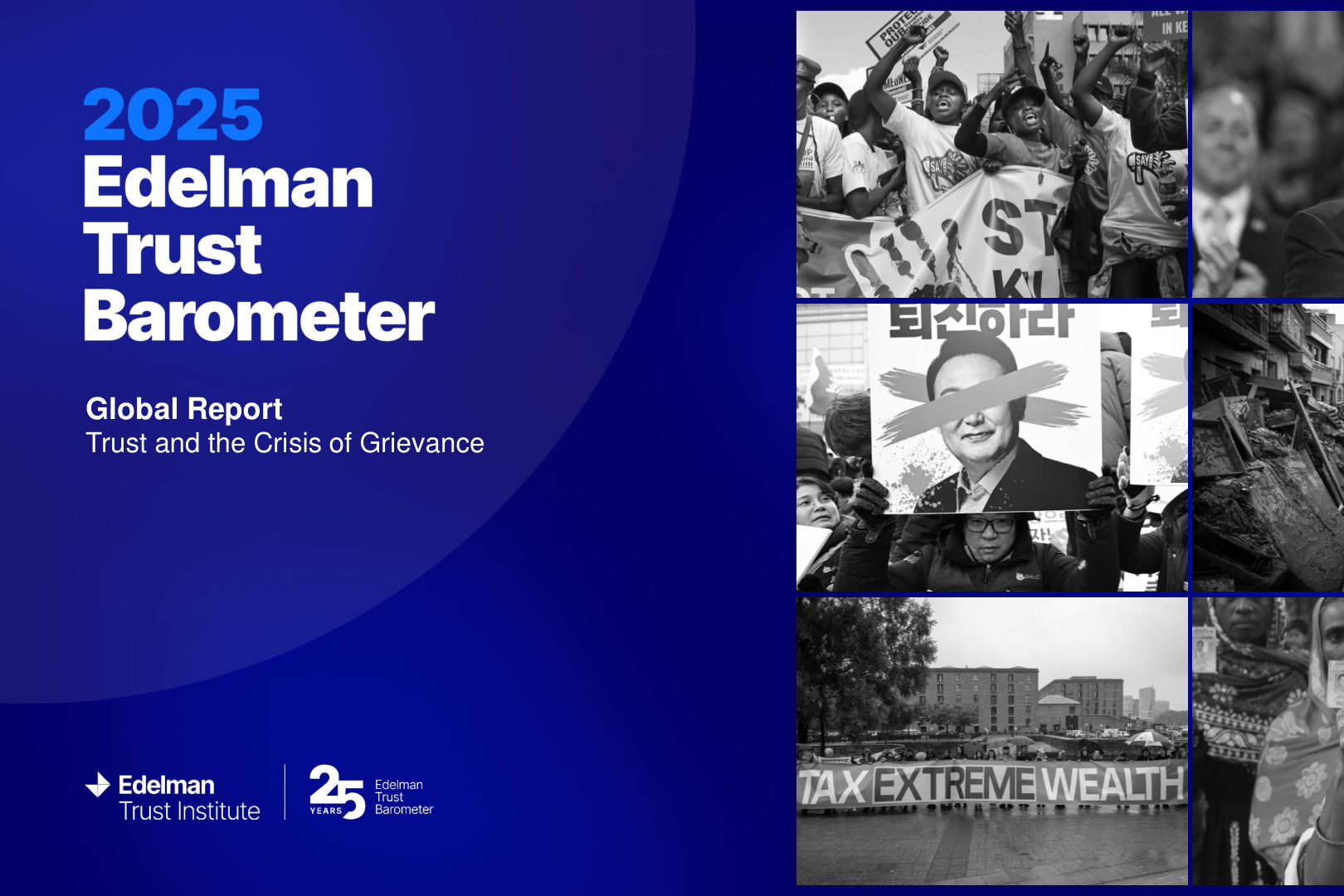
About the paper
The report is an original research study based on Edelman’s 25th annual online survey of the general population, examining global trust and what it calls a growing “crisis of grievance”.
Fieldwork ran from 25 October to 16 November 2024 across 28 countries, with more than 33,000 respondents in total and country samples ranging from 1,150 to 2,124; the geographic scope is global, spanning markets in North America, Latin America, Europe, Asia, the Middle East and Africa.
The methodology is clearly stated, though some analyses exclude certain countries or rely on adjustments because of question sensitivity or translation issues, and the report notes that in lower-internet-penetration countries the online sample may skew younger, more urban and more affluent.
Length: 78 pages
More information / download:
https://www.edelman.com/trust/2025/trust-barometer
Core Insights
1. What is the central argument of the 2025 Edelman Trust Barometer?
The report’s core argument is that a long run of institutional failures has produced not just scepticism, but a deeper and more combustible public mood: grievance. Edelman’s framing is that trust is no longer the only issue. The bigger problem is that many people now feel that business, government and the wealthy operate for the benefit of a select few, while ordinary people bear the costs. That sense of unfairness is presented as the defining context for public trust in 2025.
The report argues that this grievance mindset has material consequences. It erodes trust across institutions, darkens expectations for the future, increases acceptance of zero-sum thinking, and creates a harsher environment for leadership, public discourse and social cohesion. Its conclusion is that the challenge is not merely reputational. It is social, economic and political: when people believe the system is rigged, trust falls, optimism fades and conflict becomes easier to justify.
2. What evidence does the report present that trust is fragile and that grievance is widespread?
Several findings build that case. Globally, the overall Trust Index is flat at 56, and the report’s headline on page 6 is that elections failed to improve trust. Among the 13 countries with national elections or leadership changes in the relevant period, only Argentina and South Africa saw significant trust gains. That supports Edelman’s view that political turnover by itself is not fixing the underlying problem.
The report also shows a broad climate of anxiety and disillusionment. Job insecurity fears rose across every threat measured, including recession, trade conflict, automation and lack of training. Employer trust, which had long been a relative bright spot, fell by 3 points globally to 75, which the report describes as an unprecedented global decline. Only 36% say the next generation will be better off, and in most developed countries fewer than one in five believe that. Fear of experiencing prejudice, discrimination or racism rose to an all-time high of 63 globally, up 10 points from 2024 in the countries tracked for that measure.
Most importantly, grievance itself is widespread. The report says 61% have a moderate or high sense of grievance against business, government and the rich, and majorities reach that level in 23 of the 26 countries included in the grievance analysis. High grievance is also linked to a far stronger zero-sum outlook: 53% of those with high grievance believe that what helps people with different politics comes at a cost to them, versus 23% among those with low grievance.
3. How does grievance reshape trust in institutions, leaders and technology?
This is where the report becomes especially sharp. Among people with low grievance, business, government, NGOs and media all sit in either trust or near-trust territory. Among those with high grievance, all four are distrusted: business falls to 42, government to 25, NGOs to 45 and media to 34. In other words, grievance does not just lower trust a little; it imposes a full-spectrum trust penalty.
The same pattern appears with business leaders and artificial intelligence. Trust in CEOs in general drops from 64 among those with low grievance to 30 among those with high grievance. Trust in one’s own CEO also falls sharply, from 72 to 51. Comfort with business use of AI declines from 50 to 29, while trust in AI falls from 56 to 34. The report’s message is that grievance makes people more suspicious not only of institutions, but also of the leaders and technologies associated with them.
It also deepens perceptions of institutional motive. On page 34, those with high grievance are much more likely to say news organisations would rather attract a large audience than tell people what they need to know, and more likely to believe media would support an ideology rather than inform the public. On page 35, the report finds that understanding ordinary people matters more for legitimacy than formal authority, especially among the highly aggrieved. That suggests a growing premium on empathy, fairness and lived relevance over status or office.
4. What does the report say about business, and why does it treat business differently from the other institutions?
Business occupies a complicated position in the report. On the one hand, it remains the most trusted institution globally at 62, ahead of NGOs at 58 and well ahead of government and media, both at 52. The report also argues that business is the only institution seen as both competent and ethical in its 2025 mapping, and it notes a 19-point increase in perceived business ethics since 2020 in the subset of countries used for that analysis.
On the other hand, that relative advantage does not amount to a free pass. The report shows that people with high grievance are more likely, not less, to say business is not going far enough on affordability, climate change, retraining, misinformation and discrimination. At the same time, there is very strong cross-group agreement that business is obliged to provide good-paying jobs in local communities and to train or reskill employees. That is one of the report’s most important implications: trust in business is conditional on practical contribution, not symbolic positioning.
The report also gives CEOs a circumscribed licence to act. Majorities say CEOs are justified in engaging on societal issues when they can make a major impact, improve business performance, protect stakeholders or address problems their business helped create. This is not an argument for unlimited corporate activism. It is a case for relevance, competence and accountability. Business has permission to lead where it can deliver, but not to pretend it can solve the crisis alone.
5. What broader conclusion does the report reach, and what are its practical implications?
Edelman’s larger conclusion is that grievance must be addressed at root level. The report does not argue that one better campaign, one election or one executive message will restore confidence. Instead, it says institutions need to rebuild trust by producing fairer outcomes, improving people’s economic prospects, strengthening skills, investing in communities and improving the quality of information. On its own summary page, the report reduces this to four ideas: grievances must be addressed, business has a licence to act, business cannot act alone, and trust can restore optimism.
That conclusion is reinforced by the relationship the report shows between trust, grievance and economic optimism. As trust rises across the nine-point trust spectrum, high grievance falls dramatically while optimism about one’s family’s economic future rises strongly. The implication is that trust is not treated here as a soft sentiment metric. It is positioned as a condition that supports social stability, confidence in the future and willingness to cooperate.
For communicators, the report points to a more demanding brief. People are less persuaded by authority alone and more focused on whether leaders understand them, whether institutions benefit them fairly, and whether claims are backed by visible action. That means communication cannot substitute for delivery. In this report’s logic, credibility now depends on whether institutions can show economic usefulness, fairness and genuine understanding of stakeholder reality.